
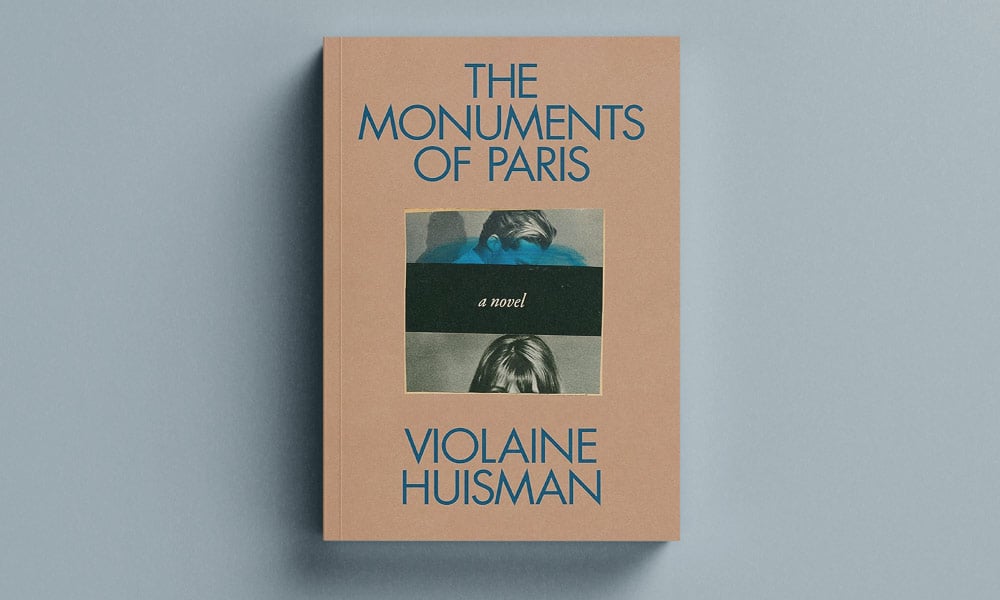
The Monuments of Paris: A Novel
By Violaine Huisman
Penguin Press, 240 pp.
The subtitle of The Monuments of Paris is “A Novel,” but the most gripping parts are historical rather than fictional. And in this engaging piece of “autofiction,” history, invention, memoir and novel jostle one another in vying for first place. The author, Violaine Huisman, a Parisian transplant to New York who translated and adapted the book herself from the French original, is the daughter and granddaughter of Jewish Frenchmen, imposing figures who participated in some of the most dramatic times in France’s modern history. It’s all recounted in abundant, sometimes messy detail: World War I; the Popular Front of the 1930s, in which her grandfather Georges Huisman played an important role; the Nazi occupation and the Vichy regime, during which the family, including Violaine’s pre-adolescent father Denis, were forced into hiding; and then the trente glorieuses, the 30 years of postwar boom that allowed Denis to become a hugely successful academic “marketer” and a minor philosophical pop star.
Violaine Huisman tells this story not as a straightforward family saga but from her subjective point of view, as befits an autofiction. In her version, her father and grandfather are themselves the “monuments of Paris” whose history and relationship to herself she seeks to explore.
Huisman’s earlier work, The Book of Mother, was an elegy to her “devastatingly beautiful,” mentally unstable mother, her father’s ill-matched third wife. The couple divorced when Violaine was five, and her mother committed suicide when Violaine and her sister Elsa were already grown. The Monuments of Paris, devoted to the paternal side of the family, presents a greater challenge. How do you write a memoir/novel about yourself and your dad and granddad when both of them are recipients of the Légion d’Honneur from the French government, so that you must also include a history of 20th-century France in your narrative?
The story begins in 2020, during a lull in the pandemic, when Violaine, who has lived in New York for more than 20 years, moves back to France with her American husband and two young daughters in order to be near her 90-year-old father, who is dying. Denis Huisman was a child survivor of the Holocaust: He was 11 years old when the Nazis occupied Paris in June 1940, upending his family’s charmed life. Violaine Huisman tells his story of persecution and survival gradually, in bits and pieces, but it has always been there for her in the background. It helps to explain why her father, as she remembers him from his glory days, did everything to excess, as if to make up for the calamities of his childhood. When he went shopping, he bought huge quantities of food that could not possibly be consumed before going bad. He married four times, fathered eight children (Violaine is the youngest), opened lucrative test preparation schools for lycée students and wrote close to 100 books, mainly textbooks and manuals of philosophy that made him a fortune.
He was brash, larger than life, a womanizer, a charmer. He was also a devoted son who called his widowed mother every day, and a doting father who stopped by at the luxurious apartment he rented for his ex-wife and two youngest daughters every evening on his way home to wife number four. His chauffeur drove the girls to school when their mother was in the mental hospital.
Huisman clearly adored her father, but she also had his number. He had a doctorate in philosophy but was content to be a popularizer, not a deep thinker, she writes: “You were not interested in ideas; you were interested in money, attention, the next big thing.” Although she does not say it explicitly, she also blames him somewhat for the disaster of his marriage to her mother.
How do you write a memoir/novel about yourself and your dad and granddad when both of them are recipients of the Légion d’Honneur from the French government?
If history stays in the background of Huisman’s portrait of her father, it occupies center stage in the book’s second part, which moves yet further back in time and is devoted mainly to her grandfather. Georges Huisman (1889-1957) was a man of the comparatively liberal Third Republic, an assimilated Jew from a poor family who earned an advanced degree in medieval history at a top university, fought in World War I, taught in prestigious secondary schools after the war and went on to a distinguished career in government service in the 1930s. Georges’s own father, an immigrant from Belgium, had been a traveling salesman, functionally illiterate; his mother, from an Alsatian Jewish family, was a nanny, but she had great ambitions for her only son. With his diplomas and good looks, Georges married Marcelle Wogue, from an established Jewish family, who encouraged him in his upward climb.
In 1931, when Paul Doumer was elected president, Georges became his secretary general, and the whole family—Georges, Marcelle and their two sons—moved into the Elysée Palace, where the head of state resided. Doumer was assassinated by a Russian anarchist the following year, and the family had to find other lodgings, but Georges’s career flourished. In 1934 he was named director of Beaux-Arts, in charge of museums and cultural affairs—a position that became all the more important when the Popular Front government, led by the socialist Léon Blum (the first Jewish prime minister of France) came to power in 1936. Georges, like the Minister of Education Jean Zay, was a firm believer in arts education as an agent of democracy. He gave speeches on the subject and published several books on art history, including a guide to the monuments of Paris that may have inspired Violaine Huisman’s title.
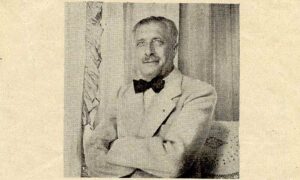
Georges Huisman circa 1950. Credit: Schnäggli (CC BY-SA 3.0)
As the war approached, Georges and his staff worked to move France’s most important artworks out of Paris to various chateaux. (Many were still looted by the Nazis.) In 1939, Georges came up with the idea of a democratic film festival to counter the Venice festival in fascist Italy. The Cannes Film Festival was scheduled to open on September 1, 1939, but had to be postponed due to war.
What followed was chaos. Georges and the whole government moved to Bordeaux when the German army invaded Paris. He and several other Jewish politicians, including Blum, Zay and Pierre Mendès-France, were among those who then set sail on the SS Massilia with the idea of continuing the struggle in Algeria. But two days later, the Vichy leader Marshal Pétain, an avowed antisemite and enemy of the Third Republic, signed an armistice with Hitler. The politicians on the Massilia were now called deserters, not resisters; several were arrested and returned to France, where they were tried and condemned to prison. In 1944, Jean Zay was taken from his prison cell and murdered by members of the Milice, a Vichy corps whose job was to hunt Jews and members of the Resistance. Mendès-France escaped from prison and went into hiding. Léon Blum was sent to Buchenwald. (He survived and briefly led a caretaker government after the war.)
Georges Huisman and his family were not important enough for such treatment. With the help of influential friends, they were able to live in Marseille, first openly and then with false papers in hiding. After the war, Georges never regained his former position, but he was named to the Conseil d’Etat, the country’s highest court. And he presided over the first jury of the Cannes Film Festival in 1946, remaining in that role for several years.
There is a lot of sleuthing in this book. Violaine consults with a historian who wrote a doctoral thesis about her grandfather, searches for newspaper articles about her father, and mines the memoir written late in life by her grandmother Marcelle, who considered her husband to be unjustly forgotten by his countrymen. She also visits the attic in the family’s country house owned by her half-brother Bruno, where their grandfather’s papers are kept in a jumble.

Above all, she invents what she cannot know, such as the story of her grandfather’s great love for a much younger woman whose trace has disappeared from the archive. The woman, named Choute, a beautiful aristocrat whom Georges meets in the 1930s, may have actually existed, but she interests the author chiefly because she reminds her of her own mother, another beautiful woman (from a much lower social class) who was likewise excluded from the family history.
The Monuments of Paris is fascinating for the personal and collective history it explores, but also frustrating for the reader who is often compelled to ask, “Is this true or invented?” That’s the thing about autofiction—it’s a slippery genre, able to claim both fact and fiction. After a bit of sleuthing of my own, I was happy to discover that in 2024, just around the time this book appeared in French, Georges Huisman’s personal archive moved from the family attic to the Archives Nationales in Paris, where it will receive the careful cataloguing it deserves. Who knows, maybe it will even turn up Choute.
Susan Rubin Suleiman is professor emerita of French and comparative literature at Harvard University. Her most recent books are the memoir Daughter of History: Traces of an Immigrant Girlhood and István Szabó: Filmmaker of Existential Choices.