
At the Tel Aviv apartment of my friend, a candidate in the Democrats Party, the mood was almost celebratory. About twenty Israelis, some of whom had flown in from Britain, France and the United States, talked politics with the confidence of people who believed their country was finally about to change course. I had arrived from Washington with my three sons, and I wanted to believe it too. The option of electoral loss never crossed our minds. On this fall Friday afternoon, as we noshed on chopped liver, pickles, kugel and challah, the only debate in the room was which of the opposition leaders was most suitable to become the next prime minister.
I was born in Israel and moved to the United States 25 years ago with my husband and then-two-year-old sons. Now, both were about to vote in an Israeli election for the first time. My youngest son, born in America, is also an Israeli citizen, but was deeply disappointed to discover that he wasn’t registered to vote. We had come to visit family but also because we felt that this election was too important to sit out.
We didn’t support the same party, but we shared the same hope for a different future.
We were hardly alone. Israelis were arriving from around the world to cast their ballots, and people seemed to recognize us immediately. At Ben-Gurion Airport, a sign greeted returning voters with the words “Todah al hakol”—“thank you for your vote.” At the car rental counter, in the cafe, at the shopping mall, employees asked if we had come to vote. They thanked us for it.
But not everyone felt this way. On my first day in Israel, a close family member called with a different perspective. “You’re not going to like what I’m about to say,” she began. “But I don’t think you should vote. People who don’t live here shouldn’t be allowed to vote.”
I argued that the stakes were too high not to use every vote we had. But privately, I felt the familiar guilt. For years, even before leaving Israel, I had believed much the same thing. Should people who live thousands of miles away help decide the future of a country where others must live with the consequences?
And yet, Israel has occupied much of my life, especially these past few years. Since October 7, I have worked with hostage families, I have helped organize protests, and I have advocated for an end to the wars. Living in Washington has hardly made me feel detached from what happens in Israel.
October 7 revealed how differently our family saw the events. In the aftermath of the massacre, my husband and I felt more Israeli than ever, overwhelmed by grief and horror. Our sons, who grew up in America, experienced it differently. They were deeply affected by what happened in Israel, were concerned about the suffering of Palestinian civilians in Gaza, and sometimes challenged us when we weren’t ready to hear it. We didn’t always agree, but I take pride in their ability to see the complexities of the situation. They may not think about Israel every minute of the day, as we seem to, but they share our love for the country, along with our frustration over what we wish to change.
And now all three had come with me to Israel (my husband, unfortunately, was unable to join us). We didn’t support the same party, but we shared the same hope for a different future, and the two who could vote cast their ballots for parties in the same political bloc.
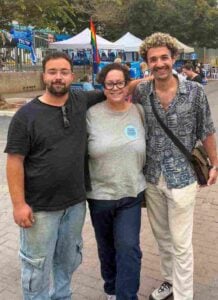
Author with her sons. Courtesy of Vered Guttman.
At another gathering, this one at the home of Dr. Nasreen Haddad-Haj Yahya, vice president of the New Israel Fund and a leading researcher and activist on Arab society and Jewish-Arab relations in Israel, about fifteen members of Israeli Americans for Justice, a group I helped found, gathered after traveling from across the United States to vote. Nasreen served a generous spread of delicious Palestinian food, including stuffed grape leaves, pastries and kibbeh. It was the least she could do, she said, for people who had come so far.
Some of her relatives in Gaza had been killed or wounded in Israel’s retaliation after the Hamas attack. She spoke about her belief that Palestinian citizens of Israel like herself, who understand both peoples, who feel the pain of both the Holocaust and the Nakba, who speak both languages, could serve as a bridge between Israel and the Arab world.
She also told us that she sometimes asks her daughters to speak Arabic quietly in the supermarket, so people around them won’t become frightened. I thought of American Jews hiding their Star of David necklaces. Nasreen, who has devoted her career to promoting equality and a shared society in Israel, said she does her political work for her three daughters, hoping they will grow up in a country where they are treated as equals.
On election morning, my friend and I drove to Bedouin villages in the Negev to help women get to the polls. The initiative had begun seven years earlier, reaching women who had never voted before. Two women squeezed into the back seat with me. The beautiful young woman beside me and I couldn’t stop giggling as my friend drove like a race car driver along the sandy, rocky roads, barely slowing down for the bumps.
Later, back in Tel Aviv, we walked to the school near my parents’ home to vote. The polling station was crowded, the atmosphere festive. My sons and I voted one after the other. Afterward, we took a photograph together, the three of us smiling. It felt good to do our duty as citizens.
That evening, we gathered at my sister’s house to watch the results. The first exit polls were disappointing, but not devastating. As the actual results came in, the picture grew worse. Sadness gave way to shock.


I thought about the families of hostages and of those killed on October 7, some of whom I know personally, who had urged Israelis to vote in memory of loved ones who could no longer cast a ballot. They were asking for an investigative committee, which the current prime minister refused to establish. I thought of the Bedouin women we had driven to the polls. I thought about my parents and about my young nieces and nephews, some of whom are going to enlist in the military in a year. And I thought about Nasreen’s daughters. Despite the historically high turnout among Arab voters, Jewish leaders were still refusing to sit with Arab parties. What would it mean for Nasreen’s hopes for her children?
The day after the election, more than anything, I felt tired. After years of protests, organizing and activism, I wondered whether any of it had made a difference. But before flying back to Washington, I was already planning to attend one more protest, this time calling on Jewish party leaders to include Arab parties in coalition talks. Apparently, the good people here are not quite ready to stop.