

Jewish Politics & Power is published every other week. Sign up for our newsletter for updates.
1. Trump chooses his rabbis
The Jewish High Holidays have always been an opportunity for presidents to interact with leaders of the community. More than an opportunity to wish “Shana Tova” and to tout their administration’s work on behalf of Jewish Americans, these meetings serve as an opportunity to hear directly from communal leaders about their concerns, needs and priorities.
Presidents Obama and Biden used to hold widely attended conference calls with Jewish leaders on the eve of Rosh Hashanah. On the line were usually about a thousand rabbis, organizational leaders, donors and activists who’d listen politely to the president’s spiel, and then a few would get a chance to politely ask a non-controversial question or raise an issue.
Trump, and there’s no surprise here, does things differently. During his first term he limited interactions with the Jewish community to those who were close to him politically or expressed their support during the campaign, which meant a much greater presence of Orthodox Jews in these meetings.
This year, Trump’s White House went with an entirely new crowd.
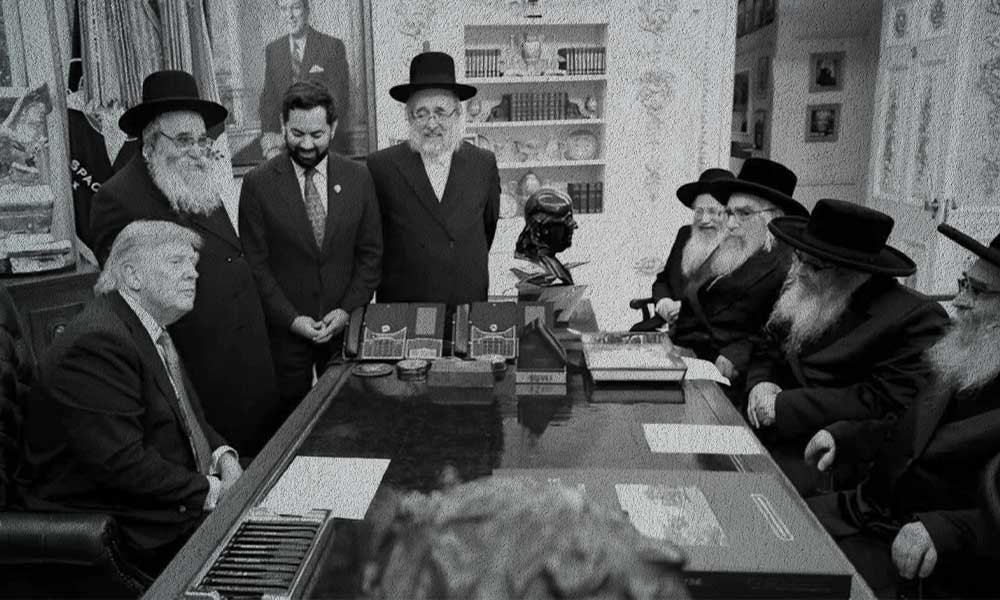
For the first time in five decades, the president invited to the Oval Office the rabbis who head the largest ultra-Orthodox communities in the United States.
Six leaders of Haredi communities showed up for the meeting on Thursday, which was also attended by Vice President JD Vance, Trump’s son-in-law Jared Kushner and Representative Mike Lawler, a New York Republican whose district includes several ultra-Orthodox communities.
One of the Satmar rabbis in attendance read a blessing for the president and then presented a leather-bound copy of it to Trump. Yossi Gestetner, a Haredi political adviser who attended the meeting, described the gathering as “an opportunity for the first time in over 50 years for the president of the U.S. to meet with the grand rabbis of the largest Hasidic sects, visibly Jewish people such as myself.” According to Gestetner, the rabbis “had an opportunity to thank the president for everything he does for the United States.”
The issues discussed reflected the concerns of Haredi Jews in America: federal funding for yeshivas, kosher food in prisons, public housing assistance and concerns over vandalism of Jewish cemeteries in Europe. These topics diverge from the set of concerns that have dominated interactions between the Jewish community and administration officials in recent years: antisemitism, safety of Jewish students on campus, anti-Israel bias and the security of Israel in the Middle East.
Most of the grand rabbis who showed up at the Oval Office are considered anti-Zionist or non-Zionist and do not support the idea of Israel as a Jewish state. Therefore their concerns are focused on the well-being and needs of their community here in the United States—and less to issues relating to Israel, college campuses and discrimination.
One Israel-related issue almost came up in the meeting, according to reports in the Orthodox press. Up to the last minute, the rabbis considered asking Trump to use his sway over Israeli Prime Minister Benjamin Netanyhau to impress upon him the need to stymie legislation requiring full military draft for yeshiva students in Israel. This is one of the main concerns of the ultra-Orthodox community in Israel, and American Haredi communities are trying as hard as they can to help from afar. The idea behind the appeal to Trump was to get the president involved in the issue, knowing that he speaks frequently with Netanyahu and is never shy of telling him what to do.
At the last minute, however, the rabbis decided not to raise the issue. According to reports in the Orthodox press, they ruled it out in order to avoid discussing controversial political issues at this rare meeting.
2. Trump brings peace, at least to two battling Hasidic sects
Trump likes to pride himself on having brokered eight peace agreements around the world, often claiming this should have earned him the Nobel Peace Prize.
Experts dispute this figure and the role Trump played in some of these conflicts, but no one can deny one little moment of peace achieved last week in the Oval Office.
Among those attending Trump’s meeting with the Haredi rabbinical leaders were Rabbi Aharon Teitelbaum and Rabbi Zalman Leib Teitelbaum. The two Teitelbaum rabbis are brothers and have been embroiled in a decades-long dispute over which one of them should have taken over for their late father as leader of the Satmar sect. In 2006, the two rabbis broke off into two separate Satmar groups, one located in upstate New York, Kiryas Joel, and the other in Williamsburg, Brooklyn, and have not been on speaking terms since.
But then, at the White House, the ice broke. According to reports, Aharon Teitelbaum congratulated his brother Zalman Leib Teitelbaum on his grandson’s engagement.
And if that won’t land Trump a Nobel Peace Prize, then nothing will.
3. JD is sticking with Tucker
It’s no secret by now that JD Vance is considering a run for the Republican presidential nomination in 2028. In fact, in GOP circles, it is almost a given that the battle over the nomination will pit Vance against Secretary of State Marco Rubio. Some have also thrown Pete Hegseth into the mix, but he is a less-likely candidate.
It is also no secret that Tucker Carlson, once a welcome conservative voice in Republican circles, has become a far-right pundit whose animosity toward Israel and unabashed willingness to entertain antisemites and their ideas are now a bedrock of his public persona.
The problem: Vance really likes Carlson, and this is something Jewish Republican voters and donors have a hard time wrapping their heads around.
Last week, Vance spoke at the Republican Jewish Coalition’s annual gathering in Las Vegas. The session was closed to the press, but according to reports based on accounts from multiple participants, Vance ducked questions regarding his relationship with Carlson.


Back at the White House on Thursday, Vance, from the briefing room podium, provided a more detailed response regarding his friendship with Carlson, and no, he is not ready to give it up.
“Everybody knows that Tucker Carlson and I are friends, and I think it’s very obvious that Tucker has said some things that I disagree with,” Vance told reporters. “Tucker is a friend despite the fact that we disagree on a number of things. And I’m not going to play the game where I throw friends under the bus because I have political disagreements with them.”
The 2028 presidential election is still far away, but if Vance insists on holding onto his friendship with Carlson, despite their “political disagreements,” he might make it all the easier for Rubio to win the Jewish Republican vote.
4. Legislating boycotts
The House of Representatives approved last week, in a 236 to 169 vote, legislation that would deny any form of federal funding to higher education institutions that boycott Israel. The bill states that academic institutions that engage in “nonexpressive commercial boycott of Israel” will be barred from federal funding. The term “nonexpressive commercial boycott” is meant to differentiate between “expressive” acts of dissent, such as protests, speeches and banners, which are forms of protected speech, and acts such as broad business boycotts, that are not. If the bill becomes law, universities will have to certify that they do not engage as an institution in acts that boycott Israel, such as banning Israeli academics and students from visiting or conducting joint research or obstructing their students from studying or participating in programs in Israel.
Objections to broad forms of BDS, especially to academic boycotts of Israel, are shared by many Democrats, yet only 33 of them voted in favor of the bill, which was co-sponsored by Republican Virginia Foxx and Democrat Josh Gottheimer. The low rate of support among Democrats could serve as yet another indicator of the party’s shift away from supporting Israel, but it also has to do with the overreaching language of the bill, named the Protect Economic and Academic Freedom Act of 2026. It does not differentiate between Israel proper and the West Bank, a conflation Democrats have traditionally objected to. Including the West Bank Jewish settlements as part of Israel means that universities would be disqualified from receiving federal funding even if they choose to boycott only scholars or academic institutions in the West Bank or divest from companies involved in the settlement project.
“This bill takes a pro-annexation position by conflating Israel and West Bank settlements,” said Hadar Susskind, president and CEO of New Jewish Narrative. “It undermines the fight against antisemitism by weaponizing the fears of American Jews to attack American civil liberties and American universities.” J Street took a similar position and lobbied against the bill, though unsuccessfully. Activists noted, however, that it would be hard to see the legislation gain the Senate’s approval, or even get to a vote before Congress ends its term.
5. A path to Jewish Canadian immigration?
Trump’s claim to fame in his second term is closing America to immigration. He has focused on illegal entries from the southern border but has also clamped down on most forms of legal entry, including refugee resettlement, foreign nationals with temporary protective status, student visas and many more.
But could Trump be open to one specific type of immigration?
Recently, the National Association of Christian Lawmakers sent a letter to Trump urging him to “establish an appropriate lawful immigration and humanitarian pathway for Jewish Canadians who are experiencing persecution or who credibly fear for their safety because they are Jewish.” They argued that since October 2023, Canadian Jews have suffered from rampant antisemitism and that 2,000 of them have expressed their desire to seek shelter in the United States.
ADL’s 2025 audit of global antisemitism confirms that Canada has a higher rate of antisemitic instances per capita than the United States.
Trump, apparently, finds the idea interesting. The president shared a report about it on Truth Social, a sign that the idea caught his attention and may one day lead him to take action.
For the president, this is yet another fight he can pick with Canada, a friendly neighboring country that Trump seems to view as America’s arch-enemy. But he may want to check with Canadian Jews before opening the gates of immigration. None of the representative Jewish organizations in Canada have endorsed the appeal or expressed any interest in facilitating any type of special visa or immigration status to help Canadian Jews flee south. B’nai Brith Canada said in response to Trump’s social media post: “While we have members of the Jewish community questioning their futures in Canada, make no mistake that this is our home and we are here to stay. Our community is strong and resilient and will not be made to live in fear.”
(Top image credit: Official White House Photo/Molly Riley)
One thought on “Trump’s Satmar Summit”
Regarding Trump’s meeting with the Haredi rabbis, I was disappointed in the oversimplification of this article. It was stated that most of the rabbis represented were “anti-Zionist or non-Zionist”. Of course the Satmar is definitely anti-zionist however many of the others are not.
I would like to know specifically which sects were represented. They are each unique and have different perspectives from each other.
Thank you.