

Jewish Politics & Power is published every other week. Sign up for our newsletter for updates.
1. A divided path
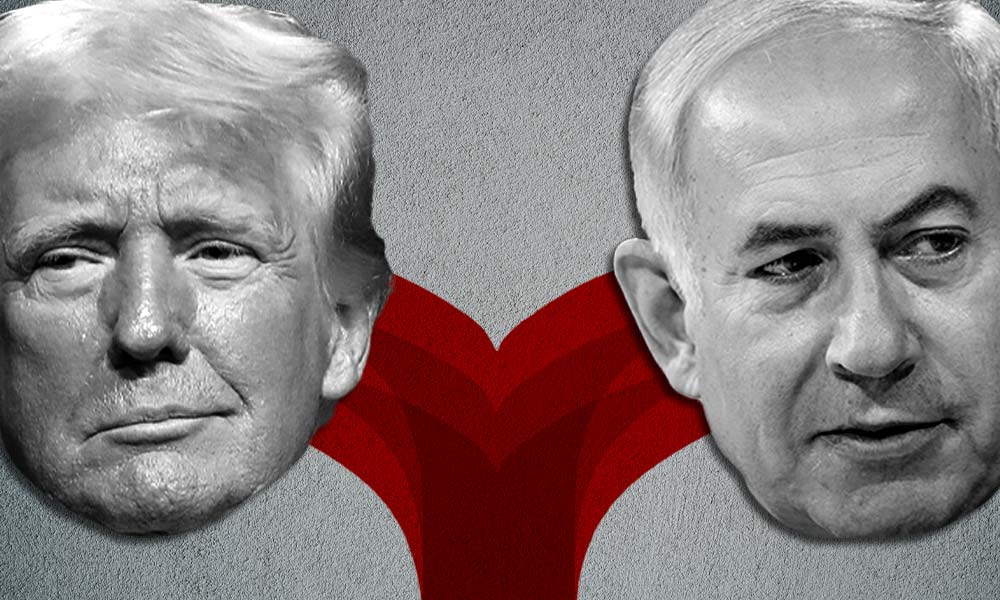
As the Israeli-American war against Iran enters its third week, Trump and Netanyahu may be nearing a point of divergence.
From the moment the first missile was fired on Tehran, U.S. and Israeli military forces worked hand in glove, providing the closest coordinated campaign in the history of both nations. Trump and Netanyahu expressed full confidence in each other, and shared the same goals for the war: eliminating Iran’s missile and nuclear capabilities and ensuring the Islamic Republic does not have the means to rebuild them.
But after achieving many of these goals, both sides are starting to look at the end game, and this is where the no-daylight approach may begin to make way for diverging goals and strategies.
The objectives of each country, “might be a little different, I guess,” Trump admitted last week, explaining that “they’re a different country than we are.”
These little differences have to do with the scope and the duration of the military campaign.
The United States, while not willing to declare an end to the war yet, is already looking for an exit ramp. Trump has said repeatedly that Iran has largely been defeated and that the war could end very soon. Israel, on the other hand, is not even considering that option yet. According to IDF spokesperson Effie Defrin, the Israeli military has “plans through at least the Jewish holiday of Passover, about three weeks from now. And we have deeper plans for even three weeks beyond that.” Defrin stressed that these plans were prepared “in coordination with our U.S. allies,” but the American side does not seem committed to pursuing these plans if a chance to end the war arises earlier.
The issue goes beyond timing. The United States could be perfectly pleased with an exit point at which Iran’s missile and drone capabilities are significantly degraded, its navy and air force all but decimated, and with a mechanism that would ensure the free flow of oil tankers through the Strait of Hormuz. Israel, on the other hand, would like to see this war deliver more: severing Iran’s ties with its proxy terror groups in Lebanon, Yemen and Iraq; causing even more damage to Iran’s missile and drone programs; and pressuring the current regime with all of America’s and Israel’s military might in order to open the gate for potential regime change. Israel cares less about the oil flow through the Strait of Hormuz and does not trust a Venezuela-style endgame in which the United States finds friendly leaders who were part of the old regime.
2. Trump and Bibi’s political calculations
This future potential split also relates to the political will and power of both leaders. Trump is leading a war that is highly unpopular at home, and he’s facing rising gas prices, growing criticism within his own political camp and upcoming midterm elections. The longer Trump stays involved in a faraway war, the greater the political price he will have to pay.
Netanyahu, on the other hand, heads a nation that widely supports the war and will likely reward him for conducting it in the general elections later this year. Even most opposition parties have refrained from criticizing the war or Netanyahu’s way of conducting it. In Netanyahu’s best-case scenario, the war continues for weeks, further diminishes the power of Iran, and carries Bibi to election day in November—or before—as a wartime leader who courageously took on Israel’s worst enemy.
As the war drags on, the “little differences” Trump mentioned could deepen, especially as both leaders begin counting their political gains and losses.
3. Are U.S. Jews out of step with fellow Americans on the Iran war?
A survey posted by the Jewish People Policy Institute after the first week of the war seemed to point to an anomaly. While a clear majority of Americans oppose President Trump’s decision to go to war against Iran, a majority of American Jews surveyed are for it. A full 68 percent of respondents support the war, 26 percent oppose and 7 percent have no opinion.
While these figures suggest that when it comes to battling Iran, U.S. Jews are much closer to the views of Israeli Jews than they are to those of their fellow Americans, there is an important caveat. The survey relies on a group of 692 “connected” American Jews, defined as “those with relatively strong ties to the Jewish community and/or Israel, and/or Jewish identity.”
This helps explain the anomaly. Those so-called connected Jews are more closely aligned with the mainstream Jewish institutions that have all (except for groups on the left) expressed support for the war from day one. American Jewry as a whole, with almost half of its members considering themselves “unaffiliated” or who define themselves as Jewish though having no religion, may hold different opinions.
So are American Jews more supportive of the war than the U.S. general public? This is a certain indication that this might be the case, but we’ll need to wait for a more comprehensive poll to know for sure.
4. Antisemitism at the pumps
Two days into the war, Tucker Carlson said that “this is Israel’s war. This is not the United States’ war.” A few days later, he claimed that the war came about because of one group within the Jewish community—the Hasidic Chabad-Lubavitch. “Chabad has been pushing in a pretty subtle way, unless you look carefully, for the reconstruction of the Third Temple,” said Carlson, who views the war against Iran as intended to “begin with the destruction of the Dome of the Rock, Al Aqsa Mosque, and then the rebuilding of the Third Temple.”
Does anyone care what Tucker Carlson has to say? After all, even Trump disavowed him recently, saying that the far-right pundit has “lost his way.”
And yet, millions of Americans still follow Carlson and his antisemitic-laden videos. Carlson represents a force within the MAGA movement, and while his anti-war perspective is shared only by a quarter of Republicans, it is still heard and amplified on social media.


The problem isn’t merely with the immediate impact of his rhetoric but with the foundation it lays for the future. Once Americans who follow Carlson believe that Israel is directing the U.S. in fighting the war with Iran and that the war is being waged to advance messianic ambitions, the ground is ready for blaming Jews for all the suffering that comes with a large-scale war: casualties on the battlefield, civilians killed and wounded and rising oil prices.
5. The cost of being Jewish is on the rise. Politicians can help
It was the realization of the worst Jewish nightmare: A truck loaded with flammable materials rams into a synagogue in a Detroit suburb where more than 100 preschoolers are in attendance alongside staff and clergy, and the driver then begins to shoot as he tries to carry out a massive Pittsburgh-style attack in a Jewish place of worship. Luckily, this horrific scenario that played out at Temple Israel in West Bloomfield, MI, last Thursday ended differently, thanks to the bravery and training of the synagogue’s security staff.
But while this incident ended with no physical harm to the community, it highlighted the increasing danger Jewish Americans are facing, a danger exacerbated by recent events in the Middle East.
If it wasn’t clear yet, it probably is now: Jewish institutions need to buttress. For decades, American Jews looked at the fortified European synagogues, with their steel doors and armed police patrols, and thought how lucky they were to live in a country where Jews can safely practice their faith freely and with minimal security. But those days are unfortunately over. With the need to add guards, to harden the entries of synagogues and Jewish institutions, and to add technological devices for monitoring the buildings and for communicating with authorities, the costs of being part of a Jewish community also rise. Eric Fingerhut, president and CEO of Jewish Federations of North America, described this added cost as “the Jewish tax.”
Increasing the dues Jewish Americans pay to participate in day schools, synagogues or communal events is largely off the table. Jewish institutions are already struggling to keep their members, and in a climate of rising cost of living, adding yet another expense will undoubtedly lead many Jews to stay home.
The most reliable source of funding for communal security needs has been the Nonprofit Security Grant Program run by the Department of Homeland Security. But it’s hard to see how $300 million budgeted for the program will suffice.
Ensuring the freedom and security of American Jews (and of other faith groups that also have access to the Department of Homeland Security’s Nonprofit Security Grant Program funding) is a national priority and should be supported by Congress. The costs may be on the rise, but until something is done to address antisemitic violence, this money is needed and should be provided.
(Top image credit: Gage Skidmore (CC BY-SA 2.0) / World Economic Forum/Manuel Lopez (CC BY-NC-SA 2.0))
One thought on “Are Trump and Bibi Reaching a Fork in the Road?”
Will the end game play out between Israel and the USA alone?. The Gulf States have become involved and they would support Israel’s plans which to end once and for all the regional threat from an ayatollah-run Iran. After that might the first steps be taken toward a hegemony in which the strongest, and only democratic, state is critical in the reconstruction of a Middle East based on peaceful coexistence? Might Israel have made some new regional allies in these terrible years? Is that a possibility that leaves the glass half full at this point?