
On my three-day visit to the Legacy Sites in Montgomery, AL, odd things happened to me that can only be explained by Socrates’s timeless observation: We carry ourselves with us wherever we go.
I’ll split the pronoun, make it “our selves” to underscore the layers of reactions I had while touring Bryan Stevenson’s brilliantly curated Legacy Museum, Sculpture Park and National Memorial to more than 4,000 Black victims of lynching. Countless visitors have reported intense responses to this remarkable place (I highly recommend Nadine Epstein’s “In the Shadow of the Lynching Memorial”), and I was no exception. My various selves—woman, wife, mother, Jew—thought they knew this history but had never seen it materialized with such artistry and clarity. Nor had I ever had a visceral reaction comparable to the one I had standing before a replica of a holding pen for slaves, a narrow barred cell as cramped as a phone booth, one of many in the darkened entry hall of the museum.
***
As I move closer to its iron bars, a ghostly life-sized holograph of an enslaved woman appears in the cell. Her phantom voice, scourged by anguish, recalls being awakened by slave traders kidnapping her children, the sound of her baby crying out for her, the men’s violence, her children’s terror, her powerlessness. And out of nowhere, I’m overcome by an utterly uncharacteristic outburst. My throat convulses with shuddering sobs. The enslaved woman’s torment is suddenly reverberating in every fiber of my “mother” self, while the Jew I carry with me wherever I go is simultaneously conjuring Auschwitz. Though the hall is dimly lit, I can feel people staring. Two middle-aged Black women bookend me; one softly strokes my arm, the other wraps her arm around my shoulders. In lullaby tones, they take turns murmuring, “It’s all right, baby. It’s okay.”
I meet their kindness with a new flood of tears. “No!” I rasp. “It’s NOT okay!” I tell the strangers that I can’t understand why they, or any Black person, are willing to speak to any of us, live with us or ever forgive us. My child self is projecting the vengeful feelings I harbored about Germans for years after the Second World War. I keep saying, “I’m sorry.”
The tall woman silences me with three words: “You came, honey.” The shorter one adds, “Not everyone is willing to see this.”
***
Empathy, the ability to identify the self with the other, is said to be the emperor of human emotions. I felt flooded with it. I kept asking myself: In the face of such degradation and abuse, would I have survived? Could I have forgiven those who transgressed against me?
Some may say it’s inappropriate to reference myself—any of my selves—in the context of another people’s story. Others that I should get canceled for historical “appropriation.” Still others might say that my abject apologies to the two women were my unconscious way of virtue signaling. But I’m not ready to slap a label on a state of mind I’m still interrogating.


In his introduction to the book about the exhibits, Stevenson, the civil rights lawyer who conceived The Legacy Sites and midwifed them into brick and mortar reality in 2018, credits Berlin’s “stumbling stones” marking individual deportations and the “many markers, monuments and dedications to victims of the Holocaust” as an inspiration. He’s also explicit about wanting “everyone to learn our history, not be condemned by it, but to be inspired to never repeat it”—an unambiguous echo of our “Never Again.” Later in the book, a text frames survival itself as a radical act, a form of resistance.
No wonder my thoughts kept ricocheting between Black people’s history and ours.
Like all complicated emotions, mine had complicated antecedents. The day after I arrived in Montgomery marked the second anniversary of the death of my beloved husband, Bert. I had remembered to pack a yahrzeit candle, the wax-loaded drinking glass so familiar in Jewish households. But I forgot the fire laws prohibiting open flames in hotel rooms.
***
When the hotel manager is unyielding, I google synagogues in Montgomery. My call to Chabad goes to voicemail. Mercifully, Scott Looper, the Reform rabbi at Temple Beth Or, answers on the first ring. When I explain, he insists on picking me up at my hotel and driving me to his shul, where we talk about its glorious history and present decline. Then he unlocks the sanctuary and escorts me up to the bima. I light the candle, recite the Kaddish, weep softly. When we leave the sanctuary, the memorial to Bert Pogrebin, its steady flame burning in the juice glass, stands alone on a small pedestal in front of the Holy Ark.
***
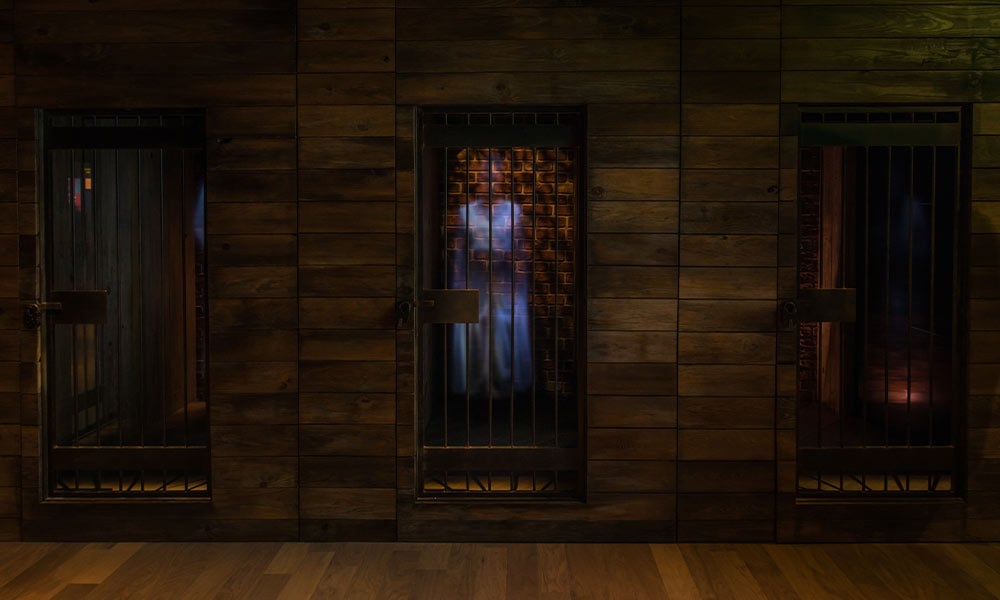
Slave pens exhibit at the Legacy Museum in Montgomery, Alabama. (Courtesy of the Equal Justice Initiative)
Maybe it was that experience that primed me the next day to take death so personally. Maybe I was just raw. Or maybe a lifetime of civil rights marches, feminist activism and a long-running Black-Jewish dialogue group had laid the foundation. Whatever it was, a third encounter, this one in the Legacy Sculpture Garden, seemed to offer an emotional coda of sorts:
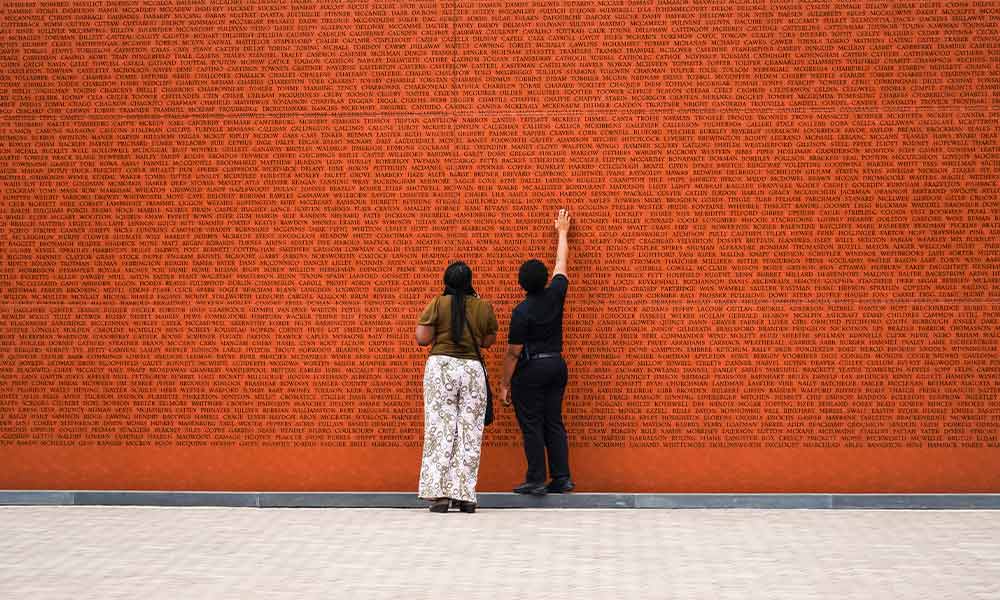
I’m standing before the majestic 43-foot-tall, 155-foot-wide, terracotta-color memorial wall inscribed with 122,000 surnames of formerly enslaved people who, in 1870, were listed for the first time in a U.S. Census. I flash on Maya Lin’s Vietnam wall in Washington, DC, where a name can evoke a person so powerfully that people come to take charcoal rubbings. Then, predictably, my thoughts meander to the six million Jews who died with their names erased, their identities reduced to serial numbers tattooed on their arms, then to ash.
While I’m musing, a young Black staff member approaches to see if I have any questions. I ask if he can point to his family name on the wall. He says it’s not there. Why? Because his surname is… Moskowitz. I choke up, stunned. He introduces himself—Kendall Mathews-Moskowitz—and explains that “Mathews” acknowledges his ancestor’s slave name, and is on the wall, but that that same ancestor later chose to add the surname Moskowitz in gratitude to a Jewish man who “took us in.” What’s more, his family members have continued to use the name for five generations. I ask if it was hard to grow up in Alabama as a Black man with a Jewish name. No, he replies, it gives him the opportunity to tell his family’s story.
***
When I relayed this encounter later to a Black friend, the pioneering legal scholar Patricia Williams, she wasn’t as surprised. Some Jews in the South, she explained, purchased Black people to liberate them from enslavement or helped after emancipation with a job or housing. And when these freed slaves took surnames, some bypassed the popular Washington, Jefferson, Jackson or Jones and instead took the names of those Jewish families.
From the minute I’d entered the Legacy Sites that morning, I’d felt guilty, maybe presumptuous, about my incorrigible interweaving of Jewish experience into Black suffering. But then Kendall Mathews-Moskowitz appeared at the wall of names to render the connection literal and human.
Letty Cottin Pogrebin is the author of 12 books, most recently Shanda: A Memoir of Shame & Secrecy. She is currently at work on a new book, tentatively entitled, Bliss: Scenes from a Marriage.
Opening image: Visitors at the National Monument to Freedom at the Freedom Monument Sculpture Park in Montgomery, Alabama. (Courtesy of the Equal Justice Initiative)