

When asked to think of a Jewish Broadway star, chances are a theater fan will name Barbra Streisand, who gained recognition for originating the role of Fanny Brice in Funny Girl on Broadway and later portrayed the character in the film adaptation. Others might name Idina Menzel, who originated the role of Elphaba in Wicked, or Ben Platt, who originated the titular role in Dear Evan Hansen. But there are always emerging talents ready to make their mark.
Broadway and Jews have had an interwoven history dating back to the late 1800s and early 1900s when Jewish immigrants arrived in New York City, and Yiddish theater began to thrive. Jewish impacts could also be felt through Tin Pan Alley songwriters, including Irving Berlin and George Gershwin, and Golden Age musicals by Jewish writers like Leonard Bernstein and Stephen Sondheim. Assimilation, antisemitism and other themes that resonated with Jewish communities were evident in shows including Cabaret, Ragtime, Parade, Falsettos and more.
While writers and scripts are the foundation for a show, actors are the ones who take the stage every night bringing their own identity and history to their roles. Whether they are playing Jewish roles purposefully, portraying them incidentally or are not playing a Jewish role at all, every Jewish actor has a different path, including originating new roles in musicals or reinterpreting roles with their own vision.
Meet three actors shaping the new generation of Jewish Broadway performers:
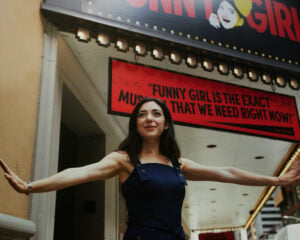
Julie Benko. Credit: Alexandra Genova
Julie Benko: An Unexpected Jewish Broadway Journey
“That is not something that I particularly set out to represent, it just sort of happened to me because of who I happened to be.”
As each performance of Funny Girl opens, an actress portraying an older Fanny Brice looking back on her life sits in a dressing room set, looks in the mirror and says “Hello, gorgeous,” a line that quickly became associated with the show, the character and the actress who so memorably delivered it first. Almost 60 years later, hundreds of people entered New York’s August Wilson Theatre to watch the 2022 revival of the well-known show and walked out with one cast member in mind: Julie Benko.
Benko was originally cast as the standby for the leading role in the show’s first major revival since its 1964 premiere. But when Beanie Feldstein departed the show early, Benko took over full-time until Lea Michele was cast and Benko became the alternate for the role. But during Benko’s five-week run as Fanny, she quickly became one of the breakout stars of the revival.
Later, in December 2025, Benko starred in a production of Guys and Dolls at the Shakespeare Theatre Company before leaving to play a limited run as Emma Goldman in Ragtime, which she reprised this summer.
Benko was born in Washington, DC, and raised in Connecticut. Before Funny Girl, she was on the national tours of Spring Awakening as an understudy and Les Misérables as part of the ensemble and as an understudy for Cosette, a role that she later took over full-time.
Although she has become closely associated with Jewish roles on Broadway after being cast in Funny Girl, Harmony, Fiddler on the Roof and later, Ragtime, Benko never set out to play Jewish characters.
“That is not something that I particularly set out to represent, it just sort of happened to me because of who I happened to be,” Benko said. “And when that happened, I just tried to represent that as best I could.”
Benko’s interpretation of Fanny showcased the comedic beginning of the character’s story. As Benko performed “I’m the Greatest Star,” her comic mannerisms shone. But despite the humorous character she played toward the beginning, Benko showed her depth as an actor and singer performing “The Music That Makes Me Dance,” a heartbreaking ballad where her vocals and acting skills were given the space to shine.
Benko said that while it was a great joy to play the role, there was a physical and vocal strain that comes with the challenge of anchoring a production like Funny Girl, the story of Fanny Brice and her rise from the Lower East Side to World War I-era stardom.
“I was just constantly in pain, constantly on vocal rest,” Benko said. “Just the stress of carrying a show like [Funny Girl], where you’re singing 14 of the greatest songs ever written, and there’s just a lot of attention on you.”
She added that every role comes with its unique challenges. Benko said one of the things that she loved about playing Fanny was that it was not about playing a religious character.
“She was proud of her heritage and she was really connected to her heritage,” Benko said. “I think the reason people love Fanny is because she’s got all these flaws, but she’s got such a good heart. And maybe they arrive at: ‘Oh, guess what? She happens to be Jewish, and I just learned something about Jewish history.’”
Benko noted that she would love to tell some of the stories from Yiddish theater because it is a really fascinating world but that she is more interested in the character than their religion. While she has been offered other roles playing Jewish women, she’s turned some down when she felt the writing “wasn’t great” or that the inclusion of the Jewish character felt forced, that is, not central to the story.
“I think some of the writing gets caught up in the identity politics of it all in a well-meaning effort to combat antisemitism by showing people what we went through,” Benko said. “I think that a lot of times those pieces of writing fall flat and so ultimately I’m just kind of trying to look for characters who are really interesting and flawed.”
Benko said that after she became associated with Jewish roles on Broadway, Cantor Azi Schwartz of the Park Avenue Synagogue wrote to her and asked her to perform there. He also commissioned a song from her, “One Step Closer,” which she wrote for Passover. Since then she has performed in holiday concerts such as Hanukkah on Broadway and frequently collaborates with Cantor Schwartz.
She added that while she loves singing at concerts as well as performing her own music, and she feels that it is essential for her as an artist to have that outlet, acting is her true calling:“That’s my true purpose in life—telling a story through the eyes of another character.”
Benko, who was excited to be returning to Ragtime, remarked that she is always grateful when people who found her through Funny Girl stay on the journey with her.
“My favorite thing about my story [is] that I think that it really offered a lot of hope to people who were in the chorus or understudying or new young actors who don’t have a job and just doing the work, just showing up constantly every day, working really hard without getting recognition,” Benko said. “And that was me for 15 years before I had my breakout.”
Benko said that people will approach her on the subway, almost always young actors who are understudies themselves and thank her for giving understudies a good reputation. She noted that sometimes people will say that they remember seeing her and weren’t disappointed so they stayed, or that her story of getting her big break gave them hope to keep trying.
“I just hope that [my] story continues to offer that for people,” Benko said.
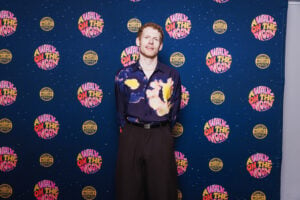
Max Chernin. Credit: Danny Bristoll
Max Chernin: Finding His Niche
“When we brought Parade across the country, I think it was a really powerful declaration of what it means to be a bystander and what it means to be a part of this history of your country for better or for worse.”
In June 2026, the Laura Pels Theatre became home to the newest off-Broadway show telling a Jewish story, A Walk on the Moon. And with that, Max Chernin stepped into the shoes of his latest Jewish character.
Chernin, who is from Ohio, has spent the past several years helping to tell Jewish narratives—from stages across the country to off-Broadway in New York. From telling the true story of a wrongfully convicted Jewish man falsely accused of murder in Parade to the story of a Jewish family in a changing America in A Walk on the Moon, Chernin has found himself a specialty.
“After our industry had a bit of a social reckoning during the pandemic, I think people are really interested in committing and having real Jewish folks tell Jewish stories,” Chernin said. “And so somehow that’s become my niche.”
The actor performed the haunting vocals of Parade, written by Jason Robert Brown, nightly with emotional depth and expert storytelling. His voice and acting skills took center stage with his performance which brought a deep vulnerability and understanding of the role.
Chernin first joined Parade in 2022, performing in the ensemble and understudying the role of the ill-fated Leo Frank at the New York City Center and its Broadway transfer, and noted that the cast was not aware that they would have the opportunity to move the show to Broadway. To have the chance to revisit the show, he said, was “icing on the cake.”
In the three years between when the production originally opened at New York City Center and closed its tour, a lot in the world and the country changed, especially for a Jewish American. Chernin said because of that, the show started to take on new meanings.
“I think [Parade] was a powerful statement on Broadway in New York,” Chernin said, “and then when we brought it across the country, I think it was just a really powerful declaration of what it means to be a bystander and what it means to be a part of this history of your country for better or for worse.”
Chernin added that while the show is deeply emotional there are also “little bits of humor” that are “so uniquely Jewish” and reminded him of his family.
“I saw my grandpa, my dad, my uncle within these characters,” Chernin said, “At base, the Jewish focus on family kind of forces you to know these people for better, or for worse.”
His rendition of “All The Wasted Time” opposite Wicked alum and Jewish actress Talia Suskauer (in the role of Lucille), showed just that. Chernin not only sang the song with the emotional quality that the song requires but told the story through his precise acting choices. Chernin said that “All The Wasted Time” was the release that both the characters of Leo and Lucille need but that the audience needs as well.
The actors performed the emotional duet, which takes place after Lucille has just come to visit her husband in jail, leading to an intimate release of emotions and thoughts. At the front of the stage on their knees embracing each other, Leo repents for the time that he spent pushing her away. The actors maintained intense eye contact and embraced each other as they sang about their relationship and the time that they spent together before the climactic ending.
“There’s all this build up,” Chernin said. “Everyone needs to kind of release that in the end. And so as an actor it was really good to do that, even though what came to follow wasn’t necessarily all that triumphant.”
During most shows, when intermission hits, the actors are given a break and the curtain drops. For Parade, however, Leo Frank stays onstage pacing in his jail cell, bringing a unique emotional challenge to the actor’s experience with a difficult role, as well as a striking visual during what is usually a reprieve from the story.
“The intermission jail was interesting, because whether I wanted to or not, [I was] throwing myself through the psychosomatic journey of Leo at the end of the first act when [he’s] on trial,” Chernin said. “Even if I removed myself from Leo a little bit just to give myself a mental break, all the little demons of my own life would creep up.”
Chernin said that the cast had incorporated some traditions into their show that he thought were beautiful. For instance, they lit Shabbat candles at the beginning of Act II, a scene which was not previously scripted into the show but was added during the show’s preview performances.
“It was cool to live in that space and think about some of the first modern Jews in our modern Jewish communities in our country,” Chernin said.
Chernin and Suskauer are now reunited in A Walk on the Moon. The show transports audience members to the Borscht Belt in the summer of 1969, where a Jewish American family is navigating a changing country.
“We found out in the dressing room,” Chernin said. “That’s such a rare gift as an actor to work with someone that you already have established an acting vocabulary with.”
Chernin made his Broadway debut in 2016 with Bright Star, a bluegrass musical about a literary editor and a young soldier uncovering an old secret. The show debuted in San Diego and arrived on Broadway via the Kennedy Center. He recalled building the show together with the original cast and being one of the youngest people in the company at the time.
“It was really a beautiful experience for me to grow up and cut my teeth in a way,” Chernin said. “And then the show itself was beautiful.”
Chernin next performed in Sunday in the Park with George in 2017 at the New York City Center in a revival starring Jake Gyllenhaal and Annaleigh Ashford.
Chernin appeared in the ensemble and was the second understudy for the role of George. He praised the production, particularly the orchestra that played the complex original background music live, rather than in a recording as in most productions. He recalled watching Stephen Sondheim, the composer of the show, hear it live for the first time at the “sitzprobe,” the first rehearsal with a full orchestra. Chernin said that is a moment he will never forget.
The actor also spoke fondly about the gala after the opening night of the musical.
“I was 27, and I lived in Washington Heights,” Chernin said. “I did Sunday in the Park [with George], with all these other incredible Broadway stars. And I’m going to this French garden themed party, and then my driver’s waiting to take me home.”
Chernin said, however, that the most special experience for him was being able to perform in Parade in his hometown for three weeks.
“There was truly nothing like that. To stand on the stage of a theater that my parents and my grandparents brought me to go see the touring shows.”
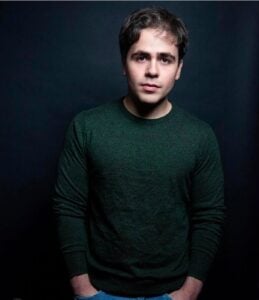
Noah Marlowe. Credit: Stephen Mosher
Noah Marlowe: Catching the Acting Bug Early
“Whatever my best is, I’m gonna give you that every time. And therefore I can’t fail as a leader, I can’t fail as a cast member and I can’t fail as a Jewish person.”
While some children were playing T-ball after school, 10-year-old Noah Marlowe was backstage at the New Amsterdam Theatre in Mary Poppins. Now, Marlowe is singing classic Max Martin hits like “Whataya Want From Me” and “I Kissed a Girl” in the national tour of & Juliet, a rewrite of Shakespeare focusing on Juliet’s life after Romeo, where she survives, packs her bags and flees to Paris with her nurse Angelique and best friend May.
Marlowe plays Francois “Frankie” Du Bois, a shy Frenchman Juliet meets and befriends who is on his own journey of self-discovery.
The actor said that he tries to make the show different every night as he continues to explore his character.
“I’m still learning things about Frankie and what he says and how he behaves,” Marlowe said, “and what a special thing to be able to say after 11 months of touring.”
Growing up in Suffern, New York, Marlowe was not the first in his family to catch the theater bug. His sister began acting before he did and was cast as a swing (an offstage cast member who covers multiple ensemble roles) on the national tour of Billy Elliot. He began auditioning for shows when he was eight.
“I could carry a tune and I looked like a chipmunk as a kid,” Marlowe said. “I kind of was cute enough to be on stage, according to my family.”
Marlowe was visiting his sister when the casting team for Mary Poppins asked to see him again. He went in to see the team and was offered the role of Michael Banks on the spot.
“My dad and I were skipping down the street and we immediately called my mom and she was freaking out. My sister was freaking out,” Marlowe said. “I think it was what also made it so special is we had such low expectations for the auditions.”
Before debuting in & Juliet in September 2025, Marlowe spent four years as the Elder Cunningham standby in The Book of Mormon on Broadway.
“Oh my gosh. If you had seen my Cunningham you would’ve been like, ‘That is the most Jewish Cunningham I’ve ever seen,’” Marlowe said.
Marlowe noted that one of the themes that he loves about The Book of Mormon is that every person engages with religion in a different way and how they do that does not make someone less religious, bad or sinful.
“Well, that is Judaism wrapped up in a box,” Marlowe said, reflecting on his approach to playing a character in a show centered on the Mormon faith as a Jewish actor, “so I can filter that through the Mormon lens.”
He added that in the show, his character makes up nonsense about the Book of Mormon, but the people are engaged, which is the point of religion—to bring community and people together.
Marlowe said that he has never played a Jewish role but that Judaism has been instilled in his identity since his bar mitzvah and Shabbat dinners at his grandparents’ house.
The actor said that he was raised with the belief that you can practice and engage with Judaism however you want and you’re still as equally Jewish as the person next to you and across the world. He added that what he loves about Judaism is that there is a family all over the world—that all Jews are family in his mind.
“That kind of warmth and that kind of connection is something I really try to push through my characters and leave people impacted in those ways as they exit the theater,” Marlowe said.
He feels that Judaism is about doing your best every single day. That even if you fail, you did your best and that makes you a good person and a good Jew. He noted that whatever his best is, that is what he is going to give every time.
“And therefore, I can’t fail as a leader, I can’t fail as a cast member and I can’t fail as a Jewish person.”
Marlowe attended the Boston Conservatory at Berklee but dropped out after being cast in The Book of Mormon. He later transferred to and graduated from Fordham University, where he was told if he wanted to be an acting major he’d have to start over as a freshman. Instead, he chose to get a degree in political science because while it is his ultimate dream job, he’s passionate about combating social justice issues and would like to do more work in activism and combating antisemitism.
He produced a benefit concert in 2022 at The Green Room 42 in New York City titled “Broadway and Borscht” which celebrated Jewish voices on Broadway and raised money to benefit the Anti-Defamation League and StandWithUs. He said that he felt the concert was necessary because he started to notice Jewish voices being silenced and people speaking for Jews who were not Jewish, which he found “really bizarre.”
“I felt like Jewish people didn’t have a platform to speak for themselves,” Marlowe said. “I was like, we need to have something that can literally put Jewish people on a stage with a microphone where they can speak.”