
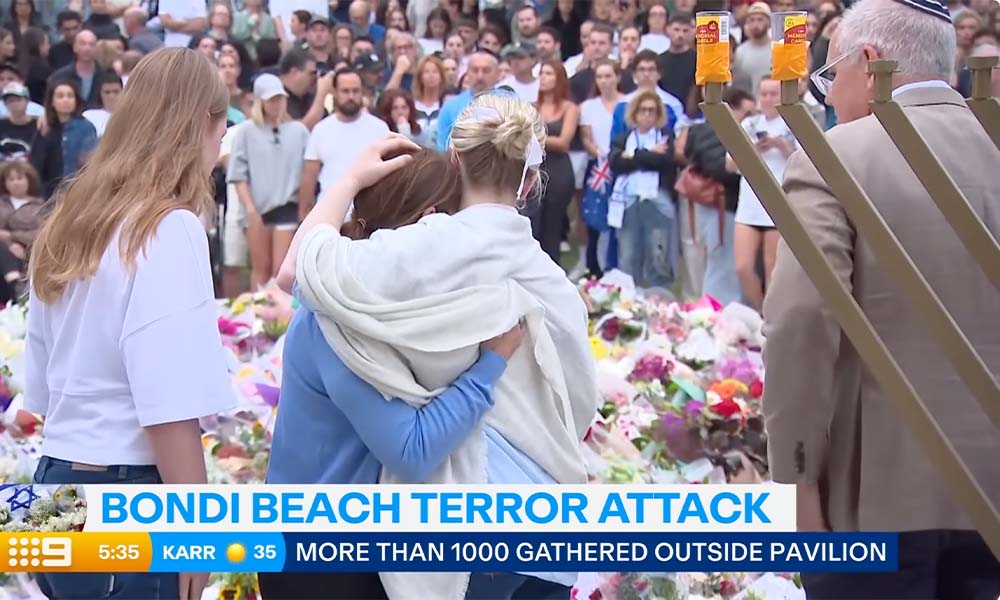
When I speak with Vic Alhadeff, it has only been a day since the horrific attack on Bondi Beach that killed 15 people at a public Hanukkah menorah lighting. Alhadeff served as the chief executive of the New South Wales Jewish Board of Deputies for over 17 years and then as chair of Multicultural New South Wales, an organization whose goal is fostering relationships between Australia’s many diverse communities. “It’s a dark day for Australia, it’s a dark day for the Jewish community,” he tells me. “Australia has always prided itself as being the most successful multicultural nation in the world. We have approximately 200 minority and ethnic groups in this country who mostly get along. This notion of ‘a fair go’ is part of the cultural ethos.” This includes Jews who were here since “day one of non-Indigenous settlement,” says Alhadeff, adding that across the board, Jews have felt like an integral part of Australian society.
“All of this has been shattered with what took place in Bondi,” he says.
The attack, allegedly perpetrated by a father and son reported to have been motivated by Islamic State ideology, did not, he points out, happen in a vacuum. “There has been a sense of complacency, a sense of belief that we are safe in this country. This has been gradually shaken and incrementally destroyed, leading up to the massacre.” Alhadeff names October 9, 2023, as a turning point, when a mass demonstration outside the Sydney Opera House included a chant that some heard as “Gas the Jews,” while others heard as “Where are the Jews?” While this was taking place police told Jews to stay away from the city and from the Opera House for their own safety. “For many this was the beginning of a tsunami of antisemitic conduct,” he says. This included the arson attack on the Melbourne synagogue, cars repeatedly set on fire in Jewish neighborhoods, the cancellation and/or doxxing of 600 Jewish artists, and the universities becoming hostile breeding grounds for antisemitism. Indeed, in 2024 there were more than 2,000 reported antisemitic incidents in Australia.
“It is important to recognize these are attacks on Jewish Australians because they are Jewish Australians, not because of what might be taking place on the other side of the world.”
While many in the Jewish community have criticized the government’s response to these incidents, Alhadeff notes that in the two years since October 7, anti-doxxing legislation has been passed, a bill for harsher penalties for hate crimes has been introduced, over 50 million dollars has been allotted to Jewish safety initiatives, and a special envoy to combat antisemitism position was created. And after the synagogue bombing was linked to Iran’s Islamic Revolutionary Guard, the Australian government expelled Iran’s ambassador, Ahmad Sadeghi, and three other Iranian diplomats. They also recalled the Australian ambassador to Iran.“We can see a number of tangible concrete measures,” he says.
However, the mass shooting at Bondi Beach has shaken the Jewish community to its core. “There are people who woke up Monday morning asking, ‘Do our children have a future here?’” It is the deadliest mass shooting to have occurred on the Australian mainland and largest attack on Jews since October 7. The Jewish community in Australia is very tight-knit, with 90 percent of Jews living in either Sydney or Melbourne. “It is also an exceptionally Holocaust-aware community,” Alhadeff says, with a higher proportion of Holocaust survivors than any country outside of Israel.
Alhadeff says the remarkable response from across civil society has given him hope. He stresses that those who wish to cause harm are a vocal minority; Australians in general, he believes, are decent and fair-minded. Alhadeff points to the Syrian-born fruit seller who tackled and disarmed one of the gunmen, saving countless lives. “We also saw the amazing courage of people of all stripes running toward what was happening trying to help,” he says. Even now thousands of people—both Jews and non-Jews—have returned to Bondi Beach to light candles in a show of unity and solidarity.

When asked how he feels about those drawing a connection between the attack and conflicts in the Middle East, Alhadeff responds: “It is important to recognize these are attacks on Jewish Australians because they are Jewish Australians, not because of what might be taking place on the other side of the world. What is happening here is attacking our right to be Jewish Australians—with the same rights every Australian should have whether they are Catholic, Anglican or Muslim. ”
“There is no going back to before Bondi like there is no going back before October 7,” Alhadeff says. “What we need right now is to repair and rebuild, to reimagine what tomorrow should look like in terms of acceptance of difference and respect for diversity. We cannot allow the upsurge of bigotry which has so tarnished this country to become the new normal.”
(Top image: Screenshot from 9 News Australia)
One thought on ““There Is No Going Back to Before Bondi””
An outstanding analysis