
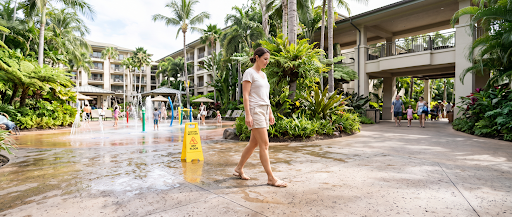
Orlando’s resort corridor is engineered to move enormous numbers of people across wet, uneven and crowded ground for twelve hours at a stretch. Splash zones drain across walkways. Queues switch back over painted concrete. Rain arrives most summer afternoons and leaves within the hour.
Falls in that environment are common, and the legal position of someone who falls there is less obvious than it looks, starting with who was supposed to be checking anything.
The Big Parks Largely Inspect Themselves
The exemption written into the statute
Florida regulates amusement rides, but the largest operators sit outside that regime. Under the amusement ride inspection statute, the section does not apply to permanent facilities that employ at least 1,000 full-time employees and maintain full-time, in-house safety inspectors. Those facilities file an affidavit of the annual inspection with the department instead.
In practice this means the major Orlando parks run their own safety inspection programs and certify the result to the state, rather than being inspected by it.
Why that matters less than people assume for a fall
The exemption concerns rides. A fall on a walkway, a wet restroom floor, a resort pool deck or a parking structure stair is ordinary premises liability, governed by the same principles that apply to any Florida business. The absence of a state ride inspector is interesting context, not the legal framework for a slip.
Where it does matter
It shapes what records exist. A self-inspecting operator generates a substantial internal paper trail: maintenance logs, incident reports, inspection affidavits and housekeeping schedules. That material is extensive and it belongs to the operator.
What a Visitor Actually Has to Prove
The core question is the same one that governs any Florida premises claim, which is whether the business knew about the dangerous condition or should have known about it, and failed to act reasonably.
What makes resort property distinctive is the recurring nature of the hazards. A walkway that floods in the same spot during every afternoon storm is not a surprise to the operator. Neither is the apron of a splash pad.
According to personal injury lawyer Nicholas R. Thompson, Principal and Managing Partner at RTRLAW, resort and park falls turn on the operator’s own records far more than on the visitor’s account, because a large operator documents housekeeping and maintenance continuously and those logs establish whether a recurring wet area was being managed or simply tolerated. Visitors hurt on resort property often seek help after a slip and fall in Orlando before leaving the state, since requesting records is far easier while the visit is still open.
Recurring conditions change the conversation
Where a hazard arises from the way the property is operated rather than from a one-off spill, the argument shifts from whether anyone noticed this particular puddle to whether the operator had a reasonable system for a problem it knew recurred daily.
Your Share of the Blame Has a Hard Edge
Florida divides fault by percentage, and since 2023 that division carries a cliff. Under the state’s comparative fault statute, contributory fault reduces damages proportionally, but any party found to be greater than fifty percent at fault for their own harm may not recover any damages at all.
On resort property, this matters more than it sounds. Flip-flops on a wet pool deck, walking while filming, carrying a child and three drinks, and ignoring a posted wet floor sign are all facts a defense will assemble into a percentage.
Warning signs are evidence on both sides
A wet floor cone cuts against a visitor who walked past it. It also establishes that the operator knew the floor was wet, which is the element a claimant would otherwise have to prove. Photograph signage either way, including how far it sat from the actual hazard, because a cone placed twenty feet away does less work than the operator will later suggest.
The Clock Is Shorter Than Visitors Expect
Florida allows two years for an action founded on negligence. For an out-of-state visitor who goes home, finishes treatment locally and thinks about it the following year, two years disappears quickly.
What to Do Before You Leave the Property
Report it in the park, not from the hotel
Every major operator has a first aid station and an incident reporting process. An entry made that afternoon, in the park, is dated and independent.
Photograph the drainage, not just the puddle
Show where the water is coming from and where it goes. A recurring design or drainage issue is a far stronger fact than a one-time spill, and only a wider photograph captures it.
Record the precise location
Resort properties are enormous and internally repetitive. Note the nearest attraction, shop name or numbered marker, because “near the splash area” will not identify a spot six months later.
Ask for the report number before you leave
Getting a copy later, from another state, through an operator’s claims administrator, is a markedly slower process than asking the person holding the clipboard. Ask for the name of the department that will hold it too, since large resorts route incidents through several.