

 n the second week of July 2024, in Washington, DC, it was hard to tell exactly where the country was headed. President Joe Biden, fresh off a disastrous debate performance but still pushing for another term, told a meeting of NATO leaders that the United States and its allies had a “sacred obligation” to defend democracies under attack. Donald Trump, days away from an assassination attempt and then his nomination at the Republican National Convention, secured a GOP platform that was more moderate than what social conservatives wanted, with a softened stance on abortion and no mention of Project 2025, the Heritage Foundation’s controversial blueprint for a second Trump term. Trump said he hadn’t bothered to read it.
What got less media attention that week, but deserved more, was a three-day “National Conservatism” conference at the Capital Hilton Hotel a half mile north of the White House. The conference highlighted an increasingly dominant strain of conservative thought centered on the promotion of America’s white European and Christian heritage and an America First nationalism. Speakers attacked globalism and advocated for greater Christian influence in the country’s social and political institutions. Several Project 2025 contributors were there, as well as eight Republican senators. Among them was JD Vance of Ohio, not yet revealed as Trump’s choice for vice president but a clear front-runner for the position after exchanging his sober anti-Trump politics of a few years earlier for a newly combative posture defending Trump’s most controversial positions.
Missouri Senator Josh Hawley, the 45-year-old Stanford and Yale Law School graduate reborn as a prairie populist, used the occasion to declare himself a follower of “Christian nationalism,” a doctrine he had not previously publicly embraced and one becoming more popular among right-wing Christians. Christian nationalism is an ideology that fuses conservative philosophy with the belief that America is, and should remain, a Christian nation. It also sometimes casts Jews, other minority religions and the nonreligious as outsiders or obstacles to a divinely ordained social order. Spelling out what this meant in practice was Douglas Wilson, an Idaho pastor who argues for explicitly Christian governments at the local, state and national levels. A featured speaker at the conference, Wilson had risen from relative obscurity to become the leading face of Christian nationalism in the United States.


The conference, funded by a variety of right-wing philanthropists and institutions, offered a remarkable preview of what another Trump term would actually bring. Many of the ideas laid out in the Project 2025 design would in fact be implemented. The promotion of America as a white Christian nation would be a major theme, something Trump had been promising for years. “Christianity will have power,” he said during his 2016 campaign, “If I’m there, you’re going to have plenty of power.” Aside from securing the appointment of three Supreme Court justices with strong conservative Christian backgrounds, he did little to follow through on that promise in his first term. However, in his second term, he’s moved quickly on a Christian nationalist agenda. Barely two weeks after his second inauguration, speaking at the National Prayer Breakfast, Trump proudly announced he had established a “Task Force to Eradicate Anti-Christian Bias.” He ordered Attorney General Pam Bondi to scour federal agencies and other institutions for any sign of “unlawful anti-Christian policies, practices or conduct.”
Trump’s February 6, 2025, executive order, focusing mainly on the Biden administration’s prosecution of anti-abortion protesters and its support for LGBTQ rights, appealed to Christian nationalists like Wilson, who often preaches against “Godless secularism.” In his 2023 book Mere Christendom, he argued that the enemies of Jesus Christ “are all represented by their covenant head, Joe Biden.” Trump’s order nevertheless fell far short of what Wilson had suggested in a blog post as the step that could make America a truly Christian nation: “The president could issue a proclamation that acknowledged that Jesus rose from the dead, and Congress could authorize the funds to have that proclamation printed and bound, read in all the schools, and posted in all the federal courthouses.” Alternatively, he said, the U.S. Constitution could be amended to include the Apostles’ Creed—the basic Christian profession of faith, which begins with the words, “I believe in God, the Father almighty, Creator of heaven and earth, and in Jesus Christ, his only Son, our Lord.”
Wilson, 72, a gray-bearded pastor who favors sweater vests that stretch over his ample middle, is a prolific author and speaker given to homey metaphors and equipped with a deep knowledge of scripture. He identifies as a Calvinist Presbyterian in the Reformed tradition, which emphasizes God’s sovereignty over all things and the inerrancy of the Bible as God’s word. He tends to speak softly, eschewing the fiery style associated with many evangelical preachers. But he is an empire builder, having inspired more than a hundred affiliated congregations in the United States and abroad, with a ministerial training program and his own publishing house, Canon Press. He urges all his supporters to withdraw their children from public schools, and he has helped establish more than 500 private schools that deliver what they see as a classical Christian education. Among his loyal followers is Defense Secretary Pete Hegseth, who in 2022 moved with his wife to Tennessee in order to enroll their children in one of the Christian schools affiliated with Wilson’s church.
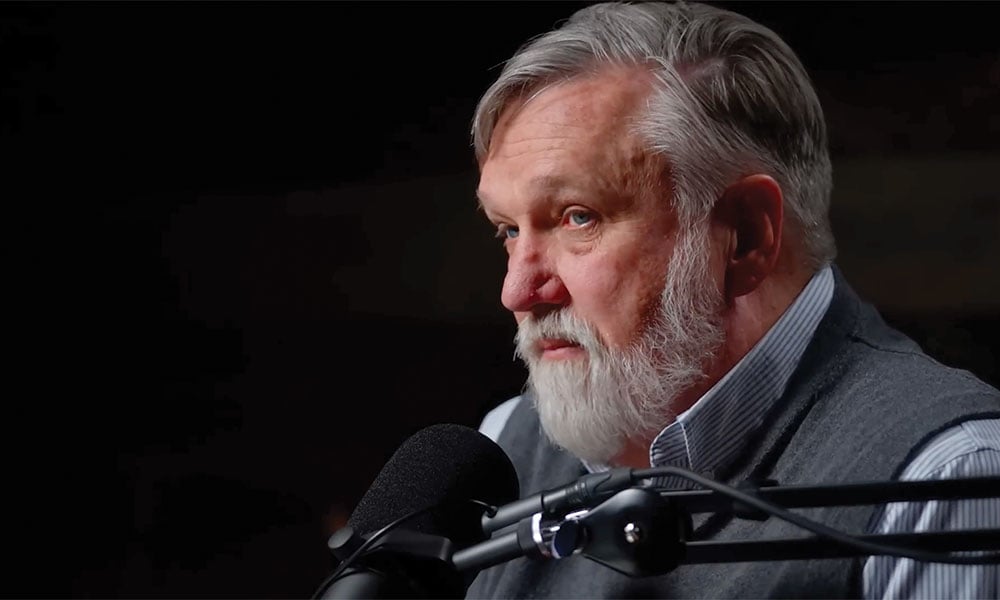
Douglas Wilson argues for explicitly Christian governments on the national, state and local levels. (Canon Press screenshot)
Once associated with only a minority of conservative believers, hardcore Christian nationalism such as that advocated by Wilson has gradually moved into the mainstream of right-wing religious and political thought and, to the consternation of critics, is powerfully represented in the Trump administration. Josh Hawley is not alone. Many conservative Christians who previously denied they were Christian nationalists now welcome the label. Its rise has accompanied the emergence of Donald Trump and his MAGA movement, and the two are related, in the mindset they promote and in their shared politics. Both have a highly combative approach, portraying their opponents as evil, and a conviction that they need to fight back aggressively. Conservative Christians these days are less likely to see themselves as the “Moral Majority,” as they did in the 1980s. Reincarnated as Christian nationalists, they now see themselves as isolated, stuck in what the influential Christian writer Aaron Renn calls a “negative world,” and needing therefore to build their own institutions. Donald Trump likewise sees himself as besieged, with American society dominated by an elite that is out to get him.
Most Christian nationalists would consider themselves evangelicals in theological terms, but they have their own outlook and philosophy. Whereas evangelical Christians traditionally focus on the need for personal salvation through faith in Jesus Christ, Christian nationalists take their evangelicalism a step further, seeking political power in order to take control of governmental institutions and transform them. Wilson speaks often of “worship as warfare.” In a 2024 post on his blog, he wrote, “The order we are pursuing is alive and disciplined, the order of a well-trained military unit. And why? Because every Lord’s Day we go into battle.” Christian nationalism as conceived by Wilson may more accurately be described as Christian dominionism, inasmuch as Christians are urged to seek dominion over the secular world, bringing it under the control of biblical authority and God’s commandments.
“Non-Christians living among us are entitled to justice, peace, and safety, but they are not entitled to political equality. Public space should be exclusively Christian.”
One of Wilson’s allies, Stephen Wolfe, takes the Christian nationalist argument a step further. In his book The Case for Christian Nationalism, published by Wilson’s Canon Press, Wolfe, 42, calls for outright religious discrimination. “Non-Christians living among us are entitled to justice, peace, and safety, but they are not entitled to political equality,” he writes. “Public space,” he argues, should be “exclusively Christian.” Wolfe, a North Carolina-based academic, offers this syllogism: (1) civil government ought to direct its people to the true religion; (2) the Christian religion is the true religion; therefore, (3) civil government ought to direct its people to the Christian religion. As for “external false religion,” Wolfe argues it should be subject to civil restraint or punishment, including through the use of blasphemy laws and “blue laws,” which mandate respect for the Sabbath. Despite saying he does not support blasphemy laws, Wilson still sells Wolfe’s book at his public events.
Empathy, being able to understand why others may feel the way they do, is considered a weakness by Christian nationalists, because it blinds people to the reality of sin and inhibits them from standing firmly against it. In their book Christian Nationalism: A Biblical Guide to Taking Dominion and Discipling Nations, Andrew Torba and Andrew Isker, the latter a graduate of Wilson’s ministerial training program, advise their readers not to let “shame words” be used against them. “Tolerance is NOT a Christian virtue,” they write. “God has zero tolerance when it comes to sin, which corrupts our bodies, hearts, and minds. We are commanded to hate that which is evil.” Douglas Wilson supplied a blurb for the book, which was published by Gab, the social networking service known for its promotion of white supremacist and antisemitic content.
The three aforementioned books by Wilson, Wolfe and Torba/Isker were published in 2022 and 2023, at a time of continually rising political polarization in the country. Among their shared features are the promotion of patriarchy and authoritarianism and their disdain for liberal values. Wilson believes that women should not hold political office nor play leadership roles in a church, nor even be able to vote as individuals, with that right assigned instead to “households,” properly headed by a man. Similarly, Wolfe writes, “Christian nationalists must affirm and restore gender hierarchy in society for the good of both men and women.” He complains that too many traditional theologians “require Christians to affirm the language of universal dignity, tolerance, human rights, antinationalism, antinativism, multiculturalism, social justice and equality, and they ostracize from their own ranks any Christian who deviates from these social dogmas.”
It is not hard to see how the growth of Christian nationalism is driving change in American congregations. Ben Cremer, a progressive Christian pastoring a Church of the Nazarene congregation in Boise, ID, found himself out of a job in 2021 when his district church leaders adopted a right-wing Christian position. Cremer started speaking out against what he saw as corrupting influences in the church, only to be stripped of his ministerial credentials. Having grown up in a white separatist enclave in Idaho and firmly rejecting that world, he recognized among his lay leadership the same fundamentalist thinking he had encountered as a young man: “There’s good and there’s evil, and nothing in between,” he says. “Anyone who opposes you is opposing God. It creates a world filled with hostility and enemies to be conquered, rather than neighbors to be loved, like Jesus called us to do. Once you believe that you are for God and the world is out to get you, you can justify anything to get victory.”
Commentators on both the left and the right have noted that politics often flows downstream from culture and religion. Jemar Tisby, a public historian and writer whose own theological training, like Wilson’s, was in a Reformed seminary, has followed their shared tradition. What is seen in Christian nationalist theology today “will become someone’s policy tomorrow,” he wrote recently. “If a church teaches hierarchy, exclusion, and authoritarian control, it will eventually shape a politics that enforces those same values.”
 emarkably, the growth of Christian nationalism in America has enjoyed the blessing of some prominent conservative Jews, most notably Yoram Hazony, an Israeli-American intellectual who co-founded the “National Conservatism” project and leads conferences connected to the movement. With a long history in right-wing Jewish political circles, Hazony argues that countries should identify above all with their own religious and cultural tradition. He even provided a front-page blurb for Stephen Wolfe’s The Case for Christian Nationalism, praising it as “pioneering” and “relentlessly innovative,” notwithstanding its bold advocacy of Christian supremacy.
In his native Israel, Hazony is a fervent Jewish nationalist, and in his 2018 book The Virtue of Nationalism, he advocates nationalism for pretty much everyone, one that is reflective of each nation’s unique history. His argument, elaborated in a subsequent book, Conservatism: A Rediscovery, relies heavily on the writings of Edmund Burke, the 18th-century British statesman widely considered to be the father of modern conservatism. Burke argued that governments should be guided by their country’s own traditions, values and institutions, rather than by some abstract conception of human rights. In his time, Burke was reacting largely to the French Revolution, inspired as it was by France’s Declaration of the Rights of Man and of the Citizen, which in turn was a product of Enlightenment thinking, the American Revolution and the Declaration of Independence. Burke opposed the Revolution’s disregard for tradition and institutions like the church.
Empathy is considered a weakness by Christian nationalists, because it blinds people to the reality of sin and inhibits them from standing firmly against it.
Hazony, 61, a Princeton-educated political theorist with a boyish face and mild manner, interprets Burke’s philosophy as challenging classical liberalism. In the American context, he argues, it means rejecting both libertarianism, which prioritizes free markets and individual rights, as well as any state-designed social welfare system. The U.S. government’s goal, Hazony says, should instead be to uphold its “Anglo-American tradition,” rooted primarily in Protestant Christianity. He challenges the traditional liberal notion that Americanness comes through an adherence to the political ideology laid out in the Declaration of Independence and the Constitution, which has been taken to mean that virtually any immigrant can become American by committing wholeheartedly to the American idea. Commonality, not diversity, Hazony argues, is what coheres a nation. In practical terms, this means emphasizing the importance of national borders and limited immigration, and rejecting both identity politics and globalist thinking.
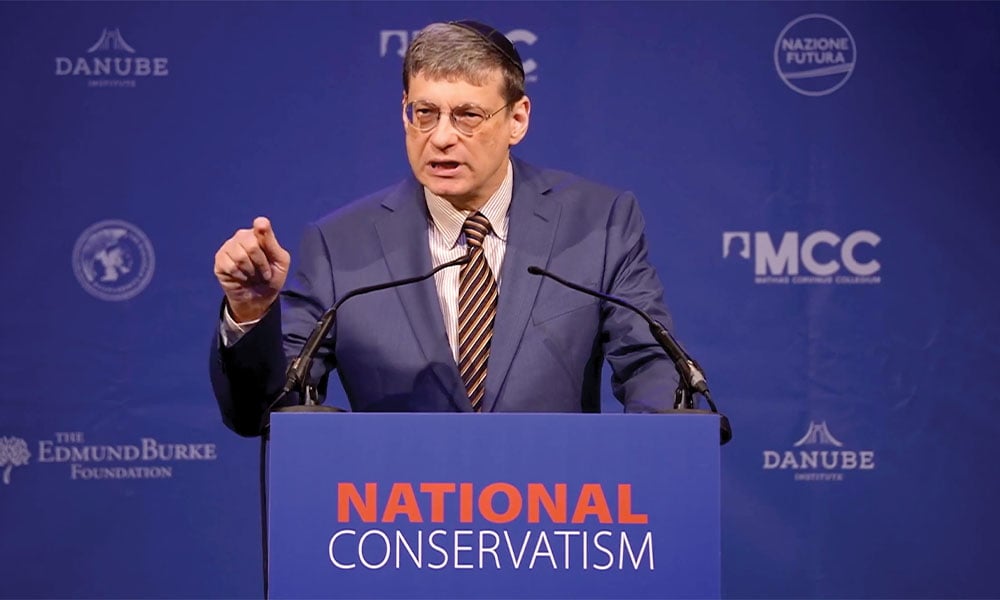
Yoram Hazony, a fervent Jewish nationalist, co-founded the National Conservatism project. (National Conservatism screenshot)
In Conservatism, Hazony acknowledges some readers may wonder “why I, as a Jew, counsel young men and women from Christian families to find their place in a Christian congregation.” It is not that he doubts whether Judaism is the true path; he does not. Rather, he says, “an individual who wishes to embark on a conservative life can do so most easily by taking up the tradition handed down for many generations within his own family, tribe, and nation…Thus, I advise the sons and daughters of traditionally Christian families to return to a conservative life by way of a Christian congregation, just as I call upon Jews to return to a conservative life by way of a Jewish congregation.” American Jews obviously shouldn’t feel compelled to convert to Christianity, but Hazony says they should accept that the United States is fundamentally a Christian nation.
In 2019, Hazony and David Brog, an observant Jew who at the time was co-director of the group Christians United for Israel (CUFI), established the Edmund Burke Foundation, whose main mission would be to articulate and promote the National Conservatism initiative, hosting conferences once or twice a year in the United States and Europe. The NatCon conferences, as they are known, have had a sharper intellectual and nationalist focus than the more familiar Conservative Political Action Conference (CPAC), whose annual meetings resemble campaign rallies that are more festive, with some attendees donning outlandish costumes, and featuring a wider variety of activists and speakers. The first NatCon, held in Washington, DC, in July 2019, attracted right-wing stars such as Vance and Hawley, then-Fox host Tucker Carlson and Peter Thiel, the conservative Silicon Valley investor. By 2024, with its explicit promotion of Christian nationalism, National Conservatism had, like CPAC, effectively become synonymous with Trump’s MAGA movement and GOP orthodoxy. Vance by then was recycling Hazony’s ethno-nationalist views, telling the conference attendees that America was best seen as a “homeland,” belonging above all to the people whose connection to the country came over generations. Senator Hawley called on conservatives to “defend our national religion and its role in our national life…Some will say I am advocating Christian nationalism. And so I do.”
Hazony had worked hard to expand NatCon by bringing in more conservative Catholics, Hindus and Orthodox Jews to join the Protestants already in the ranks. In 2020, he recruited Josh Hammer, a rising star in conservative legal circles, to join the Edmund Burke Foundation. Hammer, 36, who’d been raised in a secular Jewish household but became religious in his adulthood, soon took a leading role in Hazony’s movement, arguing passionately for the cause of Israel and advocating for Jewish-Christian collaboration in defense of Zionism.
Like Hazony, Hammer supported the idea of Christian nationalism, even as a Jew. In his 2025 book, Israel and Civilization: The Fate of the Jewish Nation and the Destiny of the West, Hammer justifies Jewish cooperation with Christians largely for “tactical” reasons, seeing conservative Jews and conservative Christians as co-belligerents against a common enemy. “The Judeo-Christian tradition,” he writes, “is the only affirmative positive force capable of withstanding and possibly rolling back the three hegemonic forces that today threaten ruin for the West: wokeism, Islamism, and global neoliberalism.” Thus, his embrace of Christian nationalism: “The more biblically oriented and the more authentically Christian America is, the better off both America and American Jews will be.”
 y September 2025, Trump and Vance had been in office for seven months and were dismantling and overhauling much of the federal government. They had wiped out virtually the entire foreign aid program, were overseeing a massive crackdown on immigration and rolling back LGBTQ rights, and were punishing or pursuing institutions deemed disloyal to the MAGA project. NatCon2025, which opened on September 2 at the Westin Hotel in downtown DC, marked the long-awaited moment when this coalition of the new Christian right, MAGA followers and pro-Trump Jews could relish the achievement of their shared agenda. The three-day conference drew a record number of registrants, despite a minimum guest ticket price of $425. Several dozen Orthodox Jews were in attendance, not surprising given the large number of Orthodox Jews who had voted for Trump in the 2024 election.
The conference tone was unmistakably triumphalist, even giddy. Never before had the religious and political right had so much success to celebrate, and Hazony led the cheering. “I think the Trump administration is the best administration I’ve ever seen,” he said on the opening day. “Our friends are in power! For those of you who are new here, hundreds of people like you are in the administration. I’ve never seen this before in my life!”
Every norm-breaking, disruptive, unprecedented step taken by the new administration was something to be celebrated. Rachel Bovard, an enthusiastic culture warrior with experience on Capitol Hill and in conservative organizations, set the tone with her welcome speech at the opening session. “You really can just do things!” she said. “Bobby Kennedy fired the entire corrupt advisory committee for immunization practices. No study, no blue-ribbon commission. Gone! Fired! USAID gone! I sat in my office and watched them take down the sign. It was surreal!” Raucous cheering followed.
Another featured speaker was Russell Vought, a self-proclaimed Christian nationalist and a key architect of the Project 2025 report, who would become one of the most powerful people in the administration and oversee the implementation of many of the ideas laid out in the Project 2025 plan. Vought described the 2024 election as having come at a life-or-death moment for the country, just before a midnight apocalypse. “There is a point of no return,” he said. “I personally believe it was pretty close to 11:59,” a dark framing that resonates with many apocalyse-minded Christian nationalists. Vought praised Trump for moving “aggressively and quickly” on his agenda, with or without the support of Congress. “We’re not going to be just sitting back waiting for you to pass legislation,” he said.
Such hyper-partisanship overshadowed the NatCon sub-theme of Jewish-Christian cooperation. An Orthodox rabbi offered the first morning prayer at the conference; the next day, an evangelical pastor spoke. The two prayers could not have been more different. Rabbi Menachem Zupnik from Congregation Bais Torah U’Tefilah, in Passaic, NJ, offered a short, modest invocation, asking God “to continue to shine light upon the path that we travel, to restore our country to its glorious traditions.” Pastor Uriesou Brito, who presides over a Florida church affiliated with Douglas Wilson’s network, followed the next day with a prayer notable for its explicitly political and Christian supremacist character, with little apparent regard for the non-Christians in the audience.
“There is only one true name given among men by which we must be saved: the name of Jesus Christ our Lord,” he said, speaking over the bowed heads of the attendees. “We ask, Triune God, that you use your right hand to turn this nation to our Protestant roots.” Brito asked specifically for divine intervention to get the Supreme Court to overturn its legalization of same-sex marriage. “The Democrats have spurred cultural confusion,” he thundered, as if he were at a Republican campaign rally, not praying for spiritual guidance.
A challenge for the NatCon project was whether the energetic promotion of Christian nationalism would strain it along religious lines. For Jewish supporters, things were getting awkward. Tucker Carlson, previously a keynote NatCon speaker, was nowhere to be seen at the 2024 and 2025 conferences. In the meantime, he had angered many Jews by hosting Holocaust revisionist Darryl Cooper on his interview show and suggesting that Americans who serve in the Israel Defense Forces should lose their U.S. citizenship. Antisemitism on the right, associated today with such figures as Black internet personality Candace Owens and racist white Christian nationalist Nick Fuentes, is not new but is gaining traction especially among younger adherents. A new generation of pastors in the Christian nationalist mode had emerged in the podcasting world, unleashing overtly antisemitic diatribes. Sometimes dubbed the TheoBros, the pastors hyped their masculinity, mixing their Christian messaging with comments on grilling meat and lifting weights.
After declaring his enthusiasm over the ascendance of the Trump administration in his opening speech, Yoram Hazony turned to the delicate subject of what it was like “being Jewish here,” something he said he had never done before and was not especially comfortable discussing. “It was very easy for me to be a leader in the nationalist movement and to be Jewish up until a year and a half ago,” he said, speaking to the conference attendees. “It’s not that easy anymore.” Hazony said he found himself “pretty amazed by the depth of the slander of Jews as a people there has been online.” While he was accustomed to seeing such sentiments on the left, he said, “I didn’t think it would happen on the right. I was mistaken.”
Hazony did not say whom he was talking about, though in a subsequent session at the conference, his colleague Josh Hammer singled out Tucker Carlson as a concern. Hammer cited a recent podcast on which Carlson said he had just read the Hebrew Bible and was “shocked by the revenge in it, the genocide in it.” In his book, Hammer argued that antisemitism in America today is largely associated with the left, a common refrain among conservatives, while antisemitism rooted in Christianity is “such a rare modern phenomenon that it is simply not worthy of our time.” By the fall of 2025, however, the growth of antisemitic messaging from the online right, from Christian nationalist pastors in particular, has had Hammer rethinking his earlier view.
In an interview after the conference, I asked Hammer whether he would revise his assessment of Christian antisemitism if he were writing today. “I would,” he said. “I would style that whole chapter a little differently.” Did he share Hazony’s nervousness about the rise of antisemitism on the Christian right? “Yes,” he said. “It’s a five-alarm fire, and virtually every single Jewish person I know in America is profoundly concerned about it.”
 n general, most U.S. Jews are suspicious of Christian nationalism and other efforts to blur the separation between church and state. A 2024 survey by the Pew Research Center found that of all religious groups in the United States, including Muslims, Jews were by far the least likely to say the Bible should have any influence on U.S. laws. Only self-identified atheists or agnostics were more disapproving.
One Christian nationalist claim that bothers some Jews is the notion of “supersessionism,” meaning that Christianity has superseded Judaism as God’s favored faith, an ancient Christian argument strongly promoted by Douglas Wilson and his followers. In his 2023 book American Milk and Honey, Wilson argues that biblical Israel is no longer what it once was. “The [Christian] church is the new Israel now,” he says. “Unbelieving Jews have been cut out of that true Israel and believing Gentiles have been brought into it.” Wilson dates the moment of this rupture to 70 CE, when the Second Temple in Jerusalem was destroyed. After that, he writes, “all they [i.e., Jews] had left were their erroneous traditions…The promises given throughout the Old Testament are the present possession of Christians, not Jews.”
Some Christian nationalists even suggest the destruction of the Temple by the Romans was an act of God meant to punish the Jews for having rejected Jesus Christ. “That was God’s conclusive, final judgment on the Old Covenant,” write Andrew Isker and Andrew Torba. “It is over.” Wilson stops short of saying the destruction of the Temple was God’s judgment on the Jews, but he rejects any notion that Jews today have any biblical claim on the land. He supports the modern State of Israel, he says, but only for geopolitical reasons. In a 2023 conversation on his “Douglas Wilson & Friends” YouTube program, he said God’s promise in Genesis to give Abraham and his descendants “the entire land of Canaan, for an everlasting possession,” no longer applies to the Jewish people. “In biblical terms,” Wilson said, “the Jews don’t have a promise of the land apart from returning to the Lord. You return to the Lord first, and then we can talk about land.”
That argument rejects the evangelical view known as “dispensationalism,” which holds that God’s promise to Abraham was a divine favor that still applies and that believing Christians should therefore support Israel as a Jewish homeland. The leading dispensationalist theologian today is John Hagee, the 85-year-old Texas pastor who chairs Christians United for Israel (CUFI), where David Brog served for a decade as executive director.
A key dispensationalist belief is that Jesus will someday return to Jerusalem and establish his kingdom there. Jews who accept him as the Messiah will enter the kingdom, while those who reject him will perish, a prophecy that dispensationalist Christians believe is spelled out in the New Testament book of Revelations. Notwithstanding that rather gloomy long-term scenario, CUFI has long included in its leadership prominent Jews such as Brog, who shares Yoram Hazony’s interest in Jewish-Christian collaboration. During his time at CUFI, Brog worked at persuading Jews and Israelis to welcome CUFI’s support, arguing that among its ranks were many Christians who were not hardcore dispensationalists and that the organization in any case served as a bulwark against antisemitism in the Christian world. The strong support for Israel and the government of Benjamin Netanyahu among evangelical Christians is due in part to CUFI’s work and influence.
In an interview, Brog said the supersessionist belief that Israel has no biblical claim to its territory is not inherently an antisemitic position, but he acknowledges it may nonetheless be problematic. “Once you take away any divine protection for the Jews, it sometimes opens the door to antisemitism,” he said, “and we do see some Christians walking through that door.”
-

- Andrew Torba (InfoWars screenshot)
-

- Andrew Isker (Right Response Ministries screenshot)
-
- Eric Conn (Kings Hall screenshot)
-

- Brian Sauvé (Kings Hall screenshot)
Indeed, many in the youngest generation of 30-something Christian nationalist pastors, among them Isker, Eric Conn, Brian Sauvé and Joel Webbon, all of whom have ties to Wilson or his affiliated churches, openly indulge in antisemitism or come close to it, which is partly what spurred Hazony to sound the alarm at NatCon2025. “The Jews killed the Lord Jesus. ‘Antisemitism’ be damned,” Conn wrote on X in 2022, daring his critics to challenge him. On that same day, he portrayed Jews as his political enemies, saying, “The vast majority of Jews in America are Marxists who support the Democratic agenda.”
Brian Sauvé posted a similar message in 2024: “The political system is heavily influenced by Jews who reject Christ and embrace all manners of evil.” A year later, Sauvé got more specific: “Jews are disproportionally involved in the negative influence in our government, wicked aspects of the banking industry, and the smut industry both now and in its rise in the 20th century.” Joel Webbon goes further: “I believe those of Jewish descent are generally marked by subversion, deceit, and greed.”
Andrew Isker is a regular guest on Webbon’s podcast. On a program in February 2025, Isker highlighted the Christian nationalist objection to the term “Judeo-Christian,” saying it is merely a synonym for secularism. “You might as well put a ‘co-exist’ bumper sticker on your car,” he said. “This country belongs to Jesus. He is God. Not any other people but his people.” On that point, Wilson is largely in agreement. “There is no such entity as the Judeo-Christian religion,” Wilson writes. “There is commonality between the Jewish tradition and the Christian tradition, but not so much that we could call it one tradition.”
Wilson has recently come to play something of a godfather role with the newest generation of Christian nationalist pastors, making guest appearances on their podcasts, discussing issues of scripture and doctrine with them, sometimes gently pushing back on their more outspoken positions. Acutely aware that antisemitism doesn’t play well politically and mindful of the respect he has achieved in the National Conservatism movement, Wilson has positioned himself as a moderate among the young extremists, all of them three or four decades younger, though he stops short of repudiating them explicitly.
In their 2023 “Douglas Wilson & Friends” conversation, Wilson and Isker delicately tossed around generalizations about Jews, noting the slanders prevalent on the internet. Isker questioned why “there happen to be a lot of, you know, people of that ethno-religious background that are in high positions of political and cultural and economic power.”
Wilson’s explanation: “The Jews, taken as a whole, are a high-performance people, for whatever reason…They have an outsized influence on all kinds of things. When they’re good, they’re very, very good. And when they’re bad, they’re very, very bad.” Wilson’s example: disproportionate Jewish contributions in the fields of heart surgery and philharmonic orchestras on one side and the pornography industry on the other. Or so he claimed.
In October 2024, amidst growing evidence of antisemitism in the Christian nationalist ranks, Wilson was one of the organizers and signatories of the Antioch Declaration, a statement denouncing “a rising tide of reactionary thinkers emerging on the fringes of our own circles.” The declaration repudiated antisemitic views, saying, “We deny that Jews are in any way uniquely malevolent or sinful, that Judaism in its multifarious expressions is objectively more dangerous than other false religions, or that it represents an exceptional threat to Christianity and Christian peoples.”
Wilson told me his conversation with Andrew Isker in 2023 came after he saw that Isker was flirting with antisemitism. “Never full tilt,” Wilson said, “but sort of walking the line. And that made us nervous…I think he’s playing with fire. Some of these things are clickbait. It’s a way to juice the numbers, but I think long-term it’s a destructive thing.” Whether Wilson has been a restraining influence on his other associates remains debatable. Pastors Sauvé, Conn and Webbon did not sign the Antioch Declaration and continue to post overtly antisemitic comments on social media.
 ix months after taking office for a second time, Donald Trump hosted a White House luncheon for business leaders who had donated to faith-aligned charities. The event highlighted Trump’s creation of a “White House Faith Office,” headed by Paula White-Cain, a Florida-based televangelist who says supernatural blessings will flow to those who give money to her ministry or to other religious causes. In his prepared remarks, Trump said, “I’ve ended the radical left war on faith, and we’re once again protecting religious freedom instead of destroying it.”
The luncheon came a few months after Trump announced the establishment of his “Task Force to Eradicate Anti-Christian Bias.” As evidence of that bias, administration officials cited several cases, including the Biden administration’s refusal to allow a Navy SEAL to claim a religious exemption from a COVID vaccine requirement; an alleged State Department threat to investigate Christian foreign service officers who want to homeschool their children; and an IRS investigation of a church in Virginia said to be violating the Johnson Amendment, a federal law prohibiting preachers from endorsing political candidates. The evidence of a specific “anti-Christian bias” was questionable. The COVID vaccine mandate in the U.S. military applied to all service members, not just Christians, and the restriction on churches’ political activity has rarely been enforced in the 70 years during which it has been in effect.
The cases were raised at an April meeting of the Task Force, featuring three witnesses. One was Michael Farris, a First Amendment lawyer who has represented many faith organizations in religious freedom cases. Farris was one of the evangelical Christian leaders who opposed Trump’s candidacy in 2016. “I think he is without a moral core,” Farris told me in an interview that year. “He doesn’t keep his word in his business transactions. He ridicules people. He doesn’t believe anything about treating his neighbor better than himself. I mean, that’s what the Bible teaches. We just don’t see any semblance of honesty, decency, integrity.” Farris is just one of many evangelicals who have come around to supporting Trump. This year, he did not respond to numerous requests for comment.
Some evangelical leaders have argued that Trump has changed since 2016 and is now a committed Christian. His new character wasn’t readily apparent at the White House Faith Luncheon, however, as he sprinkled profanities throughout his address to the group, said the indictments against him under the Biden administration were “all bullshit,” compared himself to the “great” Al Capone, and boasted about how much money he had made.
Moreover, the Trump administration’s definition of “anti-Christian” was narrowly drawn. The arrest of anti-abortion protesters was cited as an anti-Christian move, but not the arrest of a pastor protesting mass deportations in the name of his Christian beliefs, nor Immigration and Customs Enforcement (ICE) agents shooting a praying pastor in the head with pepper balls at an anti-ICE protest. Trump critics were also quick to point out that the administration’s social media posts mocking the arrest and humiliation of immigrants hardly showcased Christian values. “I love the smell of deportations in the morning,” the president posted on his own Instagram account, echoing Lt. Col. Kilgore’s line, “I love the smell of napalm in the morning,” from the movie Apocalypse Now, and depicting Trump as a macho military man. Another post from the Department of Homeland Security showed a line of alligators wearing ICE hats under the caption, “Coming soon!” apparently a reference to the opening of the “Alligator Alcatraz” detention facility in Florida.
Benjamin Cremer, the 40-year-old Idaho pastor who ran afoul of right-wing Christians in his state, wrote in response, “Imagine cheering the idea of human beings being eaten by alligators and somehow still expecting us to believe you are ‘pro life,’ let alone a follower of Jesus.” Cremer, who now devotes himself exclusively to online pastoring and writing, has emerged as a leading critic of Christian nationalism, with a significant newsletter and Substack following. In one of his 2024 columns, he lamented how evangelical Christianity, in its determination to win, has hitched itself to the Republican Party and Donald Trump, with the gospel of Jesus Christ losing out in the process. “When you worship power,” he wrote, “compassion and mercy will look like sins.”
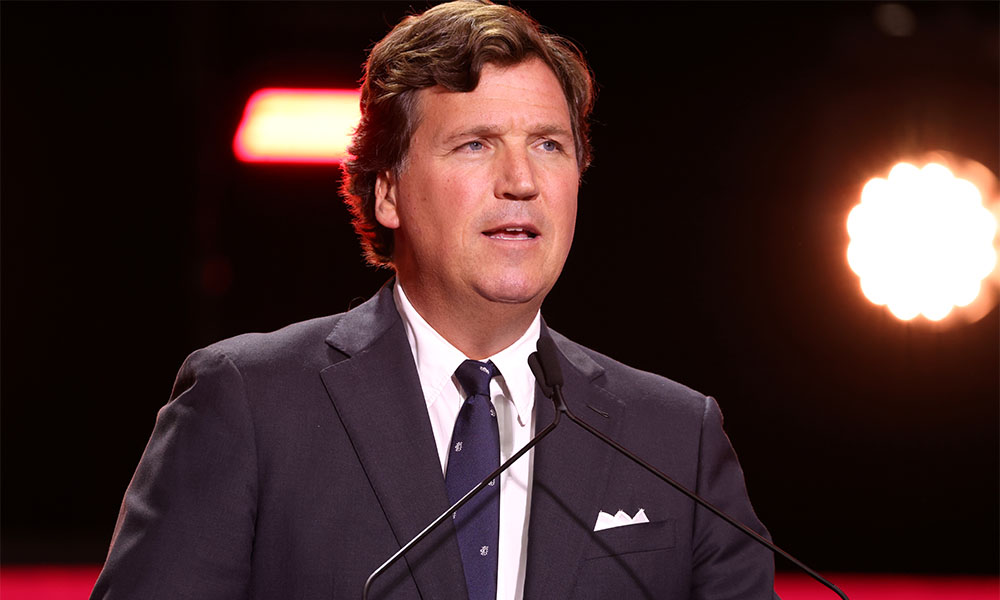
Tucker Carlson (Credit: Gage Skidmore)
In addition to his task force, Trump instituted a Religious Liberty Commission, with the mandate, in Trump’s words, of “bringing religion back to the country.” In public hearings, the commission took testimony from students who said they had been harassed for their Christian beliefs and exercise, for praying publicly, or for opposing their schools’ LGBTQ policies. The commission prepared recommendations to direct the federal government to issue new guidance on prayer in public schools and to allow more religious instruction in a school setting. The proposals were framed as necessary to expand religious freedom in the country, but they would also help clear a path for those pushing to make the United States an explicitly Christian nation.
At the same time, Trump established a new Joint Task Force to Combat Antisemitism. So far, the group has focused on allegations of antisemitism in U.S. colleges and universities stemming from pro-Palestinian activism and related harassment of Jewish college students and faculty. The task force had much in common with Project Esther, a policy proposal from the Heritage Foundation designed to undermine pro-Palestinian activism. Both initiatives have received support from some Jewish Americans, though neither addressed antisemitism on the right.
Among the groups originally endorsing Project Esther was the Zionist Organization of America (ZOA), a stridently pro-Israel group that has largely supported the Trump administration. Tucker Carlson’s sympathetic interview with Nick Fuentes in late October 2025, however, crossed a red line for ZOA and other conservative Jewish groups. When Heritage Foundation President Kevin Roberts subsequently defended Carlson, saying he was “a close friend” and “always will be,” ZOA said it would terminate its relationship with Project Esther and the Heritage Foundation unless Roberts apologized for his comments about Carlson and ended Heritage’s association with him. Antisemitism on the right was finally getting the attention of even the most right-wing Jewish organizations.
Other Jewish groups had already made clear their objections to Project Esther and the Trump administration’s antisemitism task force. In May 2025, 37 former leaders of major Jewish organizations released an open letter warning, “A range of actors are using a purported concern about Jewish safety as a cudgel to weaken higher education, due process, checks and balances, freedom of speech and the press.”
Among the signers of the letter was Alan Solow, a former chair of the Conference of Presidents of Major American Jewish Organizations. “If you look at these efforts around antisemitism, it’s apparent that they are really not about antisemitism at all,” he told me. “They’re about a broader attack on what I would call democratic society.” As a former board chairman of Interfaith America, Solow says the Trump administration’s courtship of conservative Christian nationalists only complicates the challenge. “The best bulwark against antisemitism has been having a free and open society that follows democratic and ‘small-l’ liberal policies,” he says. “That’s how minorities get protected. Whether we like to admit it or not, the Jewish people are still a small people. We may have been very successful in America, but it’s because we live in a free and open society that respects the separation of church and state, the rule of law, and the equality of human beings regardless of their religious observance.”
 he assassination of Charlie Kirk on September 10 served as an accelerant for the volatile mixing of religion and politics already inflaming the country. Kirk was both a highly effective MAGA-allied activist and a deeply devout Christian, and each cause empowered the other. Defense Secretary Pete Hegseth, speaking at Kirk’s memorial service, said Kirk “started a political movement but unleashed a spiritual revival.”
His alleged killer was evidently angered by Kirk’s opposition to transgender rights, but investigators are unsure about other possible motives. Many in the Trump administration and the broader MAGA coalition were quick to blame the entire political left. For many conservative Christians in particular, Kirk’s killing was proof that they did indeed have mortal enemies, demonstrated who exactly they were, and deepened their determination to wage religious war against them. The way people reacted to Kirk’s killing and what they said about him afterwards were seen as a measure of their character and trustworthiness.
Trump’s deputy chief of staff, Stephen Miller, who is Jewish, portrayed the critics of Kirk and Trump as enemies. “You are nothing,” he said. “You are wickedness, you are jealousy, you are envy, you are hatred.” Speaking a few days later on Kirk’s livestream show, temporarily hosted by the vice president himself, Miller blamed “a vast domestic terror movement” for Kirk’s murder. For his part, Vance hinted that the Ford Foundation could be investigated for complicity because of its funding of left-wing organizations. On Truth Social, Trump singled out George Soros, the 95-year-old billionaire, Democratic Party megadonor and founder of the Open Society Foundations, which support human rights and pro-democracy initiatives around the world.
The darkening political and religious climate in the country highlights the risks associated with the promotion of a fierce ethno-nationalism. Yoram Hazony’s National Conservatism movement is based on the argument that a country should identify with its majority cultural and religious traditions, rather than a creed centered on individual rights and pluralism. That creedal idealism has long been seen as the foundation for America’s multicultural democracy, under which Jews have flourished. One can understand the apprehension many Jews are feeling after hearing elected leaders such as Missouri Senator Eric Schmitt speaking at NatCon2025. “We were told that the entire meaning of America boiled down to a few lines in a poem on the Statue of Liberty and five words about equality in the Declaration of Independence,” Schmitt said, going on to explain why that shouldn’t be the case. Presumably, he was referring to the line All men are created equal.

Moment’s November/December 2025 cover
Moment Magazine participates in the Amazon Associates program and earns money from qualifying purchases.
One thought on “The New Christian Right, Antisemitism & U.S. Democracy”
I’d love to hear the Christian Nationalist explanation for the following:
1) Why does the Constitution NOWHERE grant the Federal Government ANY authority over Religion?
2) Why is the ONLY place in the Constitution where the word “Religion” (or any variation thereof) even appears is in the “Three No’s” – so called because they are express statements of what the government CAN NOT DO in regard to Religion?
3) If Non-Christians in the U.S. “are not entitled to political equality” and our public space “should be exclusively Christian”, why didn’t the Founders insure that by imposing a “Religious Test” as a requirement for public office (as was the practice throughout the rest of the world? Instead, in the FIRST of the “Three No’s” (Art. VI, Paragraph 3) THEY ABSOLUTELY FORBADE SUCH TESTS, thus (as Madison stated) the door to the Federal Government was open without regard to “any particular profession of religious faith”. – Federalist Paper Number 52
The plain fact is that “Christian Nationalism” is grotesquely UNAMERICAN!