THE WORD ZIONISM
RETIREMENT PLAN
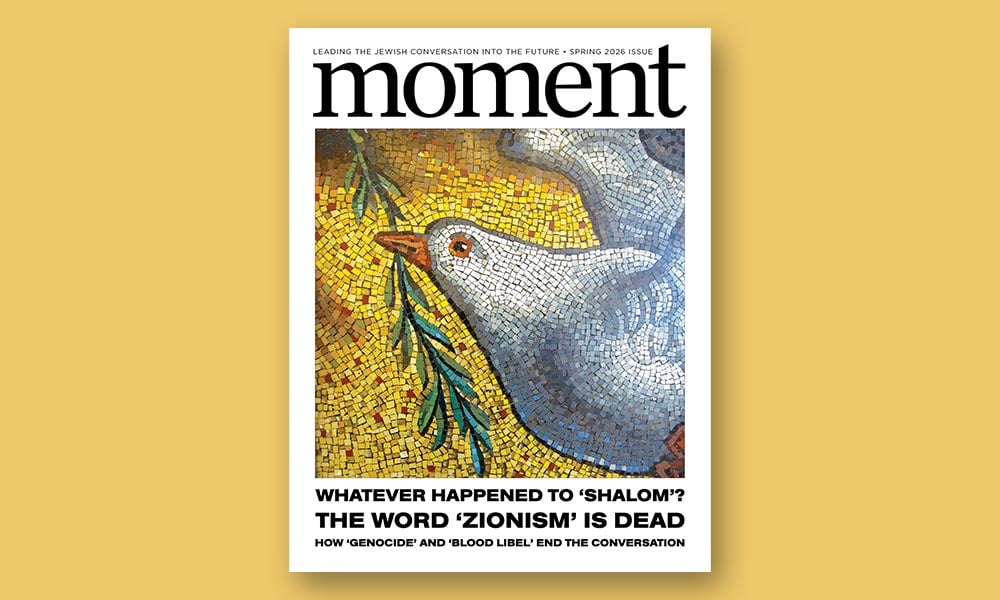
I thought Nadine Epstein’s essay “The Word Zionism Is Dead” (Spring 2026) on the many meanings and needed retirement of “Zionism” was excellent. She detailed the history of the term with vigor—not getting bogged down, as some historians are wont to do in order to show off their research. She also gave the other side(s) of the argument without bias, while remaining true to her position. Especially cogent was the observation that all nations are born in sin.
Shelby Coffey
McLean, VA
SAY WHAT YOU MEAN
I really enjoyed Nadine Epstein’s article, “The Word Zionism is Dead.” I’ve been saying that for a while, and she articulated my own thoughts beautifully. So many words have lost their meaning. They have outlived their usefulness and are used in very unproductive ways. Zionism is certainly one of them. As an aside, I remember studying with Rabbi Ira Stone, one of my beloved teachers. At one point he wouldn’t let us use the word God because he said nobody really knows what they mean when they say it or hear it from someone else. It forced us to be more precise with our language and to think more about what we meant when we spoke.
Beth Huppin
Seattle, WA
A COURAGEOUS ESSAY
Deepest thanks for Nadine Epstein’s passionately thoughtful spotlight on the term “Zionism” and its cousins. She courageously expresses the fragility of a term still trying to serve the compass of Jewish interests as it once did but now vulnerable to manipulation and weaponization. I am grateful for the alternative language she offers in its place. May this essay be a reminder and a guide to others who would build a better world.
Gina Jonas
St. Augustine, FL
RENEW MORAL ZIONISM
Nadine Epstein’s call to eliminate the word “Zionism” includes several thoughtful observations, though the expectation that doing so would reduce criticism of Israel is difficult to sustain. Those determined to wield the term Zionism against Israel and the Jewish people will continue to do so regardless of linguistic shifts.
Instead we must renew Zionism through a principled commitment to a just two‑state agreement. That renewal begins with acknowledging the injustice of the Nakba and accepting proportional responsibility for it.
This recognition does not diminish Israel’s legitimacy, nor does it erase the responsibilities borne by Arab actors. Instead, it restores moral clarity to Zionism and opens a more credible path toward reconciliation and lasting peace.
Jack Y. Edelstein
Ann Arbor, MI
A RESET IS POSSIBLE
As difficult as I found the article’s content, I believe Nadine Epstein is disrupting conventional Israeli and global Jewish identity with new questions and ideas at a time when that kind of reset is so badly needed. Words can change. Consider the word “queer.” Forever, it had been a derogatory, discriminatory word applied to the gay community. And yet, gay activists, not giving in to societal definition and pressure, took an unconventional path, stole the word, turned it around, embraced it and revolutionized it into something positive. Might we do the same with “Zionism”?
Gary Wexler
Los Angeles, CA
NO, DON’T STRIKE THEM
I strongly disagree with Nadine Epstein’s proposal to “strike the words ‘Zionist’ and ‘Zionism’ from public discourse and relegate them to history where they belong.” Elimination of these terms in this fashion would do irreparable damage to an honest and reliable account of Jewish history, Jewish culture and even the Jewish religion. The terms mean one thing and one thing only: a commitment to the legitimacy of an independent and sovereign political entity that offers the Jewish people self-determination and physical protection in their place of origin.
Elihu Leifer
Chevy Chase, MD
DANIEL PEARL INVESTIGATIVE JOURNALISM INITIATIVE
RESTAURANT BOYCOTT WAR
At a time when the debate in America over the conflict between Israel and the Palestinians has been filled with rage and vituperation, Gabe Stutman (“A New Front in the Boycott Wars,” Spring 2026) did what a good journalist is supposed to do—he got out his reporter’s notebook and went to talk to both sides of the most recent and controversial development: the targeting of Israeli and Israeli-linked restaurants by pro-Palestinian demonstrators. He has produced a thought-provoking article that captures the self-righteous attitudes of protesters who insist that anyone who doesn’t denounce Israel and Israelis is complicit in genocide and cultural expropriation, and the angst of business owners who feel singled out for harassment and abuse merely because they make and serve Middle Eastern food. Danny Pearl would be proud.
Glenn Frankel
Arlington, VA

OPINION INTERVIEW
STOP USING THIS TERM!
Adding the word “modern” to the term “blood libel” (“Fighting Words,” Opinion Interview with Yossi Klein Halevi, Spring 2026) does a disservice to my grandfather Mendel Beilis, who in 1913 in Czarist Russia was the last person arrested and tried for one, and to the other 150 blood libels since 1144. Folks should stop using the term to sensationalize their point.
Jay Beilis via momentmag.com
LINGUISTIC WARFARE
I fear that fighting a linguistic war is just another version of the PR or hasbara war. We must call out antisemitism in all its forms, but those of us who love Israel must also condemn the totally disproportionate war of vengeance that the Netanyahu government has wreaked against the Palestinians in Gaza.
Masha Dolknikova via momentmag.com
THE BIG LIE
Tragically, Goebbels got it right: If you tell a small lie, people will be skeptical. They’ll want proof. Goebbels’s brilliance was that he came up with “the big lie.” Tell a story so excessive and so monstrous that people will think that it must be true. Surely no one would make up such a story! “Israeli genocide” is a big lie. And that is precisely why people believe it. Also, antisemitism is deeply ingrained in the way the world goes round. Thus, it seems especially sensible to believe the lie that Israel is committing genocide, when the opposite is actually the case.
Rabbi Chaim Listfield
Atlanta, GA
POLITICAL MEMOIRS
A JEWISH PRESIDENT?
I enjoyed reading Robert Siegel’s review (“The Song of the Political Hopeful,” Spring 2026) of Pennsylvania Governor Josh Shapiro’s book Where We Keep the Light, and I concur with many of Siegel’s comments. However, I do not believe that Shapiro’s book should be “the book” he uses to introduce himself to the national electorate. If he is serious about a run for the presidency, he needs to be more substantive in discussing the issues Americans are concerned with today and how to address the nation’s problems. I also agree with Siegel’s commentary on Joseph Lieberman. Many people forget that in the 2000 election, a majority of the voters (popular vote) did not have a problem voting for a religious Jewish man to be vice president of the United States. Now, a quarter of a century later, I do not believe that would happen.
Jeff Margolis
Princeton, NJ
A TRAGIC ANNIVERSARY
For the first anniversary of the May 21, 2025, shooting outside the Capital Jewish Museum in Washington, DC, that killed Israeli embassy staffers Sarah Milgram and Yaron Lischinsky, we published an essay by JoJo Drake Kalin reflecting on her experience as the organizer of the event, her encounter with the shooter and her relationship to Judaism as a convert. Her piece received many responses, two of which we are printing below. Read her account “I Offered Life.”
AN IRREPRESSIBLE HUMANITY
JoJo Drake Kalin’s account of her experience is quite bracing, as much for the danger of the moment as her irrepressible humanity. And, I might add, the way it also forces an uncomfortable consideration/examination of the killer’s full nature. (Whatever he expressed in that moment triggered her humanity.)
Clara Germani via Facebook
A BRAVE CHOICE
Once again we see the strange contradiction of people choosing to become a Jew—to enter into a world full of so much joy and so much pain. There is so much anti-Jewish feeling and action out there that to find an article that so well captures the amazing Jewish people is heartening. Thank you for adding your voice and actions to the Jewish people.
Deena Glass
Harrisburg, PA
MOMENT DEBATE
KEEP IT PUBLIC
Good public schools are the best way to create a well-informed, active body of citizens (“Should the Supreme Court Permit Public Funding for Jewish Charter Schools?” Spring 2026). Public funds should not be used to foster religious education or beliefs of any kind that are not focused on the needs and interests of every citizen. Using tax money to enhance private interests is unfair and an obvious violation of church/state separation—which is a fundamental right of citizenship in our constitutional republic.
Harriet S. Katz
Arlington, VA
NO RELIGION TAX
In 1785 James Madison wrote “Memorial and Remonstrance Against Religious Assessments” to oppose a 2-cents-per-person annual tax to fund teaching religion in Virginia. (That is less than 70 cents today.) That proposed tax was in the same spirit as today’s drives to fund religious education through individual vouchers or charter schools. Any such payment is a violation of the intent of the First Amendment religious clauses that Madison authored some years later. Supreme Court decisions tearing down Jefferson’s “wall of separation” have ignored and violated principles of our nation’s religious freedom.
Les Bergen
Monroe Township, NJ
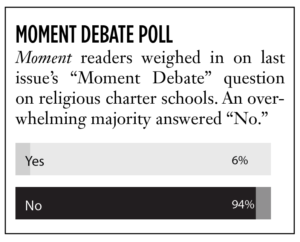
MOMENT DEBATE POLL