“While the other kids were listening to rock groups, I was listening to Bacharach, Carole King and the brilliant trumpeter Herb Alpert.”
SOUNDTRACK 250
TRUTH THROUGH SOUND
I loved and learned so much from “Soundtrack 250: Music That Makes America Sing” (Summer 2026). For example, I didn’t realize that “Somewhere” from West Side Story was originally created by a Jewish team and touches on difficulties associated with immigration. Or that “Brother, Can You Spare a Dime?” asked us to check in with our moral conscience, not only about poverty but about those being marginalized.
Then there’s Marlo Thomas’s brainchild Free To Be…You And Me, which addressed gender stereotypes in 1972 and stressed being our authentic selves. I still own that book and CD. One of my favorite songs was “It’s All Right to Cry,” sung by professional football star Rosey Grier. And raising my children in the 1970s, I also identified with “Parents Are People.”
Soundtrack 250 does indeed “tell the truth through sound.” My biggest takeaway of all is seeing unlikely partners working together for the common good and gifting us these wonderful tunes.
Sharon Brown
Walnut Creek, CA
YOU FORGOT RANDY!
A list of Jewish songs without Randy Newman?? I think his 1972 song “Sail Away,” from the album of the same name, fits your Soundtrack 250 reasoning best. It’s highly satirical, as are all of Newman’s best songs, about a slave trader trying to convince enslaved Africans that they’d be much better off in America. The beautiful melody undercuts its dire indictment of American racial history. I find the song particularly haunting, considering the current climate we find ourselves in here “in America”—the opening two words of “Sail Away.”
Frank Tucciarone
Sarasota, FL
BURT BACHARACH?
I absolutely loved Soundtrack 250, and being a songwriter myself, I appreciated your choices of memorable and meaningful songs written by Jewish composers. Thanks for reminding us how proud we should be of our musical heritage. What a high bar they have set!
I never really realized how much I am drawn to songs by Jewish songwriters. My favorite of all time is Burt Bacharach, along with his lyric writer Hal David. I never get tired of “Close to You,” “What the World Needs Now Is Love” and “Raindrops Keep Fallin’ on My Head.” Bacharach’s musicality, key changes and unusual chord combinations always astounded me. While the other kids were listening to rock groups, I was listening to Bacharach, Carole King and the brilliant trumpeter Herb Alpert, who’s still going strong and performing at 91 and recorded one of my favorite songs, “This Guy’s in Love with You,” written by Bacharach and Hal David.
Michelle Miller
Philadelphia, PA
THE WORD MAY BE DEAD…
BUT THE DISCUSSION LIVES ON
Every word in Judea Pearl’s “Zionism Is the Jewish Quest for Normalcy—it Should Shine, Not Retire” (Summer 2026) is luminous in its clarity and truth. If only those “Jews of discomfort” (and, I would add, of illusion and delusion both) would read this and reflect deeply enough to learn how false their path is.
This essay is a wonderful tribute as well to Pearl’s son Daniel. I do not say a “memorial” because (for me at least) no calling of memory is necessary, not before, not now, and never in the future. He is always with us. They were his “last” words, but ours in his honor have no end.
Mark Bernheim
Lakeland, FL
THE OSLO ACCORDS
BOTH SIDES DID IT IN
Naomi Ragen puts all the blame for the failure of the Oslo Accords on the Palestinians (“Oslo Is Dead. Should We Bury the Corpse?” Summer 2026). That is only a part of what happened. I remember very well how Israel violated certain terms of the Accords almost immediately, how they were not supported by the Israeli government as they should have been and how AIPAC opposed them here.
Ragen depicts Israel as the blameless victim of fanatics. Of course, Palestinians also present themselves solely as victims. This is not how conflicts get resolved. Claiming one’s own side is always right and never wrong means continuing conflict on the personal level as well as the national. Oslo failed because both sides claimed to be victims and justified in whatever they did.
If this continues, no one there will know peace, justice or security. Ragen’s one-sided opinion reflects the reason that any peace deal will fail.
Rabbi Phil Bentley
Hendersonville, NC


REGARDING RAGEN
If someone submitted an opinion piece to Moment proposing that the Jews of the United States either be placed under martial law or be expelled from the country, would the magazine publish the piece? Yet these are exactly the two options the Israeli government would weigh with respect to the Palestinians following a formal annexation of the West Bank and Gaza.
Reading Ragen’s piece carefully, one can easily identify the lies and distortions about the failure of the Oslo Accords, as well as the fanaticism of Ragen herself, typical of Israel’s ethnonationalists. The acceptance of this submission by the editors of the magazine is evidence of how nearly 60 years of occupation and oppression have corrupted even American Jewry.
David deBeer via momentmag.com
Editor’s Note: Naomi Ragen is a regular columnist, and her views reflect those of many Israelis. Moment is committed to publishing a wide range of opinions.
JEWISH WORD
GOYSLOP!
As a person who comes across and even uses the term “goyslop” fairly regularly, I found Sam Franzini’s column “‘Goyslop’: Down the Hatch!” (Summer 2026) highly entertaining and eye-opening. I typically come across this term on social media or use it casually with my friends in a joking manner. To me, goyslop refers to “lowly food” that should be avoided because it’s unhealthy and may be chemically processed to the point that it’s not even real food at all. We also use it jokingly as something intended to mindlessly infect the masses (think Love Island).
I enjoyed reading about the history of the word and was very surprised to learn of its more sinister uses. I had never thought of goyslop as an inherently antisemitic term. Always nice to be reminded of the meaning behind the words that slip into our vocabulary.
Max Epstein
San Diego, CA
TALK OF THE TABLE
NO REUBEN?
Your food timeline (“The Story of American Jewish Food” by Ella Gorodetzky, Summer 2026) left off the Reuben sandwich. It was created in the 1920s by the chef at the Blackstone Hotel in Omaha, Nebraska, after a poker game that included members of the owner’s family, the Schimmels, and the Kulakofsky family, owners of the Central Market, who provided the corned beef and a fresh supply of Uncle Reuben Kulakofsky’s sauerkraut, hence the name “The Reuben.” The poker table is still there (now part of the Cottonwood chain of hotels) as is a poster with the sandwich’s origin story.
Hermine Levy Dreyfuss via momentmag.com
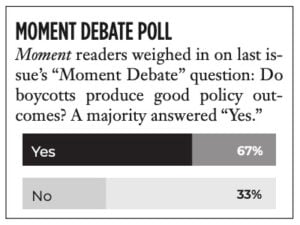
MOMENT DEBATE POLL