
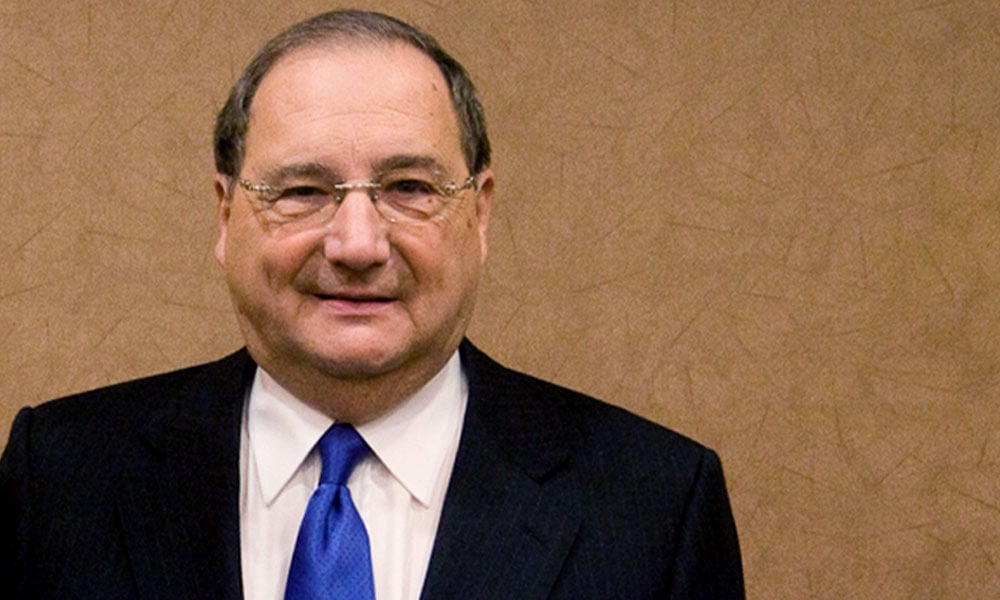
When news broke of the death of Abraham Foxman, the former national director of the Anti-Defamation League, I was moved, though not surprised, by the flood of tributes from people describing how profoundly he had affected their lives. Again and again, the stories were deeply personal. Abe hired them and changed their lives. Abe helped them through a family crisis. Abe gave professional advice. Abe remembered their children.
That was the Abe I knew too.
For those of us who worked at the Anti-Defamation League during his decades of leadership, he fostered a genuine sense of family throughout the organization. The mission was serious—combating antisemitism, extremism and hatred in all forms—but there was also an emotional glue that held people together. Abe created loyalty not through fear (though he could be a tad scary when angry) but through conviction, intensity and personal connection. He was an advocate of enormous gravitas, but fundamentally a mensch.
Working for Abe could be exhilarating, exhausting and inspiring, sometimes all within the same day. He demanded excellence because he believed the stakes were existential. To me, as the child of Holocaust survivors, and to Abe, who had been a hidden child during the Holocaust much like my own parents, fighting antisemitism was never abstract. To both of us, it felt urgent and necessary, every single day.
His brilliance was unmistakable. Abe understood not only antisemitism itself but power, media, politics and human psychology. Long before “branding” became a political obsession, he instinctively understood timing, language, imagery and pressure points. He knew when to go public, when to negotiate quietly behind the scenes and when to force uncomfortable conversations into the spotlight.
I learned my trade from him. There was no better teacher.
Like many leaders of his generation, Abe evolved over time, including on issues involving women in the workplace. Thirty years ago, after I gave birth to my twins, I asked whether I could return part-time for several months after my three-month maternity leave ended. Abe said no. So, I came back full time. There was no way I was leaving work that felt so meaningful to me.
Years later, Abe viewed that issue differently, and family practices within the organization changed. He changed on a number of issues over the course of his life and leadership. One of his core beliefs was that people were capable of growth and transformation. Otherwise, he would ask, why do this work at all? If people cannot change, what is the point of fighting prejudice, engaging adversaries or educating future generations?
That belief shaped not only his public advocacy but also his willingness to reassess his own views.
Abe’s courage was not limited to confronting antisemites. He had the rare ability to say exactly what he believed, even when it put him at odds with powerful elected officials in the United States, Israel and with leaders around the world. He did not calibrate his opinions based on political convenience or access. Presidents, cabinet members, ambassadors, prime ministers and even popes all heard from Abe when he believed they were wrong.
And they listened.
Not always happily, of course. But they listened because they knew he spoke from conviction. He brought that same fearlessness to business leaders, entertainment figures and journalists.

In recent years especially, he was deeply worried about the rise of antisemitism in the United States and around the world. He understood before many others just how dangerous and mainstream it was becoming. Even after decades leading the fight, he knew the work was far from finished. That reality troubled him deeply.
He also had remarkably thick skin. Abe could absorb criticism almost as well as he delivered it. He expected debate. In fact, he respected people more when they challenged him directly rather than whispering behind closed doors. Arguments with Abe could be fierce, but they were rarely personal for long. The work always mattered more than ego.
And then there was the Abe hug. So many have mentioned it in their remembrances. It was warm, enveloping and completely sincere—an extension of the enormous emotional energy and humanity he brought into every room. Abe made people feel seen. In an era increasingly dominated by transactional relationships and carefully managed public personas, that authenticity mattered.
The outpouring of memories after his death reflects something larger than admiration for an accomplished Jewish leader. It reflects gratitude toward someone who made people believe they personally mattered to the fight against hatred and intolerance.
Abe devoted his life to defending the Jewish people and democratic values. His work was enormously impactful. But he also built human connections that endured far beyond speeches, campaigns or headlines.
That may ultimately be his most lasting legacy.
[Read more about Abe Foxman in “The Vanishing Antisemitism Taboo.”]
Laura Kam is the president of Kam Global Strategies, a Jerusalem-based communications and public relations company. She worked for ADL for 17 years in New York City, Washington, DC, and Jerusalem.
(Top image credit: Justin Hoch (CC BY 2.0))
One thought on “The Abe I Knew”
Abe was a giant of a leader— a passionate defender of the Jewish people. I did not always agree with him but I knew he tried to be fair and called things as he saw them. At a time of crisis for Israel, the Jewish diaspora and American democracy we will sorely miss his wisdom, his passion and his guidance.