
Frankly, I hadn’t paid much attention to the reports of rising antisemitism in Germany, nor was the planned roots trip in any way religious. I was simply a Jewish German-American, secular and thoroughly “assimilated,” wanting to see where his mother’s people came from.
Bamberg and the tiny Bavarian villages around it beckoned, and my son Ben came along. We had no local contacts and had scanned little research beyond a compilation by my great-grandmother. Her parents-in-law had been married for 60 years when they died within five weeks of each other in 1895. They lay, she wrote in 1921, under a single stone in Bamberg’s Jewish cemetery.
Nazis had knocked over tombstones. So had drunken vandals in the 1960s. Ben, an accomplished photographer, agreed that we should expect little beyond my primary goal of sensing “whether the gene pool would seep up our pantlegs” as we walked in the footsteps of predecessors.
One interested me particularly. He had landed in New York in 1860 and kept right on going to join a brother in St. Joseph, MO, equipping wagon trains going west. New business boomed with the Civil War, selling uniforms to the Union Army, including to a hard-drinking officer named Ulysses S. Grant. Their little operation then moved to St. Louis and became Rice-Stix, one of the largest drygoods companies in the United States when sold a century later.
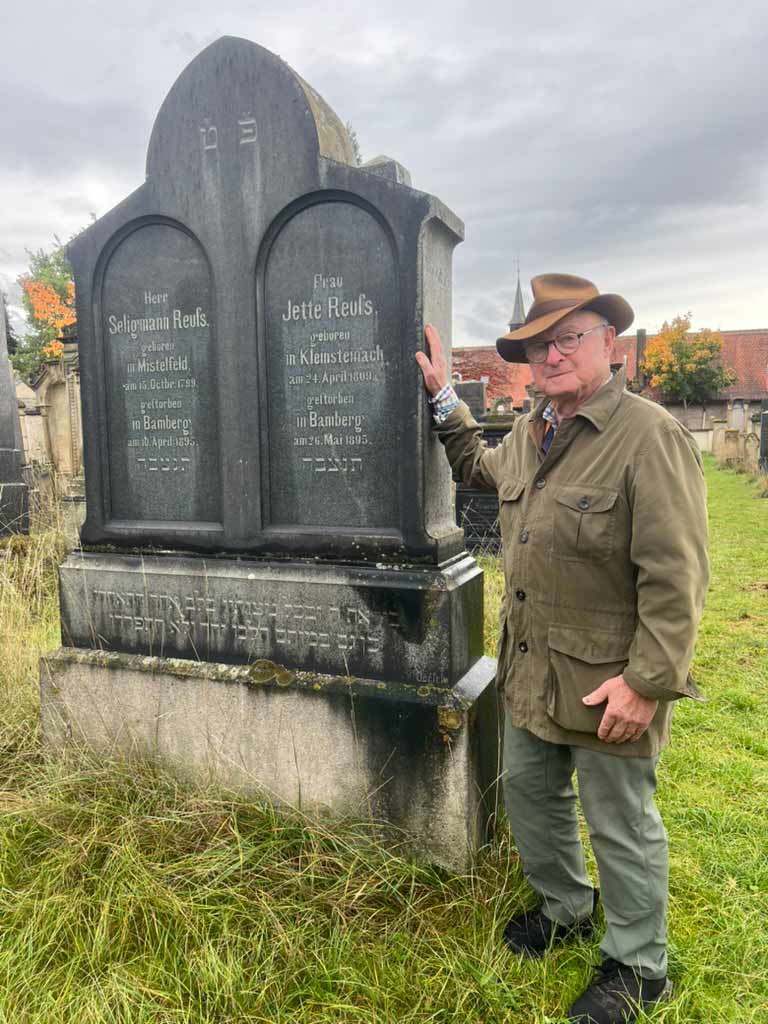
The author in Bamberg, Germany. Courtesy of Charles R. Eisendrath.
We found Bamberg to be a medieval charmer of a town with Renaissance flourishes. The region has its own cuisine (Franconian), beer (smoked), schnapps (herbal) and countryside alternating tidy fields with forested hills. At restaurants and on tour boats we fell into easy, gemütlich, conversations with locals. Yes, we were smitten and, yes, too, I thought I could sense some sort of kinship at an engagingly plausible genetic level.
An exhibition of Bamberg’s Holocaust experience and memorial plaques set among cobblestones recounted the dark side of those links, but in general terms. We had relegated a specific tomb search to our last stop, late in the afternoon of the final day. A previous search by a family member did not get past the entryway of the cemetery and internet jottings by tourists suggested a staff unhelpful even when present. So, when an open side gate presented itself as we pulled into the parking lot, the reporter in me sputtered to life: Offer apologies later if necessary, but don’t miss what might be an only chance near closing time.
In a city where everything is clean and clipped, the scruffy turf inside shouted unusual neglect. Remaining grave markers stood in close ranks, seemingly standing at attention to face a broken heap of their row-mates where a commandant—of a military unit or concentration camp—would have barked directives of the day.
Rollcalls of the names on those stones—Silberman, Rothschild, Straus, Rosenwald—formed a roster familiar to any Jewish German-American. Some exactly matched people I know.
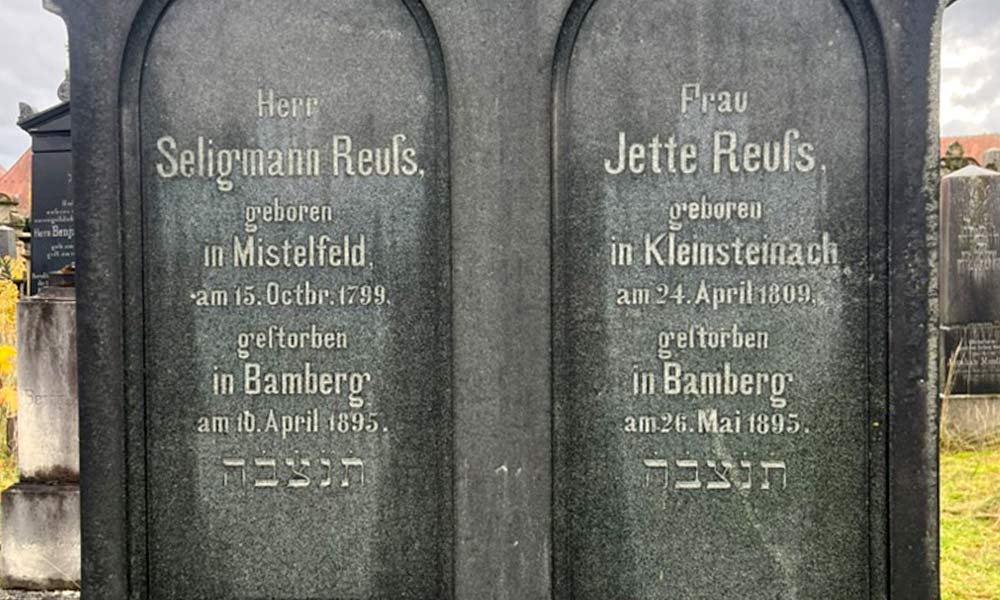
Then a shock. There they were: Yetta and Seligman Reus (Reus changed to Rice in America) the names carved on a single tombstone that recounted their long lives together. What I felt was neither vague nor mere chill. Every vertebra spasmed, as if I had brought Ben to meet his great, great, great grandparents in the flesh.
A sudden clanking noise began. Yetta and Seligman and the ranks behind them blocked our view of its source, but I could easily guess it: the gates were closing. We hadn’t signed in with the grave-keepers, after all, and it was time for them to be going home. Darkness was falling, along with a cold misty rain.
Two Jews in Germany locked inside the unscalable spikes of an iron fence! The image didn’t register until I got back to the now-chained gate next to the now-darkened guardhouse. At first it seemed funny in an absurdist kind of way. After all, we were in no immediate danger in a well trafficked place in this pleasant city. Across the street, a man leaned against a second-floor windowsill, arms folded, taking in the neighborhood scene. He seemed to understand my waves; help would surely soon be coming. What happened next seemed odd, then disorienting. Or rather, what did not happen.
That he gave no response whatsoever triggered mental images in my mind from old newsreel scenes of Nazi Holocaust transport trains. In crisp black and white, ordinary Germans looked on impassively as neighbors were loaded into freight cars. Across the street, the man’s arms stayed crossed. He didn’t even change expression.
We looked for a break in the spikes. That failing, I tried asking passersby for help, knowing many Germans speak English. Nobody stopped; few even glanced our way. A woman in blue with a daughter aged ten or so, however, signaled she would help. I watched as she knocked at nearby doors. Most didn’t open. Instead, residents spoke from their windows for more removed conversations about keys and ladders. A shake of the head and the windows closed.


Why not call the authorities? Police, I knew, would ask why two foreigners had trespassed at a place of troublesome sensitivity by deliberately avoiding the lawful entryway. Was the motive theft? Since we were Jews, possibly of religious artifacts? Questioning, I imagined, would be polite but lengthy. The woman in blue agreed, volunteering that she was Russian-born and not surprised by the behavior of her adoptive countrymen, a bleak assessment. She would stay with us.
Ben had been prowling the perimeter of our cage like a zoo animal. He now shouted from a narrow gap in the spikes. A muscular young German nearby was willing to help enlarge it. We were free.
Or maybe not. Ben seemed unbalanced by a sudden mood shift I recognized. At his age, I had had my own self-perception similarly scrambled. In 2010 a Jewish Center on the other side of Germany had organized a combination reunion and conference for and about my father’s family. It included the story of Leonie Eisendrath, our own Anne Frank, who met a similar fate. I had left feeling Jewish for the first time, and more German, too. At 40 in Dorsten, Ben had been unmoved. Now, at 54 in Bamberg, it was his turn.
“We’re doing okay and whack!” he said. “Doing okay again later and the same thing happens. For hundreds of years.” A “Whack-a-Mole” cycle, he called it, “No matter how ‘assimilated’ we are.
We had walked smack into the assimilation metaphor: Avoiding gatekeepers—literally—to slip into Jewish history as we pleased, we assumed we could also stroll out at our leisure. But at any moment an unpracticed identity can close around us with the dry rattle of chains, leaving us depending on mercy from strangers.
Charles R. Eisendrath is emeritus founding director of the Livingston Awards and Wallace House for Journalists at the University of Michigan and a former Time correspondent in Washington, London, Paris and Buenos Aires.
Top image: Tombstone of the author’s great, great grandparents, Yetta and Seligman Reus. Photo courtesy of Charles R. Eisendrath
One thought on “Sometimes it Takes a Graveyard”
I am a proud first generation Jewish American-both my parents were born in Poland. A country I will never visit- why-they are still proud anti Semits F them all
I am glad you got out of the grave area but I hope you and members of your family will think twice about visiting countries with a horrible history of killing our people
It is important to see people/countries as they are.
I feel there are 2 miracles that I am very happy about
1.We Jews still exist as a people
2. The state of Israel exists
Thank you Hashem