
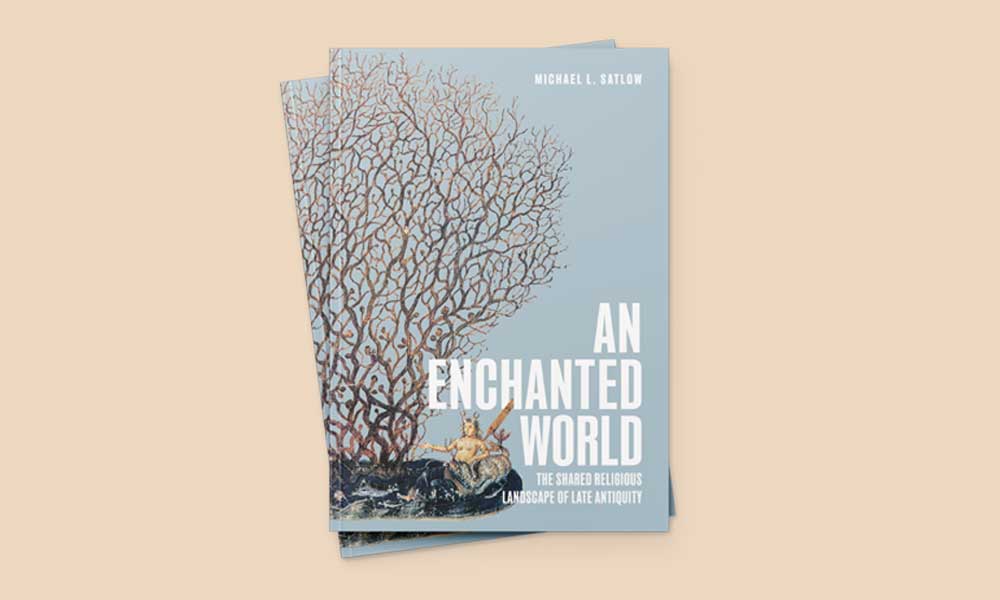
An Enchanted World: The Shared Religious Landscape of Late Antiquity
By Michael Satlow
Princeton University Press, 360 pp.
Back in the 1990s, when Yugoslavs were engaged in battles of slaughter and displacement, and the formerly Soviet republics, newly freed from Russian rule, were grappling with the balance of ethnicity and citizenship in places like Ukraine, a wise historian once described to me the profound difference between the popular journalistic take on national identity and that of contemporary academic scholarship.
In popular accounts, nationalist animosities were typically described as age-old, if not ancient. Identity was something “carved in stone.” To scholars, however, what was of interest in national identity was its very fluidity. When the past was scrutinized with scholarly rigor, freed from the blurring of time’s proverbial mists, a picture of national differences and similarities might emerge that would be unrecognizable to modern-day nationalists accustomed to summoning erroneous ideas about nationality for their own purposes.
Reading Michael Satlow’s fascinating new book, An Enchanted World: The Shared Religious Landscape of Late Antiquity, brought that caution from the 1990s to mind. The type of identity that concerns Satlow, a scholar of ancient Judaism at Brown University, is not national but religious. The landscape he surveys is not one of national borders but of the boundaries between different religious beliefs and practices in the Roman Empire in the period roughly between 300 CE and 700 CE. Those boundaries, he shows, turn out to have been far more porous than a modern reader might think—or, more to the point, more porous than the ancient world’s intellectual guardians of Judaism, Christianity and the old religions of the Greeks and Romans wanted their followers to think.
My use of the word “followers” begs the question. Rabbis, bishops and Roman priests no doubt wished the population to follow, but between demands for public obedience and compliance with those demands there was much distance. The era in question witnessed dramatic changes. Christianity became intertwined with Roman imperial authority; its newfound importance came at the expense of the older Roman modes of worship. As for the new faith’s separation from Judaism, Satlow finds the idea of a “parting of the ways” to be “ultimately not a useful one.” As he writes, “Jews and Christians, no less ‘Judaism and Christianity,’ never formed fully coherent communities. We would do better to ask when Jews of a particular community saw Christians as distinct and why, and vice versa.”

One motive for the development of a distinct “Jewishness” was Roman tax policy. The imposition of a tax on Jews after the destruction of the Temple in Jerusalem in 70 CE required an answer to the question, who is a Jew? The ancient Greek word ioudaioi, “Judeans,” was evidently an ethnic designation. A second-century Roman historian, Cassius Dio, affirmed that it described the residents of Judea but added that “it applies also to all the rest of mankind, although of different ethnicities, who affect their customs. This race exists even among the Romans.”
When bishops and rabbis excoriated necromancers it was more a question of keeping that magical talent in clerical hands than of efficacy.
In effect, Romans who forsook the Roman gods for the Jewish one gained a defined and protected legal status, paid for with their taxes. It was at this very time that the rabbis took up the question of Jewish identity. Satlow reasons that both the legalized status of converts and the rabbinically sanctioned definition of a Jew “may well have been reactions to (the) Roman legalization of (Jewish) identity.” As for the transition of Christianity from persecuted minority to a state religion, Satlow cautions against seeing the conversion of Roman temples into churches as “a sign of Christian triumphalism” but, rather, as a message of continuity: “The god may change, but the role of the god in civic life was to remain much the same.” And quite a role it was.
For Satlow, the most significant fact about the period in question is the “enchantment” of his title, the near-universal belief that the supernatural—major and minor deities, angels and demons, sources of good and ill fortune, deceased relatives—may be invisible, but is nonetheless real and subject to some human influence. He cites the Talmudic stories about a dream interpreter named Bar Hedya who, he says, may or may not have been Jewish. Two rabbis brought Bar Hedya essentially the same dream citing the same biblical verses. One paid him and the other did not.
Guess which one got the upbeat, hopeful interpretation of the dream? When the non-paying rabbi figured this out and paid for a subsequent dream to be explained (again the same dream as that of his fellow rabbi and fellow customer) his fortunes improved.
Bar Hedya’s business practices notwithstanding, the Talmud discusses the use of biblical verses to mitigate bad dreams and presumably foretell better outcomes. It was assumed that magic worked. When bishops and rabbis excoriated necromancers, those who claimed to raise the dead, it was evidently more a question of keeping that magical talent in clerical hands than one of efficacy. Necromancy, fortune telling, astrology and the interpretation of dreams may have drawn criticism from rabbis and priests for how, when and where they were used, but their power was not in question.

The perceived throngs of supernatural, invisible beings possessed of varying powers render the distinction between monotheism and polytheism less than helpful, Satlow says. Greeks, Romans, Jews and Christians believed in them:
While the intellectuals fought about which of these beings could really be called “gods” and which came under other designations (e.g., “angels” or “spirits”) the fight was largely academic. For most people, what mattered was to figure out which beings did what, which ones could help and which ones could harm, and how to effectively communicate with them.
While the intellectuals’ polemics may not have swayed many people, they, and not the odd mix of spiritualism and pragmatism described above, have come down to us as the authoritative description of what was going on. The rabbis and priests had the benefit of literacy; the author goes with the estimate that only three to five percent of people could read a contract or an official document. That small minority consisted largely of men whose families could afford to have them educated and whose livelihood largely came from service to the authorities of their communities. The history we are left with from such sources is the story told by the victors.
Satlow writes with an appealing humility, as likely to tell us what cannot be known about life in late antiquity as what can. While reading his book, I have found myself questioning my own assumptions about the beliefs of people in today’s highly secularized world. A 2023 poll by AP-NORC found that 69 percent of Americans say they believe in angels and 56 percent say they believe in Satan. Donald Trump attributed his 2025 survival of an assassination attempt to God’s determination that he should resume his effort “to make America great again.” Many of his supporters evidently agreed. The poet Christian Wiman wrote in Harper’s Magazine about the spiritual world we intuit with the right brain, only to learn to suppress that knowledge in the analytic tyranny of the left. Wiman writes of AI as a system, built on mathematics and analysis as opposed to intuition and feeling. “What,” he asks, “is AI but the apotheosis of left-brain lunacy?”
The cynic in me expects a backlash—perhaps a wave of books about the hereafter, as intuited with our right brains or as sampled in near-death experiences—as my pig-in-a-python demographic cohort, the post-World War II baby boom, sees its former stars of the front pages migrate to the obits. Ruminations on mortality should have a built-in demand in the coming years, given the boomers’ natural interest. If so, Satlow’s book is especially timely, a reminder that what we believe and what we are said to believe are not always the same.
Robert Siegel is Moment’s special literary contributor.
Moment Magazine participates in the Amazon Associates program and earns money from qualifying purchases.