
The following story won First Place in the 2025 Moment Magazine-Karma Foundation Short Fiction Contest, which was founded in 2000 to recognize authors of Jewish short fiction. The 2025 stories were judged by Joan Leegant. Moment Magazine and the Karma Foundation are grateful to Leegant and to all of the writers who took the time to submit their stories. Visit momentmag.com/fiction to learn how to submit a story to the contest.
We are in the station wagon driving north to Niagara Falls. The border is seven hours away and after crossing the George Washington Bridge my father announces we’ll make one stop in about three hours. Sam and I roll around in the back of the car. Sam is twelve. I am ten. This is the 1960s. The seat belt law is years in the future.
There’s a faint smell of metal and cardboard from the car parts that fill the back during the work week. Alternators, filters, hoses, brake shoes, fuel pumps, mufflers and more. Sometimes on Saturdays my father delivers parts himself. Then Sam and I ride with him to gloomy garages near the Hudson. Bored with the cargo area, we tip forward into the back seat and sing camp songs. “There’s a hole in the bucket, dear Liza, dear Liza, there’s a hole in the bucket, dear Liza, a hole.” We go through all the rounds. Then we tickle each other. Laughing, pushing, it doesn’t take long before we’re fighting. Sam threatens me. I spool between hilarity and fear. His fist enters my back. I shriek. He laughs.
From the front passenger seat, an enormous hand comes crashing in. It hunts flesh, finds Sam’s face first, then my thigh. Grab. Twist.
“Stop before I give you a real reason to cry.” The hand withdraws.
I cry quietly and rub my thigh. Sam stares out the window. I peek over at him. His cheek is red from the hand, from its ring with a small diamond and lethal claws. The car is quiet. I squeeze into the door. Small. Smaller. Smallest. Hands can’t find me now. Then my mother breaks in loudly.
“איך האָב דיר געזאָגט, אַז ער נעמט דיין טאַטע אין באַנק און נעמט אַרויס דאס געלט.”
Anger in Yiddish scares me. It sounds as if it’s about to go off the rails and fatally smash into bystanders. I wait for my father’s answer, in German, since he doesn’t speak Yiddish, though the languages are close enough for them to communicate. My father says nothing. The pause in the front seat is anything but calm.
“איך האָב דיר געזאָגט און דו טוסט גאָרנישט.”
My mother repeats herself. My parents revert to Yiddish and German when they don’t want us to understand since they can’t switch to Hebrew. We’re already fluent in that language. But we also understand Yiddish and German and don’t reveal it. This is how I know my mother just said something about someone who went with my grandfather to the bank to take out money. And how my father does nothing about it.
Knowing these languages gives Sam and me a secret heads-up on things, though right now we’re headed north to Canada, to Niagara Falls, for a family vacation, and everything’s pretty good. And it will be better once we’re next to the biggest water flow rate in the world, our father said when we brought our bags to the car. Between four and six million cubic feet of water per minute. I cannot imagine those numbers. I don’t know what a cubic foot is. But I know this means a lot of fast-moving water. Alotoffastmovingwater.
“Er darf mit meinem Vater zur Bank gehen. Das heißt nicht, dass er sich Geld genommen hat.”
My father’s response in German is not angry. It’s his usual: Here are some words, hopefully the right ones, to make this conversation go away.
I look out the window. My left ear turns to the words coming from the front. Okay, they’re talking about my father’s father who went to the bank with another “he,” who could only be my uncle Moe, the warm generous jokey Moe but apparently also a cheat. At least according to my mother. According to my father, just because Moe went to the bank doesn’t mean he took out money for himself. I concentrate hard to follow the conversation. This is interesting.
“ער טוט דאָס יעדער מאָל ווען ער איז אין תל אביב. און דו טוסט גארנישט. ער גנבעט פון דיר. ער גנבעט פון דיין אלטער טאטע.”
Sam has also tuned in. We grin at each other. My mother’s pitch rises.
“ער איז אַ גאַנעוו. שולדיק יעדן געלט. דו אויך.”
“Ich würde mit ihm reden. Ich möchte jetzt nicht darüber sprechen.” My father tilts his head discreetly towards the back seat. He doesn’t want to talk about this now.
We’re a good enough reason not to talk about uncle Moe now. Not that my father will want to anytime in the future either. But that doesn’t matter. My mother wants to talk about him now. She loves to talk about Moe. To fight about Moe. To call him names. The evil midget. The liar. The show-off. Now the thief—who knew?—who owes us and everyone else money and my father isn’t doing anything about it, even though he said he’ll talk to Moe about the bank visits. Discussion over. Head tilt to us with suction ears in the back.
Vacation or not, the fight is brewing and the sharp edges of my mother’s words are warning shots. When she wants to fight, nothing stops her.
“איך בין קראַנק פון דיין ברודער און זיינע ליגנס. ער פֿאַרניכט אונדזער לעבן.”
Sam winks at me. Here it is. The Moe fight.
“I’m sick of your brother and his lies,” Sam whispers to me in English, quickly, so our parents can’t catch the words. Even after fifteen years in the country, rapid speech or a slight accent throws them.
“Moe,” Sam whispers into his armpit. “Lies.”
“Stealing,” I add.
“ער פֿאַרניכט אונדזער לעבן,” we sing operatically and burst into laughter. Uncle Moe destroying our lives.
This time not a hand but a full-body twist comes our way. I’m not sure whether she has heard us, but it doesn’t matter. Noise, laughter, joy from the back seat is enough to provoke her. She leans over the front seat, launches toward us and screams, this time in Hebrew, that she knows we understand.
“תשתקו!!”
And we do. We shut up and place our faces close to the windows to show that we know she means business. She can retreat now. But she’s not satisfied. She needs more. Sam’s ear gets smacked with her right hand and my left hand gets squeezed so hard I am sure she’s going to break its bones.
“Ayyy!” I yell.
“What’s going on?” my father asks, his eyes fixed on the road, his hand searching the dashboard for a pack of cigarettes. His head of grey hair doesn’t move right or left.
“Nothing.” My mother turns and drops back down into the front seat. “Sam hit her. I had to separate them.”
“What?” Sam says. “That’s a lie.”
“Don’t speak to me like that.” My mother begins to rise again, the monster emerging from her depths.
“Find me the matches.” My father distracts her with a task.
I slowly crawl back into the cargo area, out of her reach, and lie down. I wish I could read, but I get car sick easily. At home I have my books and little room to hide in between school and supper. Sam and I eat alone. My father doesn’t come home until much later. Much. Later. And my mother, who’s been home for hours from the nursery school where she assists, never eats with us. In fact, we rarely see her eat, which is strange because she’s big. And strong. She leaves us until she hears laughter or loud talk. Then she barges in, and like a tank turret, slaps tatata tatata our heads, faces, and screams we’d better shut up or she’s going to kill us.
“America, you wanted. America. Everyone at home lives better than us working like dogs and no vacation.” She barks at my father in the front seat.
“We’re on vacation now, no?” he asks calmly.
“Two nights in Canada. Great. I hate water, you know that. Niagara Falls. More water than we know what to do with.”
I fall asleep in the cargo area and Sam nudges me awake when we get to the rest stop. My father needs a coffee and a stretch. We all go to the bathroom and Sam and I are allowed to buy one piece of candy each. I choose Milk Duds and he gets an Almond Joy. He’ll eat his two soft gooey pieces quickly and then will make moves on mine. Milk Duds are hard and chewy and take time to finish. There’ll be another fight. Another fist. Another pinch, twist and slap. I can’t wait to not be ten anymore. When I’m eighteen I’ll leave them all forever.
Back in the car, Sam and I start singing, “One hundred bottles of beer on the wall, one hundred bottles of beer, if one of those bottles should happen to fall, ninety-nine bottles of beer on the wall. Ninety-nine bottles of beer on the wall, ninety-nine bottles of beer…” and so on until we get to zero. That takes up a nice chunk of time. Two hours from the Canadian border we play the license plate game.
“New Jersey!” I yell out.
“Big deal. We’ve been seeing them the whole trip.”
“Maine!” I yell out.
“No way,” Sam says.
“There.” I point to a grey truck on our right.
Sam throws himself on top of me to look out my window. His elbow sinks into my stomach.
“Get off!” I push as hard as I can, but he is bigger and stronger and I have to make maximum effort with minimum noise so our mother won’t notice.
Sam doesn’t budge. “Oh yeah, Maine,” and grinds his elbow into me even deeper when he peels himself off. “Ohio, up ahead, eleven o’clock.”
But I’ve stopped playing. I don’t want to play with him now or ever again. It’s twilight by the time we get to the Falls. We cross into Canada and go in search of a motel.
“Holiday Inn!” I call out.
“Too expensive,” Sam mutters.
My parents don’t say anything. I feel bad. I know how hard they work. I should have kept my mouth shut like I usually do.
In the morning we leave our small motel and drive twenty minutes to the park entrance. I jump out of the car and run toward the water’s rumble. It’s going to be a great day.
“תפסיקי!”
My mother yells, so I stop, though it’s hard to stand still. Luckily it doesn’t take long for my parents to organize the food bag and camera. And we’re off. The roar gets louder. Sam and I lean over the railing separating us from the mighty chasm. We are awed. My mother holds on to the railing so tightly her knuckles turn white. My father comes back from somewhere with tickets. We are going into the tunnels. Sam and I smile at each other. A good day’s getting better. Thrilled, we go down a staircase and then into a room to gear up in long black raincoats with hoods and black rubber boots. My father lines us up and snaps a picture. His three penguins, he chuckles.
An elevator takes us down through the rock to a large semi-circular deck beside the thunderous water that covers us in mist and droplets. Sam and I stare directly into the wet white thunder. A wave of nausea rises in me. I step back to lean against the slick tunnel wall.
The deck fills with people. The water rushes down, down, down, crash, crash, crash into the river basin below. My father tugs at my sleeve and indicates we are moving. I follow into the tunnel directly behind the furious curtain of water. Thunderous vibrations invade the body. Is this like the eye of a hurricane? A place of relative stillness so close to wild movement? My father puts his arm awkwardly over my shoulders. Awkward because of the bulky raincoats.
I press against him and smile. I am happy. He smiles back. He is happy. I knew this would be a great day. Sam creeps toward the opening of the tunnel. My mother watches him and when he is a few footfalls away from the railing, she grabs his raincoat. He backs away slowly.
No one wants to leave. There is peace in that rock where it’s almost too loud to speak, where the water is so powerful it dwarfs everything but survival.
“Leave it up to Canada and America to engineer this space,” my father says loudly, full of admiration for his adopted country.
Space in the vortex. Safety in the middle of great danger. Oh, America. Land of patents. Cars, movies, the Statue of Liberty and her poem welcoming people from all over the world. People like my parents who entered from Israel on the German quota.
We watch the water fall and fall and now I begin to understand what millions of cubic feet means. A lot. More than a lot. A whole lot. An amazing lot. A fantastically exciting and perilous lot.
Later that night, after we return to our motel room and shower and change, we go out to eat. Our second and last night in Canada. Early the next morning we need to begin the seven-hour drive back to New York City. My father has to open the shop by seven a.m. on Tuesday after this rare three-day weekend. Long hours, every day, six days a week he’s at work making sure there’s money coming in. We have no safety net here. Everyone who really cares about us is in Israel.
We are hungry and dinner is festive. We order pizza and cola and laugh remembering how funny we all looked in the black raincoats, hoods and knee-high boots. My father looks relaxed. My mother is munching on her pizza. Our vacation is a success. I am glad but remind myself to not get too excited. To not be lulled. At any moment it’s liable to be ripped away.
“I read that ‘niagara’ comes from the Mohawk word for neck, that’s Indian,” Sam says as he reaches for another pizza slice.
“What Mohawk? Now you’re an Indian?” my mother laughs and we laugh with her.
“The Indians called it that because of the way the land connects…”
“I once saw an Indian on Broadway, down on 181st by Chock Full O’Nuts, you know how much I like their coffee. With Ricky.” My mother reaches for another slice of pizza. “We had coffee and egg salad sandwiches, waiting for you kids at the dentist. He stood on the corner across from Loew’s, feathers sticking out everywhere and leather pants…”
“Or it might be Iroquois, something…” Sam persists. “No, Mohawk.”
“We couldn’t believe our eyes. An Indian man, tall and handsome, like out of the movies, in Washington Heights.”
“Something about land cut into two…”
“Be quiet, I’m telling a story,” my mother snaps at Sam. “And Ricky wanted to talk to him, and we almost did. I’m not shy. I could go up to him and ask how he is. I know what it’s like to be different. I know what people think of me here. With my accent. My whole life has been hard. From the time I was fourteen I worked and took care of my brother when my mother was at the factory. We had nothing.”
Sam stares at her with scorn. My father stares at Sam and hopes he will let it go. I look at my father and then at Sam and then back down at my plate. I chew the remaining pizza slowly and deliberately, focusing on the mechanical grind of crust between my teeth. It helps dilute the flood of words and laughter rolling out from my mother’s mouth.
In the morning, she packs our things, and our father loads the bags in the car.
“We’ll eat breakfast after we cross the border,” my mother says, glancing backward to make sure we’ve heard.
Sam and I nod. I am still not fully awake, not yet hungry, and try not to think of the many hours in the car. My father pulls out of the motel parking lot and we are off. We are glad. It has been a good trip. A great trip. Niagara Falls is glorious and our petty wrangles pettier in its presence. We drive to the border and get in line to cross.
“Passports?” my father asks my mother.
She looks for them. First in her purse. Then in the plastic bag at her feet with the apples and cookies we didn’t finish on the drive north.
“They’re not here,” she says. “I don’t know…”
“I need them.” My father puts out his hand as our car inches forward toward the crossing.
My mother opens the glove compartment and looks through some papers. The car before ours goes through the border, and when we don’t move, a gap is created. A border policeman comes toward us and signals for my father to move forward. My father rolls down the window.
“We’re looking for passports.”
The policeman looks at my father. Looks into the car at my mother who is going through her purse again. He glances into the backseat at us. Policemen scare me. Another moment passes. My mother looks up frantically.
“Where are they?” she screams.
The policeman straightens his body and points to the shoulder.
“Là-bas.”
My father looks at him and doesn’t move.
“Là-bas. La voiture.”
“מה הוא רוצה?” my mother screams in Hebrew.
“תשתקי,” my father growls at her to shut up.
Sam lets out a deep sigh and stares out the window at the policeman.
“English?” my father asks the policeman.
“Français.”
“We’re looking for passports, bitte.”
“Français, s’il vous plaît.”
“Français,” my father whispers and stares up at the car ceiling patterned with geometric dots that almost look like stars.
“מה?” my mother snarls.
Her what makes me shrink down in my seat. My head is going to burst.
“He said to move the car over there,” I say.
Then my father understands and drives to the shoulder so other cars can continue through while we look for the passports.
My mother searches through the bag at her feet a second time. My father gets out of the car and with a bang swings open the tailgate. I turn around and watch him unzip one bag and remove things, item by item. He moves slowly to contain whatever it is that is pushing hard against the muscles of his face. My mother joins him and starts ripping through another bag, her rage quickly gaining strength.
“It’s your fault,” she stares up at me. “You lost them.”
Her words kick me in the stomach. No air. I can’t breathe. I can’t live.
Sam twists in the seat to face her.
“Her, not you. She lost them. She was playing back here. What did you do with them?”
My father looks up briefly and gives me a rare look of utter and total derision. Because of me we’re stuck in Canada and he won’t open the shop tomorrow. Because of me we’re going to spend the night in jail. Because of me we’ll never reenter the country that offered refuge and opportunity. Me. Me. Me. Me. And only I seem to know that my mother never gave me the passports. Why would she? I’m ten years old.
They go through two bags and start on two more.
“אני אמות כאן,” my mother says, predicting her death, here, now, on this border.
I perk up with hope.
“Only English,” my father commands her. “We’re American.”
“She’s always making trouble,” my mother snarls to herself. “Trouble from the beginning when I had to lie in bed for months. Bleeding.”
“We’ll find them and go home,” my father’s voice is matter of fact, not loud, but he looks scared. Is he thinking of the German crossing in 1933?
All four weekend bags…no passports.
“Out of the car,” my father says behind clenched teeth.
Sam and I jump out. He starts searching under and around our seats.
“Tell him we can’t find them. Tell him.” My mother pushes me toward the policeman. “Tell him we need a few more minutes.”
I am terrified.
“You know French.”
“I don’t know French,” I mumble.
“You do.”
My father and mother surround me. Helpless giants. Like Niagara, their noise thunders down around me.
Tell him.
Ask him what to do.
Explain the situation.
We’re Americans.
We just want to go home.
Sam watches. But he won’t or can’t help.
True, I am learning French in school. Started in third grade. I know how to say window and door and please and thank you and my name is and how are you and in fact I know many words. I am good at languages. But at this moment I can’t remember anything but Je suis une petite fille.
“Go, tell him.” My father urges me, looking like he’s about to collapse.
I start crying.
“They have to let us in. They can’t keep us out…” my father whispers, his German accent drenching the English words.
“Be quiet,” my mother hisses at him. “This is not Europe. לכי,” she screams.
“I can’t.”
“Go!” she screams this time in English.
I go. I, who barely ever speak, even at school, who is taunted for being shy, who’s learned it’s best not to speak in a household full of roars.
The policeman watches me approach. I feel like one of those tightrope walkers from a hundred years ago that I read about in our encyclopedia. They crossed near the Falls while hundreds cheered them on. My favorite is Maria Spelterini. The only woman to do it. Once she wore peach baskets strapped to her feet. Another time her wrists and ankles were tied together. And she even did it blindfolded.
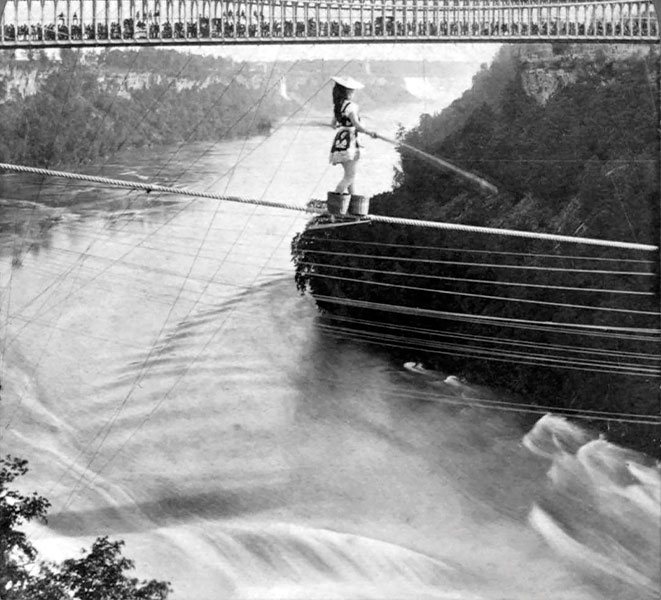
Maria Spelterini, the first and only woman to cross Niagara Falls on a tightrope, July 8, 1876.
“Monsieur,” I say softly, not knowing what to say, or how to say what I am expected to say. I am afraid of the mantle of responsibility thrown on me by parents who obviously can’t take care of me in this world. I look up at his big face, his big hat, and tell the only truth I know at this moment. “Monsieur, mes parents ont peur.”
With his hand he indicates that the next car in line should move forward. He looks down at me, I think, waiting for more information.
“Effrayés.”
“Oui. My parents are afraid.”
“Dites-leur de prendre leur temps et de chercher soigneusement. Les passeports sont probablement dans la voiture.”
“Merci,” I say quickly, not totally understanding, though I get the smile and tone. He isn’t upset or angry.
Carefully I cross the road, back to the shoulder where my family waits. Their fate in my hands. My shoulders sink. My mother’s arms are crossed against her chest. My father’s hands deep in his jacket pockets, balled into fists. I know he is thinking that no one will keep him out of his country. Sam is enjoying watching me implode from the gravity of the situation. No doubt he’ll make much of this in the coming weeks. Merci, monsieur, he’ll mock me. Merci, he’ll make twisted faces and howl that that’s how I looked talking to the policeman. And I won’t have the nerve to say why me, why not you, two years older, two more years of French class, of Bonjour, Mademoiselle Melamed. Bonjour les enfants. Comment allez-vous?
I stand in front of my parents on the edge of falling and can’t find words. My mother’s deep-set black eyes bore into mine. My father stares a few inches above my head.
“What?” my mother shouts into the one second, then two three four seconds of silence. “What did he say?”
Luckily words appear. “He said to take our time and search the car better.”
“We searched. They’re gone. You lost them.” She grabs my arm and squeezes. I look at my father. Won’t he do anything? But he is seething with his own terrors and turns away to search the car again. Sam grins.
“Merci, monsieur,” he says. “Merci merci merci.”
The Falls are so loud but not loud enough to drown out Sam and my mother.
“Stop it,” she says and lunges for him. He steps to the side and she stumbles when her body meets air, not mass. She recovers and with both hands slams Sam into the car. He swallows the pain of shoulder meeting metal and runs into the back seat to get away. He sits hunched over, pretending to be busy, to search so she won’t come after him again. He’s scared. Or maybe not. Maybe he’s really helping.

My mother stares at me like she stares at the children in the nursery school when they get on her nerves. Not a shred of tenderness. For me, the days she works late are the best. I let myself into the apartment and have some quiet time without fear. On other days, I pause by the front door, key in hand, and listen to pick up clues about what’s going on inside: Which mother is there today? The funny joking one; the angry raging one; the one who hugs, the one who slaps; the depressed one in bed who can’t tolerate a smidgen of noise but also has no interest in others (fine by me); or the one who quizzes me about everything I did that day and with whom, and what happened to the other three points in the vocabulary quiz I just got back? Why 97 when it could have been 100? She’s kidding, she says, but not really. I’m never good enough. No one is.
I look away from her hateful stare.
“You are going…” She takes a step toward me. I make myself smaller leaning against the car. Smaller means easier to miss. But suddenly, her body loses all tension. “I want to go home,” she whimpers and covers her face with her hands. By home, she doesn’t mean Manhattan, but Tel Aviv. “I want to go home. הביתה.” And I have an image of myself suddenly living a different life. Wearing short shorts to school and playing soccer with the kids on the street.
“We’re going to leave you here when we cross the border if we can’t find those passports.” In a flash, she shifts gears.
I begin to shake. The abyss opens up before me.
My father emerges from the car waving. In his hand, four blue American passports. My mother runs over.
“Where?”
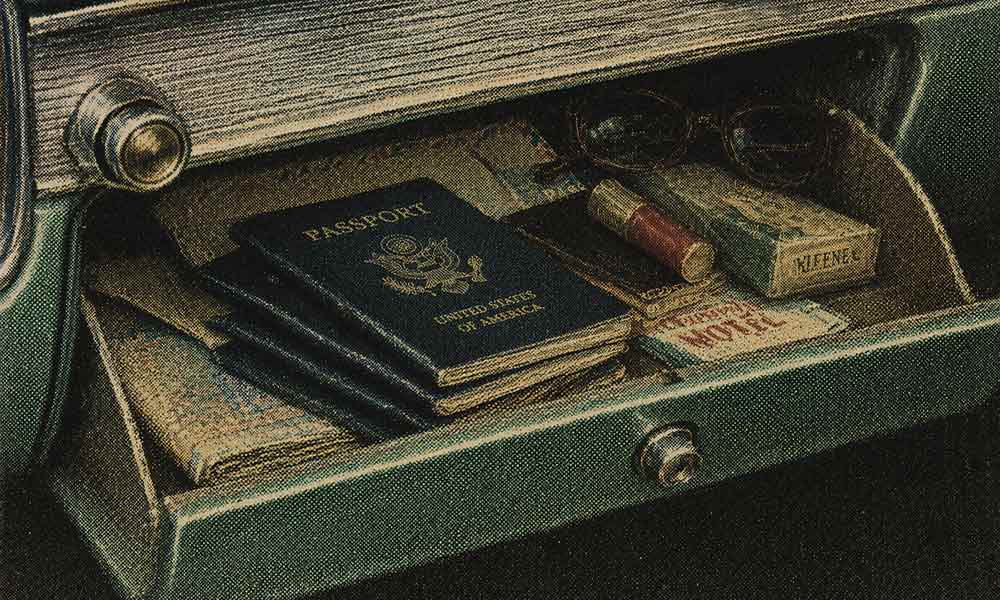
“Glove compartment. You didn’t search well.”
“Don’t talk to me like that,” she sneers.
“I’m just saying the obvious.”
“It’s because they got me angry. I can’t stand their noise. They fight all the time.”
“We didn’t make any noise,” Sam said, emerging from the car. “You just didn’t look enough and always blame us.”
My mother grabs his arm and starts to twist it. In front of our father for the second time? She, who is so careful that no one sees how she hurts us? I can’t believe it. Sam yanks his arm away from her grip and grabs her wrist and squeezes.
“You like that? Touch me again and I’ll break your arm,” he says and starts to twist it behind her back. He has never been so bold. It must be because our father is there, witnessing everything. Finally.
“Ow, you’re hurting me,” my mother cries out like a child.
My father grabs Sam’s hand and pulls it off my mother’s wrist.
“Enough. You made your point.”
“You know nothing,” Sam says. “And don’t want to know.”
“מספיק,” my father says. “Enough,” he adds in English for emphasis. “Get in the car.”
He’s also afraid of my mother. I wonder if she hits him too. With her hands. With words for sure. I hear her hammering away at him at night before I fall asleep.
I run and climb into the cargo area of the station wagon and hope Sam stays in the back seat. I don’t want him near me. I want to be alone, to be quiet, to forget about what just happened. I want to slip into the movie reel in my mind where I am in a different life, a different house, different parents, native English speakers, calm, considerate, not blaming a child for every bump in the road.
My father waves the passports at the policeman. He nods and gestures that our car should enter the line. As we pass through what looks like the toll booth on the George Washington Bridge, my father hands over the passports. The officer barely glances at them.
We cross and I put my hands in prayer position over my heart. We are safe but I know, really, that I’m not.
“איך וועל קיינמאָל מער נישט קומען קיין קאַנאַדע. מיט זיי.”
My father says nothing.
Fine, she doesn’t want to ever come to Canada again with us. I don’t ever want to go anywhere with her again. Ever. Ever. Ever.
There is disgust in her mouth when she says the word: zey. Sam and I are the “them.”
“דו האסט גארנישט צו זאגן?”
You have nothing to say, she asks? After all that just happened, she still wants to fight.
“Ich habe dich gehört. Es reicht.”
He says he heard her. It’s enough now.
But it’s not enough for her. Not Canada. Not the kids. Not Moe ruining their lives. ער פֿאַרניכט אונדזער לעבן. She is about to launch into the rant.
Shaking slightly from cold and fear, I lie in the cargo area of my father’s American station wagon and pull a small blanket over my body. Through the long side window, I stare up at the tops of quickly passing road signs. Welcome to New York flashes by against a blue-sky backdrop. I close my eyes and picture myself leaning into Niagara’s fast furious drop. Leaning, leaning, leaning, I fall asleep.
2 thoughts on “Short Fiction | ‘Niagara Falls’”
A haunting, terrifying story. Perfectly written.
This is a shocking, funny, tragic, hopeful story. Hopeful only because we know the narrator will survive. How was this story born? I’d love to know.