
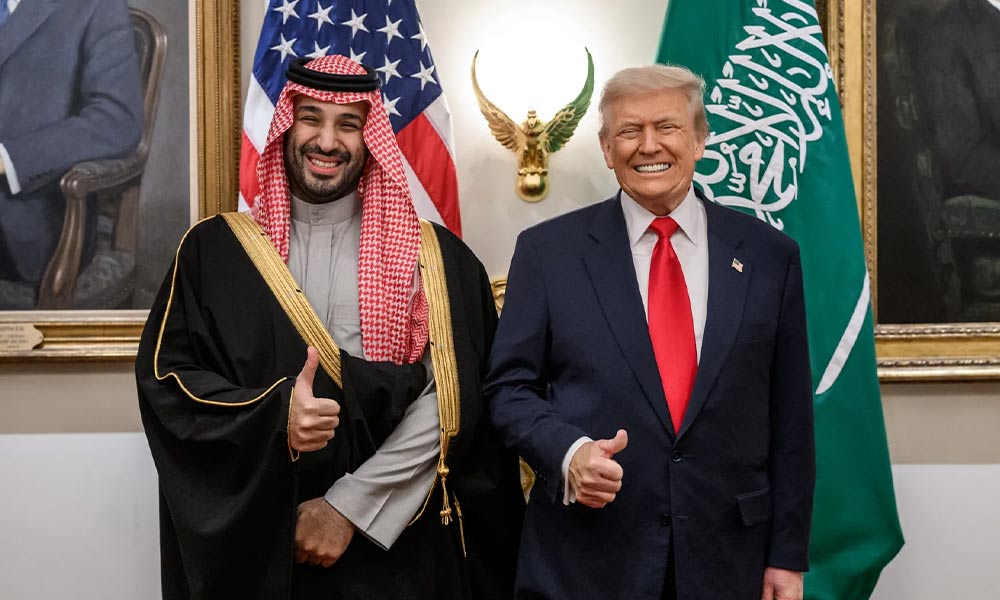
This excerpt is part of Friday’s MomentLive! conversation “Shifting Sands: Saudi Arabia, Israel and America’s Changing Middle East Strategy” between Middle East expert Aaron David Miller, who is a senior fellow at the Carnegie Endowment for International Peace, and Moment Special Contributor Robert Siegel, former senior host of NPR’s All Things Considered. Watch here at MomentLive!
Robert Siegel:
Well, we have quite an interesting situation that’s developed in the past few days with the White House announcing a nuclear deal with Saudi Arabia, then adding the condition, after it was already signed by the two countries’ energy secretaries, that Saudi Arabia would have to normalize relations with Israel. This would be extremely strange in nearly any other administration I could imagine. What’s going on? Why does the U.S. want to have a nuclear deal with Saudi Arabia? Do the Saudis want it so much that they would normalize relations with Israel?
Aaron David Miller:
Why the Saudis would be interested in this seems pretty elemental to me. They’re hedging, because they’re very close in proximity to Iran, and geography is destiny in the Middle East. Iran is a latent nuclear weapon state, even after the June 25 strikes against its nuclear infrastructure and the current Operation Epic Fury, which may in fact resume again. They’re dependent on the U.S. for their defense. There’s no question about that.
But Mohammed bin Salman (MBS) is pursuing a 360-degree foreign policy. He’s very close to the Russians. Very close to the Chinese. And MBS has said repeatedly that if the Iranians get a nuclear weapon, then [the Saudis] will need one, and they will get one. The Biden administration was prepared to use the idea of civil nuclear cooperation with any number of asterisks to allow the Saudis to control their own fuel cycle, and basically either reprocess spent fuel or enrich uranium, which is the problem, of course. And with the first step in producing a nuclear weapon, they were prepared to link this to what then, pre-October 7, appeared to be the real possibility of Israeli-Saudi normalization.
I thought the idea was a bad idea then. Even with Israeli-Saudi normalization, which improved the idea, but now it’s even worse. Trump is a transactional president who, frankly, doesn’t care about a brutal, repressive, authoritarian regime, who is interested in ginning up the American nuclear industry. Clearly, this would mean billions of dollars if the deal goes through.
The amount of self-dealing and corruption in this administration is extraordinary.
At any rate, the deal would have allowed a contractor, probably Westinghouse, to build the reactor, and at the end of the two-year study period, there would be a conclusion reached jointly, presumably by the U.S. and Saudi Arabia, as to whether or not Saudi Arabia needed an indigenous capacity to enrich uranium. Then, if the answer was yes, the U.S. and Saudis would build a black-boxed, term of art, joint enrichment facility, which would be monitored and supervised in some fashion by the United States, so the Saudis would not be able to, in an undeclared way, enrich uranium, or look at the other elements of what it takes to actually make a nuclear weapon.
There is no—I repeat, no—commercially civil nuclear justification to allow the Saudis to enrich uranium, even under American auspices, other than the obvious, which is to take another step toward the possibility, if they needed to do so, of constructing their own weapon. We have denied the South Koreans their request to basically enrich uranium domestically, and they are a treaty ally of the U.S. They are a democracy. They are not a brutal authoritarian regime who are cooperating intimately with the Russians and the Chinese. So, to me, this is a very bad idea. It undermines decades of U.S. nonproliferation policy.
It is emblematic, I think, of the way this administration thinks about many things—Gaza, the memorandum of understanding with the Iranians—it’s highly transactional. No one’s thinking through the consequences, the implications of what it would mean, and the bad precedents that it sets.
The wrinkle in all this, of course, which is also emblematic of the dysfunction and the national security decision-making of this administration, is that the president has basically said, and Caroline Leavitt has amplified this, that there will be no deal unless Saudi Arabia and Israel normalize. The prospects of that happening right now…it’s an idea that is tethered to a galaxy far, far away, rather than to the realities back here on planet Earth.
Robert Siegel:
You have voted for and served both Democrats and Republicans, and you’re no stranger to negotiations. How unusual is it to negotiate an agreement, have it signed at the cabinet secretary level, and then announce a pretty significant condition for the deal that you just signed?
Aaron David Miller:
Look, I worked for administrations from Jimmy Carter to Bush 43, and Obama and Biden. There’s no precedent for this.
Robert Siegel:
No precedent.
Aaron David Miller:
I’m even thinking back to negotiated agreements we then didn’t sign, or the Senate didn’t ratify, but there’s never been anything quite like this on an issue that is so important. And paradoxically, or maybe it’s ironically, the fact that the president is prepared to walk away from this, frankly, is a positive endorsement. I’m not sure he’s thinking about our non-proliferation policy this way. The Wall Street Journal published an editorial saying that if Lindsey Graham were still alive, he would have been on the phone with the president, telling him he couldn’t do this, that you can’t give up your leverage on this for nothing. What are you getting? You’re getting billions of dollars of Saudi money invested in something the president thinks is important, which is a reinvigoration of the American U.S. nuclear industry.
I think he heard a lot of pushback, a lot of unhappiness, and then made this decision. Now this decision does not kill the deal. The deal is now signed, and according to the 1954 Atomic Energy Act, Section 123, I think, talks about a 90-day period once this agreement is signed or submitted to Congress, where the agreement would go into force if Congress would not or could not pass a joint resolution majority, I think two thirds in the House and the Senate, to oppose the accord, so it is now on automatic pilot. The president may decide not to submit it to Congress. He could let it sit. He could figure out something with the Saudis that isn’t normalization that creates some language about a pathway. I mean, I’m just throwing stuff against the wall here, but it’s dysfunctional and it makes the U.S. look bad. This was a deal whose time, in my judgment, has not come, and sets a very bad precedent on a very important issue.
Robert Siegel:
Have you read, heard, or do you assume that Israeli leaders were informed of the agreement that the U.S. had cooking with the Saudis on nuclear? And does Israel feel betrayed or downgraded in importance to Washington by this approach to the Saudis?
Aaron David Miller:
I think the second Trump administration has brought about a remarkable change from the way any previous Republican or Democratic administration has dealt with the Israelis, such as starting a direct dialogue with Hamas, about which the Israelis learned after the fact, and concluding a ceasefire with the Houthis in 2025, over and above Israeli objections. I heard President Trump say the other day, “I’ll talk to Hezbollah, I’ll talk to anybody,” and frankly, I believe it. Vice President JD Vance has already met with Mohammed Gallibaf in Switzerland, and Glalib, former mayor of Tehran, is associated as much as any, with a crackdown of dissidents in Iran. So, the no-surprise policy—which we abided by (more or less) in the Democratic and Republican administrations I worked for—has been violated so many times.


This agreement has been cooking for quite a while, but I think the Iran war delayed it. It was probably ready for prime time in February, and I think the administration would have preferred that it go forward, so that he can preside over what I think is his inclination, which is to let the Saudis under U.S. auspices enrich uranium. The two-year period was picked specifically to make sure that the Trump administration had a say in the conclusions of that two-year study, which is supposed to provide a decision point as to whether or not Iran will be able to control its own fuel cycle under U.S. supervision or auspices. So I think the Israelis were dismayed. I’m sure they were aware that this agreement was about to be previewed. I think the Trump administration has denied the fact that the Israelis complained, and this is why Trump walked it back with the normalization piece of it.
Robert Siegel:
How could that wisdom have eluded the planners of the war if indeed they were convinced that within months the regime would crumble under the strength of air strikes?
Aaron David Miller:
I think that Donald Trump was inclined to accept the fact that Netanyahu was again offering him a historic opportunity in June. In the June War, Trump became the first American president, Republican or Democrat, to strike Iran in nuclear sites to do significant damage without a major escalation. He killed Qasem Soleimani in January of 2020, head of the Al Quds Committee in the IRGC, without a major regional war, in Venezuela, he I think succumbed to recency bias, that the power of the U.S. military was so great that a massive display of American missile, naval assets, and air power would basically find Venezuelan Vice President Delcy Rodriguez in Tehran, and the Israelis fed this by basically saying the regime was brittle. The Kurds, who they were supporting, would provide internal support. And as my colleague at Carnegie, Karim Sajjapoor, says, Trump didn’t find a Delcy Rodriguez. He found an Iranian Kim Jong Un—and not just one Kim Jong Un but several. Now he’s confronted with a regime that has survived what many people thought it might not.
So now the president finds himself in the position of spending billions of dollars to open the Strait of Hormuz, which was opened before he went to war. I guarantee you, had the Iranians not overplayed their hand, wanting to turn the Strait into an ATM machine, the deal in Trump’s mind was: we’re going to remove the blockade, which they did. We’re going to have a ceasefire, which they did. We’re going to allow the Iranians unsanctioned oil, which they did. And in exchange, the assumption was the Iranians would have opened up the Strait. Had that happened, I think Trump would have found a way to walk away from this.
They would have engaged interminably on the other issues, including the nuclear issue, and there probably would have been no resolution of that. Maybe there would have been, but this was all very much like Gaza; a phase one and done. I mean, Trump got the hostages out, ended the war along the lines the Israelis had waged it. There’s horrible food insecurity, problems with sanitation, potable water, medical care in Gaza. But you don’t hear reports anymore, so Trump got Gaza off the front pages, and boy did he succeed. And that was the transactional one-and-done approach I think he would have been willing to take in this war. But July 28 is the beginning of the fifth month, Robert, and there are no signs of abating.
Robert Siegel:
Well, Aaron, the agreement between the United States and Saudi Arabia that either does or does not include a requirement that Saudi normalize relations with Israel has taken us to the state of war and politics. And as ever, you have been enlightening on all of these fronts. It’s great to talk with you. I hope you’re enjoying your summer, and I hope we’ll talk again. And maybe one of these days we’ll have some good news to discuss.
Aaron David Miller:
It would be great, Robert. Thanks for having me, and thanks to Moment for having both of us.
(Top image credit: The White House)