
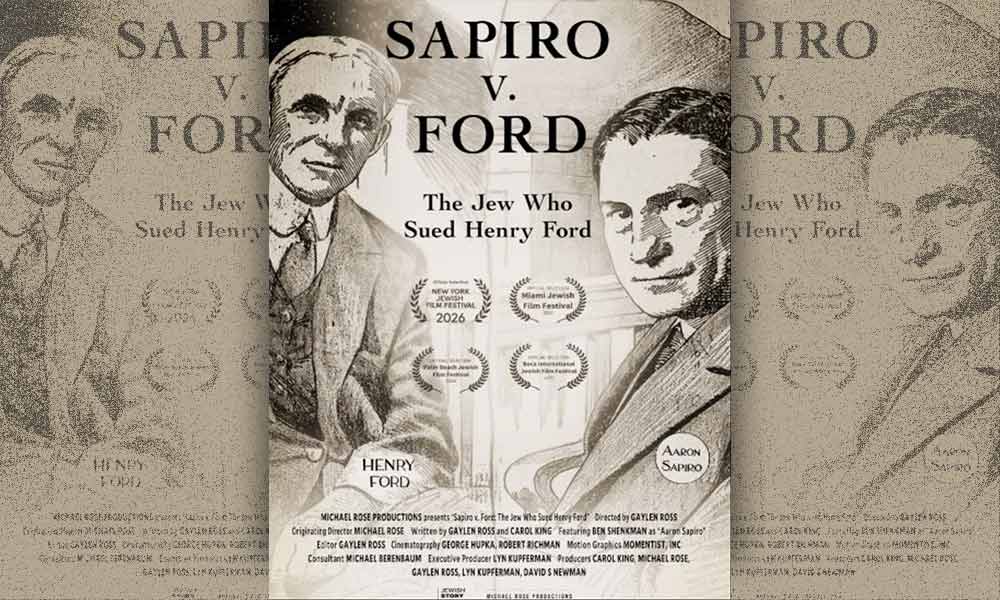
In the annals of Jewish American history there are few villains as toxic as Henry Ford, who, along with the likes of Charles Lindbergh, rose to the height of pre-WWII American society all while being a Nazi sympathizer and borderline collaborator.
Learning about the history of Ford’s long-running antisemitic campaign of hate in the new documentary Sapiro V. Ford: The Jew Who Sued Henry Ford, I found the extent of his obsession with spreading vile antisemitism to be somewhat shocking. Fortunately, there was one man who wanted to do something about it: Aaron Sapiro, a Jewish lawyer and activist from San Francisco. In 1924, when he found himself in Ford’s crosshairs, he decided to do something Ford was clearly not expecting; he decided to fight back.
The documentary, part of the Docs And Dialogues series at the Weitzman Museum in Philadelphia and currently being screened around the country, shows a fascinating and encouraging history lesson. It is the kind you may not read about in textbooks, but is well known to many American Jews. Following World War I and at the height of his success, the automobile mogul Ford sought to achieve even greater influence across the world. He was yet another wealthy baron, one of the richest men in the world, whose fortune gave him a platform from which to exercise social influence. He confused having wealth with having something of value to say.
In the 1920s, he bought and circulated the publication The Dearborn Independent to spread hate, lies and conspiracy theories about the Jewish people. He published special volumes, including the not-so-subtly named “The International Jew,” which earned him the respect and admiration of Adolf Hitler. With such a wide circulation (The Dearborn Independent’s circulation was once second only to The New York Times’), one can’t be sure just big of a role Henry Ford played in stoking the fires that brought on the Holocaust—but it was not nothing. Yet he also somehow considered himself a pacifist. He claimed to be against war and intervention in foreign affairs, and this was a major rationale for his antisemitism (because, of course, it was the Jewish people who were responsible for all wars). He is certainly not the only famous person to spew hatred against subjugated, scapegoated groups while also considering himself a man of peace.
Sapiro, meanwhile, was organizing on behalf of labor rights among Canadian farmers. I was curious why the documentary was spending so much time on this, but then it became clear that this was part of what put him on Ford’s radar. Ford saw him as an agitating communist type, common accusations flung at progressive Jews of the time. Sapiro himself was orphaned as a child but grew up seeing the role of Jewish people in the world as moving humanity towards a place of good conscience. It was by following his moral compass that he naturally landed himself in Ford’s crosshairs. He surprised everyone in bringing a libel lawsuit against Ford, which (spoiler alert) was far more successful than anyone thought possible in bringing Ford to account.
With all documentaries, a choice has to be made how to present the information. Do you rely on talking head interviews? Do you rely on voiceovers? Do you do reenactments? The filmmakers decided on an interesting middleground—along with historical images, including newspaper headlines and cartoons, and interviews with contemporary scholars, they cast actor Ben Shenkman (Angels In America, Billions) to soliloquize passages from Sapiro’s diary. In an attempt to create the feeling that you are in the room with Sapiro, the device, while well-intentioned, ends up feeling a bit distracting and perhaps confusing, as Shenkman appears in contemporary dress in a modern set. His voice and acting chops are lovely, but this device may be better suited for the stage than for the screen. However, the material of the story is so unbelievably rich that it makes for an engaging documentary nonetheless.

Watching Sapiro V. Ford brought me to reminisce about one of the more memorable television events of my childhood—when NBC aired Schindler’s List in 1997, uncut and uninterrupted on primetime television for the world to see. And what company was the official sponsor of it? Surprisingly, it was Ford. The company claimed at the time that its sponsorship had nothing to do with remedying the brand’s legacy. I suppose there are points for trying, but after watching this documentary, I’m not sure anything could make Ford’s legacy right. Nice try!
The documentary ends in an interesting place. Libel laws have changed to an extent where the documentary suggests that had Sapiro brought this lawsuit today, there would be a smaller chance that he would have succeeded. The battle of free speech vs. hate speech goes on and on in this country, for better or worse. The courts now do more to protect the freedom of the press—a positive thing. But this presents problems when one powerful man owns his own media enterprise and uses it for nefarious purposes: He is protected as well.
It feels good to learn about a brave man who took on the worst of the powers that be—a man who disarmed a Goliath. Not for forever, but for a brief moment in time. It reminds us that it can be done.
Watch the MomentLive! interview with Carol King, Gaylen Ross and Ben Shenkman about the making of Sapiro v. Ford: The Jew Who Sued Henry Ford with Moment Deputy Editor Jennifer Bardi.
3 thoughts on “‘Sapiro V. Ford’ Is a Powerful David & Goliath Story”
Is the documentary on any of the streaming services?
Is Shapiro v Ford available for watching on line?
Great question. The film is making screenings at various festivals and venues but does not have a theatrical release nor is it yet available for streaming. Check their website for more information as it comes