
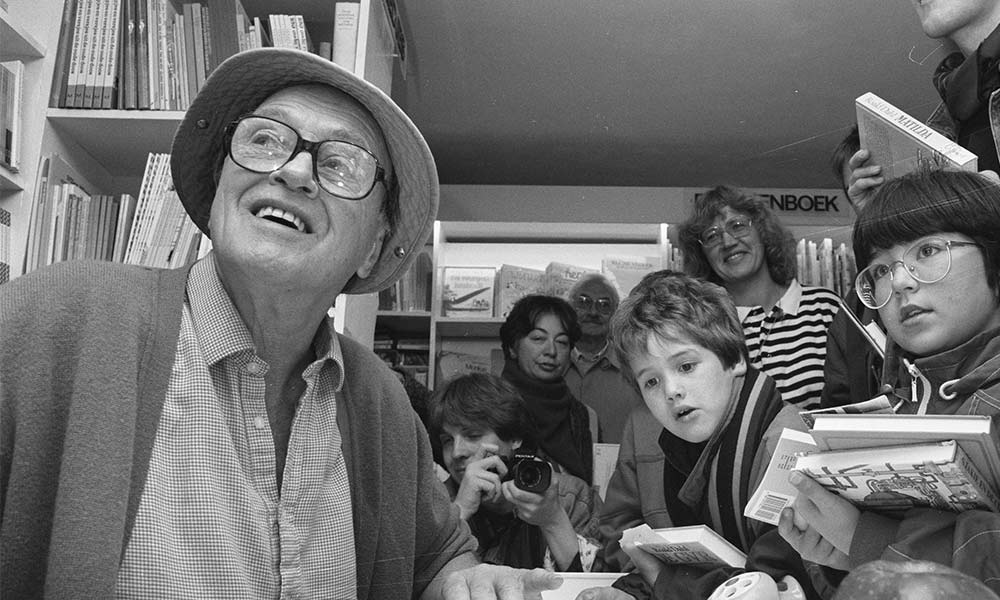
I emerged a little weak-kneed from Giant, the Broadway play starring John Lithgow as a brilliant, twisted, and ultimately hateful Roald Dahl.
The play has been the focus of excited chatter, and rightly so. Powerful and uncannily timely, it digs into a true episode from 1983, when the beloved and prickly children’s author, about to publish his novel The Witches, ran into a public relations uproar after reviewing a book about the Israeli bombing of Beirut. The review condemned the Jewish state and the “Jewish race” in such sweeping and stinging terms as to awaken suspicions of something darker: “Never before in the history of man,” Dahl writes at one point, “has a race of people switched so rapidly from being much-pitied victims to barbarous murderers.” In the play, Dahl’s British and American publishers—both of them Jewish—converge worriedly on his country home in hopes of getting him to say something conciliatory to a friendly journalist, lest bookstores take him as an antisemite and refuse to stock the book.
Dahl pushes back, and the sharp wrangles that ensue—at first civilized, then less and less so—echo all the most agonizing issues we hear debated every day, online, offline and possibly at your family seder. Where’s the line between pro-Palestinian fervor and hatred of Israel? Between condemnation of Israel and plain old ugly bigotry about Jews? And when Dahl’s red-hot invective eventually melts all such distinctions and spills past the boundaries of the acceptable (“Even a stinker like Hitler didn’t pick on them for no reason,” he tells a journalist, on the record, in the play’s final minutes), what inner demons are driving him?
While gripping in 2026 New York, the play apparently hit even harder in its 2024 and 2025 runs in London, where it won multiple awards. One online commenter warned prospective patrons of a “hard watch,” to be approached with “eyes wide and after-care planned.”
Perhaps the most surprising takeaway for an American viewer, in light of all this emotion, is how little it has intersected so far with past battles over cancellation—or even current ones, like the arguments that continue to swirl around J. K. Rowling and the Harry Potter empire. In Britain, critic Fiona Mountford noted acerbically in The i Paper that “It says something—and not something good—about the nature of fame that this incident had no lasting impact on Dahl’s reputation; it is hard to imagine a less profitable author, or a less male one, emerging unscathed in the same way.”
Today, the simplest explanation for the absence of cries to cancel Dahl is that cancellation, for better or worse, is already baked into Dahl’s story. The question of what to do about Dahl’s well-known views and whether to cancel him has been raised and dealt with repeatedly over the years. The play’s characters in 1983 worry that Dahl’s newest release will be shunned; in real life, The Witches did fine. Indeed, while Dahl was being rightly pilloried for antisemitism, The Witches was observed to skate along the edges of misogyny; still, it made lists of the top 100 children’s books (and, for good measure, was cited as the 22nd most banned). It remains popular, with two movie versions. And The Witches is minor Dahl compared with the most loved parts of the Dahl oeuvre, from Charlie and the Chocolate Factory and James and the Giant Peach to The BFG and Matilda. In other words, despite recurrent controversy, generations of fans, child and adult, have made clear their willingness not only to enjoy Dahl’s books without reference to his prejudices but even to disregard (or, possibly, to savor) elements of the books themselves that speak to a streak of what one reviewer calls “witting and unwitting cruelty.”

In 2020, the Dahl family and the literary estate (now owned by Netflix) issued a formal apology noting “the lasting and understandable hurt caused by Roald Dahl’s antisemitic statements,” adding, “Those prejudiced remarks are incomprehensible to us and stand in marked contrast to the man we knew and to the values at the heart of Roald Dahl’s stories, which have positively impacted young people for generations.” Nor was that the end of it: A few years later, the estate went head-over-heels in the other direction by authorizing the publication of expurgated editions of the books that replaced words like “fat,” “stupid” and “crazy” with anodyne equivalents. For good measure, sensitivity readers altered some references to characters’ gender and made a variety of other changes that suggested that the essential charm of Dahl’s childish nastiness had escaped them. A tremendous outcry ensued. Puffin Books eventually had to announce it would continue to publish the originals.
Does any of this imply squishiness on antisemitism? Does an appreciation for the appeal to young readers of Dahl’s particular strain of naughty, bullying humor—which, in Lithgow’s amazing performance, seems inseparable from his genius—mean we have to tolerate the ugly bigotries that lie beneath it? On the other hand, does the structure of the play—in which Dahl’s words build inexorably from what sounds like political criticism to unmaskable hatred—imply that beneath every harsh criticism of Israel’s actions lies a substrate of vitriolic Jew-hatred? Either conclusion seems reductive. The playwright, Marc Rosenblatt, has said that his intention was not “to smash the Roald Dahl piñata” nor “to reduce him to the level of bogeyman”; what we get instead is the towering talent (hence the play’s title) and poisonous complexities of one utterly unique man. Properly framed, such a portrait can teach us more about humanity, and also about hatred, than any generality could ever impart.
(Top image credit: Nationaal Archief)