

At last count, Tanya Gersh had received more than 700 threatening, hateful and anti-Semitic messages. Even now, one arrives every few days. That may sound like a lot, but it isn’t, she says. Not compared to before, when they came day and night. Neo-Nazis intimidated the secretaries who answered the phone at her husband’s office. They even tried to contact her 12-year-old son. “You have no idea what you are doing, six million are only the beginning,” wrote one. “You are surprisingly easy to find on the internet. And in real life,” threatened another.
When I meet her, it has been six months since Andrew Anglin, founder of the neo-Nazi website The Daily Stormer, called on his followers to intimidate Gersh, publishing her photo and phone number, her husband’s work address and her son’s Twitter handle. Six months since Gersh, a real estate agent, came home to find her husband sitting in a darkened bedroom, luggage open on the floor, telling her: “We need to go.” “Where are we going?” she asked. “I’m not really sure,” he replied. Six months since she stopped answering unknown numbers on her cell phone and began locking herself in her car every time she left the garage. Six months since the panic attacks started. “I’m afraid every day,” she says. “I took a walk this morning, and somebody pulled up behind me and made a U-turn, and I felt my blood pressure rise.”
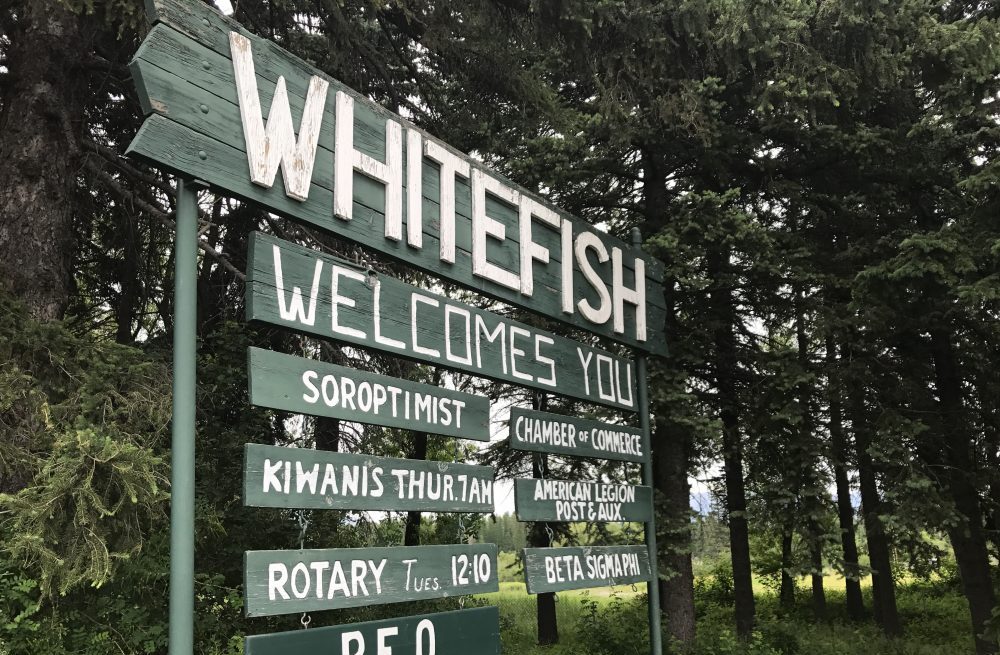
Whitefish, hometown of white supremacist Richard Spencer, is home to about a dozen Jewish families.
The Gershes live in Whitefish, the small ski town in Montana’s Flathead Valley, 30 miles south of Glacier National Park, that made national headlines last December and January when The Daily Stormer’s harassment campaign went viral. Eight months before the white supremacist march in Charlottesville, Virginia, where one person was killed and 19 others injured, Whitefish was on The Daily Stormer’s radar. It is the hometown of Richard Spencer, the 39-year-old president of the National Policy Institute, credited with coining the term “alt-right.” He came to national attention after the November election, when he stood in front of a crowd in Washington, DC, calling out, “Hail Trump, hail our people, hail victory!” and audience members responded with Nazi salutes.
It was Spencer’s speech—reverberating across the country—that precipitated The Daily Stormer’s campaign. Most Whitefish residents, including Gersh, were horrified by Spencer’s beliefs and his connection to their town. Spencer’s mother, Sherry Spencer, owns a commercial building downtown, and Gersh started hearing rumors of plans to protest in front of it. She knew some of the building’s tenants and called them to let them know. Soon after, she says she received a call from Sherry Spencer, who asked for advice on how to handle the situation. “I told her, ‘Sherry, if this were my son, I would probably sell the building, and I would donate some money to a human rights cause. And I would make a public statement saying I don’t believe in the ideologies of my son.’ And Sherry said, ‘Tanya, you’re right, that’s what I should do. Thank you.’” Gersh says Spencer gave her the access code to the building and asked her to act as her realtor.

The commercial building owned by Sherry Spencer in downtown Whitefish.
Sherry Spencer remembered the conversation differently. In an online essay published several weeks later, she claimed that Gersh had tried to extort her: “[Gersh] relayed to me that if I did not sell my building,” she wrote, “200 protesters and national media would show up outside—which would drive down the property value—until I complied.” On December 16, Anglin recounted Sherry Spencer’s story in The Daily Stormer. “This is the Jews for you, people,” he wrote. “They are a vicious, evil race of hate-filled psychopaths…There are only 6,000 Jews in the entire state of Montana, yet they’re 100% of the people trying to trying to silence Richard Spencer by harassing his mother.” He added: “So Then—Let’s Hit Em Up. Are y’all ready for an old fashioned Troll Storm?”
Anglin also encouraged readers to contact three other Jews who live in Whitefish: Francine Roston (a Conservative rabbi who leads the town’s unaffiliated synagogue), Ina Albert (cofounder of the local human rights group, Love Lives Here) and Allen Secher (the town’s retired Reform rabbi, and Albert’s husband). They, too, received an onslaught of hateful messages.
“I was terrified—and didn’t know what was going to happen.”
—Francine Roston
From there, the harassment spread through town. The attackers targeted business owners who were Jewish, had Jewish-sounding names or supported Love Lives Here. For weeks, Whitefish residents felt besieged. “It was very tense,” says Love Lives Here cofounder Will Randall. “We had no idea where these people were, if they were going to actually organize and come here and cause trouble.”
From the beginning, Gersh was the main target. “It’s like that feeling where it knocks the wind out of you, and you can’t really breathe,” she says. She knew she needed help, but she didn’t know whom to ask. Right away, calls began pouring in from local law enforcement, government officials and the FBI. Prominent national organizations such as the Southern Poverty Law Center (SPLC), the Anti-Defamation League (ADL) and Secure Communities Network also offered guidance.
“We were advised very quickly that we should go quiet,” says Roston. “You don’t engage these cyberterrorists. That is oxygen for them. That is food for them. It just keeps them going.”
So the victims and their families went dark.
___________________________________________________________________________________________________________
Tanya Gersh moved to Whitefish 20 years ago, straight out of college. Raised in a small Idaho town where her family never locked their doors, she knew it would be possible to bring up a devout Jewish family here. She wanted her children to experience a tight-knit Jewish community, where friends called if they didn’t see you at services.
That is the story of Whitefish, population 6,000. It is a place that traffics in small-town convention: where everyone knows everyone, I’m told, where people care about who you are rather than what you do. (“So what’s your odyssey?” Secher, the retired rabbi, asks me.) Only about a dozen Jewish families live in Whitefish, although the greater Flathead Valley is home to around 130 Jewish households.
Politically, the area is quite conservative: In Flathead County, Donald Trump captured nearly 65 percent of the vote, while Hillary Clinton received only 28 percent. But for years, the town has struggled with its connection to the Spencer family, who first visited the town in 2004 and built a home there soon after. “We have not sought to associate ourselves with the Spencers,” says Whitefish City Council Member Frank Sweeney. “They have sought to associate themselves with us.” Partially in response to Richard Spencer’s growing notoriety, the city council passed an anti-discrimination ordinance in 2014. Even his parents—Sherry, heir to thousands of acres of Louisiana cotton and corn fields, and her husband Rand, an ophthalmologist—wrote a letter in 2016 to a local paper, distancing themselves from their son’s beliefs: “We are not racists. We have never been racists. We do not endorse the idea of white nationalism.”
When the harassment began, most Whitefish residents united behind the targeted families. They sent cards and letters, and local businesses proudly displayed paper menorahs in their windows. In January, in zero-degree weather, the town held a rally: Gersh stood in the back, wearing sunglasses and a hat, afraid of being recognized. The outpouring of support, she says, gave her the “most overwhelming sense of peace.”
“The life that I had and everything that I had built was just taken away from me.”
—Tanya Gersh
Yet there is no cultural script for something like this. As the town’s rabbi, Roston followed the advice she was given and decided that the first order of business was to protect the victims, in particular, the Gershes. This meant no participation in organized protests and no interviews with the media. This was frustrating for some Whitefish residents who wanted to fight back immediately, to defend their town, to do more than send cards and hold a rally. “I had some pretty direct—and borderline heated—arguments or discussions with civic leaders and others who thought that what we have to do is just be quiet,” says former Montana State Senator Dan Weinberg. “I felt very strongly that that doesn’t make sense. And really, how can anyone stand by while your neighbors are being victimized?”
Anglin’s threats only escalated. In late December, he announced an armed march through Whitefish in a post on The Daily Stormer. Attached to the post was a photo of Auschwitz, decorated with swastikas and a yellow star, superimposed with images of Gersh, Gersh’s son, Roston and Albert. “Montana has extremely liberal open carry laws, so my lawyer is telling me we can easily march through the center of the town carrying high-powered rifles,” he wrote. The march was set for Martin Luther King Day; later, the event was named for King’s murderer: “The James Earl Ray Day Extravaganza.”

Andrew Anglin, the founder of The Daily Stormer, posted this image last December with the photographs of four Whitefish Jews, including a 12-year-old boy, announcing a planned neo-Nazi march.
The announcement of the march shook the town and drew international attention. Fortunately, Anglin failed to file the correct paperwork, and the march never materialized. Whitefish—unlike Charlottesville—avoided a white supremacist gathering that could have quickly turned violent. But no one knew that then: Roston started receiving hundreds of messages from people around the country who wanted to come to Whitefish to support the victims. She thanked them all, but asked them to stay home, convinced that more attention would only intensify the attacks. Most well-wishers agreed. But a few, she discovered, did not heed her request.
___________________________________________________________________________________________________________
From the moment she learned about it, Roston was concerned about a group of Orthodox rabbis planning a visit to Whitefish. She called the group’s organizer, Shmuel Herzfeld, the rabbi at Ohev Sholom in Washington, DC, explaining that the national attention that would come with the visit could be harmful. “He said, ‘No, we’re coming. We’re coming to stand with you,’” she recalls. She then called rabbis senior to Herzfeld, hoping they might persuade him to stay home. Secher spoke with Chaim Bruk—the Chabad rabbi in nearby Bozeman, also part of the group—and asked him to respect Roston’s wishes. But the rabbis insisted. Resigned to the visit, Roston called back with one request: “Please, no press. Once there’s press, there will be more harassment and terrorism directed toward the Gersh family.” The rabbis agreed.
A week after Martin Luther King Day, the rabbis arrived: Herzfeld, Bruk and four others. They met in Helena, Montana’s capital, where they met with Governor Steve Bullock. Despite Roston’s concerns, they allowed the press to cover the meeting. “It was important for the world to know that the governor and the speaker of the house are supportive of the Jewish community,” says Bruk. The rabbis then drove to Whitefish, where Adam Scheier, a rabbi from Montreal, presented Police Chief Bill Dial with a mezuzah; together, they hung it publicly in the police station. Some of the rabbis met privately with the targeted families and other community members. Photographs from the visit to the Whitefish police station found their way online, and a few days later, Herzfeld wrote about the trip in The Forward. “In the end, their visit was harmful,” Roston says. “They kept the news narrative going.”
Herzfeld says it was important for the group to travel to Montana. “If Nazis are marching in Montana, it is not just about the Jews of Montana,” he says. “If Nazis are marching in Charlottesville, it’s not just about the Jews in Charlottesville. It is about all of us.” Both Herzfeld and Bruk say that many Jews, locally and nationally, supported their visit. For those who didn’t, says Bruk, “they have to realize that Chabad is a force of light that will continue to shine whether people are fully on board or not.” That’s how he sees his role—it’s an approach also evident in his new initiative, the Montana Chumash Project. Started in response to the Whitefish attacks, the project aims to give every Jew in Montana a copy of the Five Books of Moses. “There’s one thing an anti-Semite can’t handle,” he says, “and that is Jewish pride and light.”
Roston says the Chumash Project was also unsolicited. “Our community was supported and served well when people asked us what we needed,” she says. Yet she was grateful for the personal support the rabbis provided during their visit. “Throughout this whole episode, I was a person being attacked, but also the leader of the community,” she says. “And here there were rabbis who were there to offer care.” Gersh also found that the visit brought her comfort. “They danced with my son to celebrate his upcoming bar mitzvah, they brought us a copy of the Torah and just helped us feel less alone,” she says.
Soon after, Roston decided that a second rabbinical visit—on her terms, and with no press—would help the community begin to heal. So in early March, 42 Conservative, Reform, Reconstructionist and Renewal rabbis from around the country arrived in Whitefish at her request. They ate dinner with some 60 Jews from the Flathead Valley, and later that evening, as part of a thank you to the city, they attended a celebration open to the community. The governor came, and singer Neshama Carlebach gave a concert. “I sincerely doubt that there have been 42 rabbis in Montana any time before or since,” says student rabbi Laurie Franklin, who leads a congregation in Missoula. Throughout the visit, Franklin watched the visiting rabbis—particularly those from cities—grapple with the enormity of the ordeal. “You could hear them trying to work it out in their minds,” she says. “Because they come from places that are more diverse, less isolated.”
This group of rabbis eschewed all publicity. It was “a pastoral presence,” rather than “a march-down-the-streets prophetic presence,” recounts Elyse Wechterman, executive director of the Reconstructionist Rabbinical Association. At first, she thought she and her colleagues were coming in their role as Jewish leaders. But really, they were there to comfort a community that had been shaken. “They came without tweeting, without posting on Facebook, without talking to media,” Roston says. “Forty-two rabbis came to the town of Whitefish, and no one knew about it.”

A Love Lives Here sign displayed in the window of a Whitefish business.
___________________________________________________________________________________________________________
Eventually, the targeted Whitefish families decided to end their silence. Secher and Albert now give talks around Montana, warning others that what happened in Whitefish could happen anywhere. Secher, in his 80s, grew up in the Holocaust’s wake, and he remembers being beaten as a child because he was Jewish. When asked if the threatening messages scared him, he is defiant. “The answer,” he says, “is absolutely not.”
But then he backtracks: Soon after the harassment began, he walked into the men’s room at a local restaurant. Behind him, he noticed a man with tattoos, camouflage pants and a bandana around his head. Secher wondered: “Is this it? Is the plan to get me alone in the men’s room and do me in?” When nothing happened, Secher realized what he’d done: Before that moment, “I’d never profiled in my life,” he says. “Never, ever.” Secher’s moment of fear was not unfounded: The SPLC classifies The Daily Stormer as a hate group, and some of its fans have turned to violence: Dylann Roof, who murdered nine black people in Charleston, South Carolina, and Thomas Mair, who killed a British member of Parliament last year, were among its readers.
“The usual question to the two of us is: Were we scared?”
—Allen Secher
In April, with the help of the SPLC, Gersh filed a lawsuit against Andrew Anglin. The 63-page complaint accuses Anglin of invading Gersh’s privacy, inflicting emotional distress and violating Montana’s Anti-Intimidation Act—and asks for more than $75,000 in damages for each count. In Gersh’s case, Anglin “didn’t just express opinions about the Gersh family—or even about Jewish people in general,” says co-counsel John Morrison, a Montana attorney working with the SPLC. “He issued a directive to his fanatical followers to go forth and make these attacks on the Gersh family.” Morrison hopes the lawsuit will set a precedent, serving as a warning to potential cyber-tormentors. Gersh finds it painful to recount the story of what happened over and over, but she finds it empowering to know that something good could come from her family’s ordeal. “They messed with the wrong family,” she says. “I don’t want this to happen to anybody else.”
In August, The Daily Stormer’s web host, GoDaddy, kicked it off the internet after Anglin disparaged 32-year-old Heather Heyer, the counter-protester who was killed during the Charlottesville white supremacist march. “Most people are glad she is dead,” he wrote in a Daily Stormer post. The Daily Stormer then tried a series of new hosts, which quickly evicted the site as well. It eventually moved to the dark web, a section of the internet accessible only through special browsers that allow users and website owners to stay anonymous. (“Right now, we are working through technical issues that no one in the history of the internet has ever had to deal with. And we aren’t getting any help,” Anglin wrote on his personal website. “This is a big thing.”)
But as Anglin tries to maintain his web presence, he has kept a low profile in person; Gersh’s lawyers haven’t yet been able to track him down to serve the suit. Without Anglin’s cooperation, the SPLC will need to put a notice in a local paper for six consecutive weeks in order to proceed. “The circumstances in which these steps are normally taken is when someone owes $7,000 on their credit card bill,” David Dinielli, Gersh’s lawyer at the SPLC, told The New York Times. “This is not what happens in nationally prominent civil rights litigation.”
Before its eviction, The Daily Stormer had been collecting money to support Anglin. “Donating to the Daily Stormer Legal Defense Fund is Your Duty as a White Man,” read a headline from May. “This is an attempt by Organized Jewry to shut down the crown jewel of our movement,” the article proclaims. The website raised over $150,000 from more than 1,900 contributors, who had the option to include a message with each donation. “I wish I could give the magic six million,” one donor wrote, “but here’s 500 instead.”
___________________________________________________________________________________________________________
Sherry and Rand Spencer remain in Whitefish, and although their son lives in northern Virginia, whispers circulate whenever he returns home. When I visit, Joan Vetter Ehrenberg, who led an effort early in the year to send gifts to the victims, had just seen him at a local performance of Cabaret. “I bristled,” she says. “I was ready to sing ‘America the Beautiful’ if he were to start anything.”
“There’s some businesses that will not let him in the door,” says Paula Greenstein, the owner of Wasabi, a popular Whitefish sushi restaurant. Greenstein is Jewish, and her business was one of those targeted. She says Spencer has dined at her restaurant, though not in the last several months. “To me, he doesn’t mean anything,” she says. “I told my staff that if they have something to say to him, they can say whatever they want. It’s a free country.” Greenstein prefers not to focus on him. She’d rather focus on the police officers who offered to walk her staff to their cars, the people on the street who gave hugs and begged her not to close Wasabi. “I never felt afraid or unsafe,” she says. “I just felt sad that this kind of mentality is still in the world.”
“We didn’t need to leave. We were in the right place.”
—Francine Roston
Across the country, hate crimes are rising. In the ten days following Trump’s election, the SPLC recorded 867 hate incidents. According to the ADL, anti-Semitic incidents jumped 86 percent in the first quarter of 2017. In Missoula, a three-hour drive from Whitefish, American Nazi Party leaflets were distributed on people’s doorsteps after the presidential election. In early summer, anti-Semitic leaflets were delivered to several neighborhoods in Bozeman, a five-hour drive from Whitefish. Around the same time, Ed Stafman, the Renewal rabbi of Bozeman’s Congregation Beth Shalom, discovered a protester outside his synagogue carrying a sign that read, “The Goyim know,” a phrase associated with anti-Semitic conspiracy theories. (Stafman asked if the man would talk over a cup of coffee; he said no.) And by late summer, the white supremacist movement had grown more organized, drawing hundreds of protesters, including Spencer, to Charlottesville. During the rally, marchers shouted “Jews will not replace us” to TV cameras, and three white supremacists with semi-automatic rifles stood across the street from the local synagogue during services, while others shouted anti-Semitic messages as they passed by.
A few days later, 150 people gathered in Whitefish for a vigil to honor Charlottesville’s counter-protesters who had been injured or killed, organized by Love Lives Here, the local human rights group that had been targeted months before. The townspeople are grateful that the harassment campaign never escalated into physical violence, but they are also unsure of whether the painful chapter in the town’s history is closed. “People ask me all the time, ‘Oh, is it over?’” says Roston. “My answer is: Things are quiet, and that’s good. Our lives will never be the same.”
Roston, like Gersh, is still cautious when she walks around town, and she looks at the world a little differently now. She mentions one man who told the attackers which businesses to target: He is a local, she says, someone “we since have come to know is the father of one of my son’s best friends.” As a rabbi, she doesn’t want to answer anger with anger. The world, she says, isn’t filled with hateful people. “There are more of them than we realized,” she says. “But now we’re awake.”

5 thoughts on “After the Cyber Storm”
Thanks for the fine article. As a person with some Jewish ancestry, this past year has been an awakening. The Whitefish community is resilient. Challenges will make us stronger and coninue to bring us together.
We left Whitefish in 1995 after a series of anti-Semitic events. Although we lived there for 7 years, as a Jewish family we found it a very unwelcoming place. Happy to be gone.
The times and events seems to repeat, yet Jews don’t get the message of danger – again! To my Jewish family and friends worldwide, come home to Israel while there’s still opportunity to make a great life in the most beautiful, and safe country in the present world. This is your real home, though you stubbornly insist on staying among your enemies. I, as a Black American Hebrew Israeli citizen, have been welcomed as ‘family’ by fellow Jewish servants of HaShem, and so will you be. There is nothing to be gained by you staying outside of Israel now, except your eventual annihilation by your enemies. Your only real future is here. America will never recover, or again be the ‘country of promise’ because it has turned its back on HaShem, from whom all blessings come. Your choice – make the right one before you’re trapped – and can’t escape. Shalom! Avraham Tzadok from Jerusalem, Israel
One correction if I may- Whitefish is NOT Richard Spencers hometown. He may have lived here, but this is not his home.
Passive resistance may work in some cases, but when it comes to anti -semitic neo-nazi white supremacists Nothing says NEVER AGAIN like a Jew with a gun. Take advantage of your rights under the second amendment.It is quite clear in the Torah that we have a right and a duty to defend ourselves and others.