
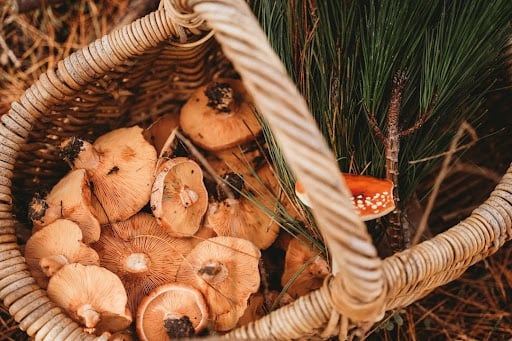
Ask an older relative about the forests outside Vilna, Lodz or Kyiv, and mushrooms often come up. There were Sunday walks with baskets, strings of caps drying over the stove, and barley soup that tasted of the woods all winter. Pickers also learned one rule early. The bright red cap with white flecks stayed where it grew.
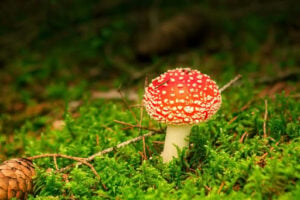
That red cap is the fly agaric, and it has lately moved from the forest floor to a different kind of shelf. Adults curious about folk traditions now meet it among botanical and mushroom products sold as dried caps, capsules and tinctures. Its real story is older and stranger than either the old warning or the new trend.
Why Did Eastern Europe Love Its Mushrooms?
The fondness has a name. Valentina Pavlovna Wasson, a Russian-born physician, and her American husband, R. Gordon Wasson, called it mycophilia. Mycophilia is a cultural love of wild mushrooms. Their 2-volume 1957 book, Mushrooms, Russia and History, argued that Slavic peoples embraced fungi while English speakers feared them.
Jewish kitchens shared that Slavic appetite. Moment’s own column on Jews and mushrooms traces shveml, the Yiddish word, through soups, kasha and knish fillings. Mushrooms were free to pick and easy to dry, so they stretched a poor family’s winter. Soviet Jewish émigrés later carried the picking habit to American suburbs.
Interwar Jewish life there was more varied than the famous photographs suggest, a point Moment made when it took a second look at shtetl life. Across that variety, a basket of mushrooms was a familiar autumn sight.
Krupnik is a Polish barley soup, and the classic recipe calls for 1 ounce of dried Polish mushrooms and about 45 minutes of simmering. A Jewish Women’s Archive essay on krupnik recalls a Yiddish saying about it. Better barley soup at home, it goes, than a roast at someone else’s table.
The memory runs deep in Polish families too. Nela Rubinstein, wife of the pianist Arthur Rubinstein, wrote about it in her cookbook. She remembered whole-family outings in Iłgów and summers at a dacha near Moscow. Each child carried a basket, and nothing went in without a parent’s approval.
Which Mushroom Did the Pickers Leave Standing?
The fly agaric, Amanita muscaria, is the classic storybook toadstool. It grows beside birch, pine and spruce, trading nutrients with their roots. Polish folk wisdom even says that where red toadstools appear, king boletes are close by.
Its common names all point to flies:
- Russian: mukhomor, from mukha, the word for fly.
- Polish: muchomor, built the same way.
- German: Fliegenpilz, or fly mushroom.
Households once crumbled the caps into a saucer of milk to stun flies.
Pickers were right to treat it differently, but folklore exaggerated the danger. It is a separate species from the death cap, which causes most fatal mushroom cases. Writing for the Penn Museum in 2004, the anthropologist Peter Furst called the fly agaric’s “deadly poisonous” label undeserved.
Chemists trace its effects to ibotenic acid and muscimol, a pair of molecules in the cap. Careful drying shifts a good share of the first into the second. Like many plants and fungi, it can cause unwanted side effects, especially if misused or improperly prepared.
Which Stories Grew Up Around the Red Cap?
Few mushrooms carry so much story. The heritage stretches from Arctic Siberia to the walls of European chapels:
- The Koryak tale. In Kamchatka, Big Raven could not lift a stranded whale until he ate the wapaq, earth spirits identified with the fly agaric.
- Siberian ceremony. For centuries, shamans across the northern forest belt used prepared caps in healing and ceremonial work.
- Village medicine. In parts of Russia and Eastern Europe, families kept dried caps or a homemade tincture for aching joints and winter colds.
- Medieval art. Plaincourault, a small chapel in central France, holds a fresco dated to 1291 whose branching tree looks strikingly like the mushroom.
- Storybook pictures. Slavic and German fairy-tale illustrators made the spotted red cap the forest’s signature.
Each of these customs was built on generations of careful observation. They deserve a respectful hearing, not a footnote under a warning label.
Why Has an Old-World Mushroom Returned?
Interest in traditional botanicals has grown among adults who want something older than a pharmacy aisle. The fly agaric fits that search, because its record runs so long.
Amentara, one of the sellers in this space, says its Amanita comes from family foragers in Siberia and Eastern Europe. Those families have gathered mushrooms for generations. The mushroom cannot be farmed, so every cap begins in a living forest.
Laboratory work on the fly agaric is still thin, and a portion of it is industry-funded or poorly designed. Weigh human studies alongside tradition, collected personal accounts, your own discernment and a professional’s advice. A lab certificate is one signal among several, since some labs still struggle to measure Amanita accurately.
Which Facts Should Come Before Any Purchase?
Curiosity works best with a few facts in hand. Before anyone buys, a short list helps:
- Adults only. These products are made for adults, not for anyone under legal age.
- Legality varies by location. Rules differ by state and country, so check local law first.
- Effects are dose-dependent. Raw material holds more ibotenic acid, and correct preparation lowers it.
- Combinations matter. Interactions are possible, most notably with other GABAergic compounds, so consult a medical professional before combining. That includes alcohol and sedatives.
- Microdosing is common. Plenty of adults take a small amount daily or near-daily without trouble; everyday high dosing is what calls for caution.
- No cures. Nobody can lawfully sell it as a certain cure, so lean on your own discernment.
A Forest Memory, Read Accurately
The old pickers were careful, and their caution made sense. Yet the red mushroom they stepped around also carries centuries of folklore, art and healing tradition. Remembering both halves of that story is the respectful way to meet it now.
FAQ
How Does the Fly Agaric Differ From the Death Cap?
They are not the same. Both belong to the Amanita genus, but they are different species. The death cap causes most fatal mushroom cases, while the fly agaric has a long record of prepared use.
Why Is It Called the Fly Agaric?
European households once soaked the caps in milk to attract and stun flies. The habit gave the mushroom its name in English, German, Polish and Russian.
Did Eastern European Jewish Families Pick Mushrooms?
Many did. Dried mushrooms flavored soups, kasha and fillings in Ashkenazi kitchens, and the picking habit traveled to America with later émigrés.
Can Americans Buy Fly Agaric Legally?
It is not federally scheduled, but state rules differ, and Louisiana restricts it. Adults should check their own state and local law before buying.