
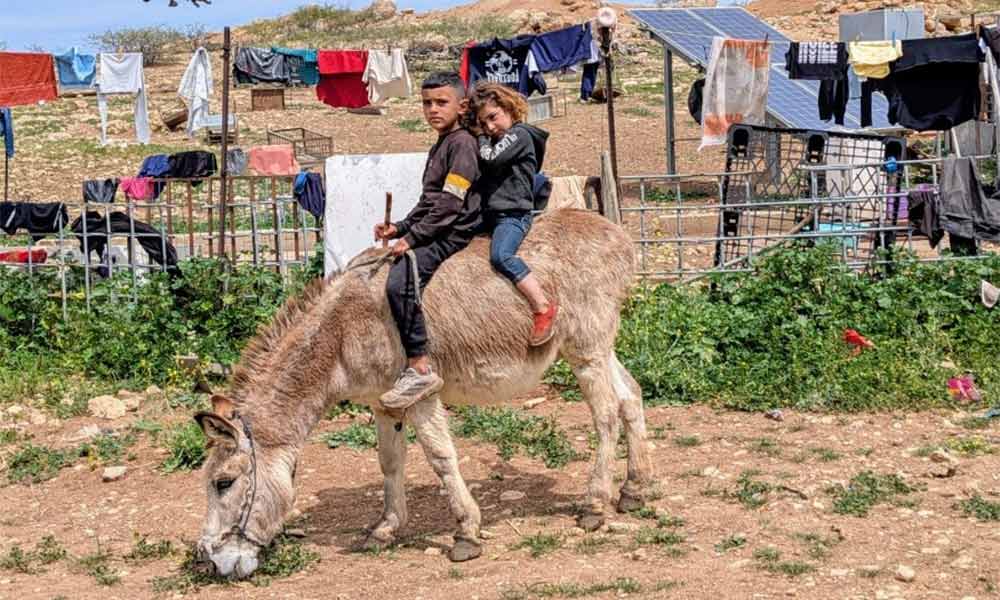
There is an open secret in Israel: Actions that can only be described as ethnic cleansing in the West Bank, also known as Judea & Samaria, are supported by all the powers of the government. While public attention has been focused on Gaza for the last few years, bringing the hostages back and helping displaced families, the settler movement in Israel has been busy ridding a large area of the West Bank of Palestinian communities. Between the Israel-Hamas War’s start at the end of October 2023 and the spring of 2026, over 200 outposts have been set up according to B’tserlem and Rabbis for Human Rights (RHR). These are not the traditional outposts that spring up close to an already existing settlement as small clusters of caravans or temporary buildings, usually built on hilltops. In the case of the traditional outpost, the Israeli government later paves a road and supplies electricity, and eventually the outpost becomes a settlement. Sometimes these are reclassified as neighborhoods of existing settlements, although they are often not contiguous with the older communities. This traditional method of increasing settlements has been the pattern since the 1990s.
On a sunny but chilly weekday in mid-March, I joined 20 other Israelis on a tour of Palestinian communities in the northern Beqa’a Valley. It was organized by Rabbis for Human Rights (RHR), who have been working since 1987 for peace and coexistence. Since it was a weekday, the ages of the participants skewed younger (students) and older (retirees), and they came from all over Israel, from Eilat in the south to Misgav in the north (though the majority were from either Jerusalem or Tel Aviv).
On our way there, Yael, the coordinator of volunteers for RHR, gave us some background. Outposts are springing up all over Area C and encroaching on Area B of the West Bank. Area C encompasses 63 percent of the West Bank and is under full Israeli control. The settlers live there under Israeli law, while the Palestinian who live there are under the military government. The army can arrest Palestinians, while settlers have to be arrested by Israeli police. These three areas were formulated under the Oslo Accords in 1995 and were meant to be temporary until a final status agreement, but they are still in place today.
With the wave of new outposts over the last few years, Yael says, the shift has been toward shepherd outposts as a key method of expansion. These are settlements of just a few people who have flocks of sheep and goats, and sometimes cows. They require a large amount of land in order to have pasture for their herds. Thus, the outpost will begin as a caravan or a few tents and livestock pens, but the total land includes the pasture. This method gives control over much larger areas of land with minimal construction, compared to the outposts previously set up near existing settlements. The shepherd outposts, Yael tells us, are located near small Palestinian communities that are then harassed by the Jewish shepherds until the families are forced to leave.
 Since the last Israeli election in 2022, Bezalel Smotrich is both the finance minister and a minister in the Defense Ministry responsible for the West Bank, while Itamar Ben-Gvir is the minister of national security in charge of police and internal security. Both live in the West Bank. In 2017, Smotrich published “The Decisive Plan,” whereby the Palestinians residing in Area C (under full Israeli control) and Area B (under partial Israeli control) were to be persuaded to move into Area A (under Palestinian Authority control). Area A is less than 20 percent of the West Bank. This plan is being implemented using the outposts and the settlers living there, with the tacit, and in other cases explicit, support of the government.
After outposts are swiftly approved by the government, they are given subsidized loans to buy livestock, along with pickup trucks and ATVs for use in the field. The main army unit in the field is a reserve unit, primarily made up of Israelis living in the West Bank. Residents of Palestinian villages have said that when the settlers arrive to harass a Palestinian community, the army may arrive as well but, again, can only arrest Palestinians, not settlers. If the police are called, they generally come after any conflict has ended and do not make any arrests.
***
After driving down from Jerusalem to the Biqa’a Valley we drove north, and at the Mehola junction we turned onto route 579, also named Allon Road, to visit the Palestinian community of Khirbet Mak-hul. Allon Road runs north-south along the eastern edge of the hills of the West Bank, roughly parallel to the Jordan Valley. It was built after the Six-Day War and named after Yigal Allon, the IDF commander and acting prime minister who proposed Israeli control over the Jordan Valley. This was before the peace treaty with Jordan, and when there were terrorist incursions over the border, from armed groups in the Palestinian refugee camps in Jordan.
 Khirbet Mak-hul, on route 5787, is a group of canvas-covered structures on the side of the road. There we met Kai, the coordinator for the Northern Jordan Valley for Rabbis for Human Rights (RHR), and Janeen, a daughter of the patriarch of the community and a university student in the town of Jenin. Kai explained why the structures are right by the road and look so temporary. He showed us a map of the area and explained that the army has designated all of it, except strips around 22 yards wide along the roads, as a firing range. And this firing range is off-limits to the Palestinians. The family at Khirbet Mak-hul has lived there for over 30 years and rents the land from a Palestinian, including areas in the firing range, but they can only farm in the narrow strip along the road. They have sheep and grow barley and wheat there. They are not allowed to build permanent structures, because there are no building permits given to Palestinians in Area C. The dwellings we visited had concrete floors, but parts of them, sometimes the walls, other times the roof, were canvas.
The settlers come to the area where Janeen and her family live and harass them, she said. Sometimes the settlers bring their own sheep, or they come with ATVs and chase the sheep of the community, or they enter the living area and destroy property. She names one particular settler, Uri, as a man who causes problems. Janeen told us that one recent Friday her mother was out with the sheep close to the road. Uri came on an ATV and told her she was trespassing. She was not, but she brought the herd back to the family compound. However, he still called the IDF and had her arrested. She was taken to a police station in Ma’ale Adumin, some 60 miles away. Late that night the police called to say that she was being released, but that if her family could not collect her, she would be transported to a prison inside Israel. The family members now take turns keeping watch during the night to try to prevent theft and damage.
At times, volunteers from RHR have spent days at the Palestinian community. This is known as “Protective Presence,” whereby volunteers stay with the family, and if settlers from the outposts harass the community, the volunteers document their activities, call the army and the police, and try to make the public aware of what is happening.


These activities are inspiring but ultimately futile. In the past year 15 communities from the area have been driven out, Yael said. She went on to explain that often the families have limited options. They may go to relatives in another community, or to one of the towns, but they will have to sell their livestock and with it their livelihood.
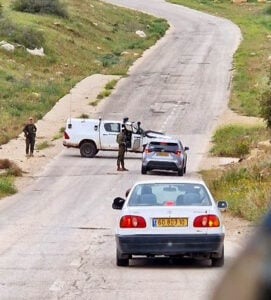
Our next visit was to Burj Al-Malkh, a community of 15 families that recently disappeared. A few hundred yards from the community, on route 5799, we encountered a “flying roadblock”: A white truck was parked across the road, and three soldiers were stopping vehicles. This road led to Tubas, the Palestinian town nearest to the communities in the area. We left our cars at the roadblock and walked up to where we could see the remains of Burj Al-Malkh. Kai explained that, one by one, the families who lived there were driven out. First the women and children left, and the men stayed with the herds. There were some volunteers who stayed in the village, but the settlers threatened them daily, and eventually the Palestinians dismantled their houses and left.
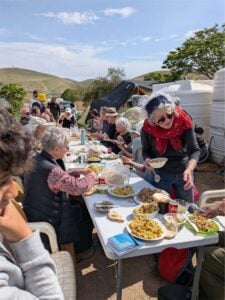
Following this sobering experience, the tour went to Al-Farisiya, a Palestinian community of six families next to Allon Road/route 578. It is overlooked by the Israeli settlement of Rotem, which was established in 2001 and currently has about 350 members. Surrounding the community are a number of recent settler outposts. The settlers have put up a fence at the edge of Al-Farisiya to box the community in and erected a covered pergola on the nearby hill overlooking Al-Farisiya, where they can watch what happens down below. We ate lunch at Al-Farisiya outside at a long table and then went into a visitors’ tent to talk with community members. There were two volunteers who were staying with the community. One of the Palestinian men explained that without the presence of the volunteers the people would not be able to continue to live there. Since October 7 there has been constant settler activity. They come and steal sheep, break solar panels, drive into the community with their vehicles and frighten the children. The community has been there for about 100 years. There are two patriarchs in the village, and both were born in Al-Farisiya.
At the end of the visit, Hanna, a young mother, read a welcome poem in Arabic that Kai translated for us. It begins:
In a time when storms have intensified, and paths have diverged despite the closeness of hearts, where borders have drawn lines between the earth… but failed to draw them between souls, we welcome you…
And concludes:
So welcome among us, where humanity is a homeland whose door never closes, and where meeting is not a coincidence… but a promise that we are still human.
(All photos by Susan Lurie)