
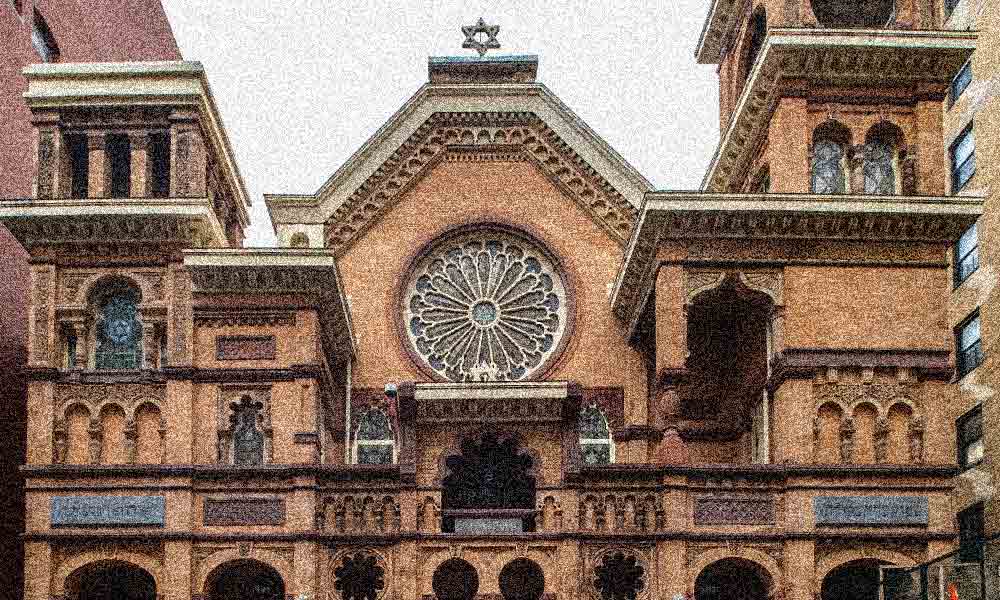
New York Governor Kathy Hochul recently introduced legislation to curb synagogue protests, which have been on the rise even before Mayor Zohran Mamdani’s arrival in office.
In late 2025, pro-Palestinian demonstrators protested outside Park East Synagogue in Manhattan, where they chanted “Globalize the intifada” and other inflammatory slogans. Critics called this an attack on the Jewish community and a symbolic “targeting” of the synagogue. Jewish community members held a rally in support of the synagogue afterward.
Last month, about 200 anti-Israel protesters gathered outside the Young Israel of Kew Gardens Hills synagogue in Queens, chanting slogans including “We support Hamas.” The protests were in response to the synagogue’s hosting of an informational program for people interested in moving to Israel and purchasing land there, including in the West Bank. Officials and state leaders condemned the protests—particularly those in which chants were perceived as advocating violence or antisemitic rhetoric—and called for buffer zones to protect houses of worship by maintaining a distance between them and protesters. The governor’s proposal is in line with these calls.
And yet Jewish voices have not been unanimous on the issue. Some Jewish groups, including Jewish Voices for Peace (JVP) and Jews for Racial and Economic Justice (JFREJ), have already spoken out against the governor’s proposed measures, specifically the effort to place boundaries on where protests can occur. JFREJ wrote in a statement on Facebook February 9 that “while it is understandable that the image of people protesting outside a synagogue can spark discomfort and even real fear…houses of worship make a choice when they host nonreligious political events, and that choice includes the knowledge that they might be protested for doing so.”
I’m glad JFREJ’s statement also asserted that “people should be able to pray and observe religious holidays without fear of harassment.” Unfortunately, virtually everything else in their post reflects anti-peace and anti-Israel sentiments.
Jews should be for racial and economic justice. This is a Torah charge and moral principle. But JFREJ distorts the Torah’s teaching and the Jewish people’s prophetic mission by excluding core needs of their very own tribe from that mix.
For thousands of years, Jews have prayed in one direction—towards Zion, towards Jerusalem.
For thousands of years, when Jews finish eating a meal with bread, they recite a blessing afterwards that includes a wish to return to their ancestral homeland.
There is simply no extrication of Zion or Zionism from the Jewish psyche. We might wrestle with that conundrum, we might call those names “symbols”—and indeed they are—however, they are also real, physical places, with people. The Jewish people, our people.
The action of moving to Israel, now deemed “political” by some, is simply what Jews have done since the beginning of the Jewish project.


Since the outset of the diaspora, since the destruction of the Second Temple, Jews have fought for their right to return to their homeland. The Hebrew term Yehudi, or Jew, relates to the land of Yehuda, also known as Judea. That historical region is part of modern Israel and the Arab territories where Palestinians live and from which they draw their own heritage. There is no question that Israel ought to do everything in its power to ensure Jews live up to the highest moral codes in the way they treat their neighbors. But if we can’t call Israel the Jewish homeland, how can we be expected to engage in that conversation seriously and without defensiveness?
To claim that these protests, in this very hostile climate, are unique because of the specificity of “the settlements” or to claim that houses of worship make a “choice” when they engage in “political” activities involving Israel is to not-so-covertly deny the Jewish people’s intrinsic bond with Zion. And saying that anything involving the West Bank is separate from and more problematic than support for Israel is an oversimplification. Some committed activists for peace have lived in the West Bank. One might wonder if these organizations would have protested the work of the late Rabbi Menachem Froman, an Israeli activist known for his efforts to promote dialogue and religious reconciliation between Israelis and Arabs and who himself lived beyond the Green Line.
We should call out corruption, degradation and abuse of power and never give up our right to criticize or protest. But a place of prayer should be sacred. And a place of Jewish prayer, at a time of heightened Jewish hatred, harkens to more dreadful pasts. When the largest and only synagogue in the Mississippi state capital is attacked by an arsonist and anti-Jewish graffiti and assault are on the rise, why do fellow Jews continue to stand with organizations that undermine their very own safety and security?
Avram Mlotek is a rabbi and cantor and is the author of Why Jews Do That, Or 30 Questions Your Rabbi Never Answered.
(Top image credit: Ajay Suresh (CC BY 2.0))
One thought on “Opinion | Protesting Outside Synagogues Attacks Religion, Not Politics”
The same people who determine that Jewish activities in a synagogue are “illegal” are the same people who have no comment on the outrageous sermons in a majority of mosques regarding Jews – and purposefully decry such questions with accusations of imaginary “Islamophobia.” “Jewish voices for Peace are neither “Jewish” nor “peace.”