
Eight decades of horrors later, the language of the Holocaust retains the power to stifle conversation and silence rational debate. Which, if any, contemporary waves of state violence qualify as “genocide”? Which dictators can fairly be labelled fascists? And when is a performatively brutal holding facility for undocumented immigrants a concentration camp?
From the start of Donald Trump’s second term, Nazi terminology has been wielded as a weapon almost daily. I hear from readers who refer to the president simply as “Hitler”—not exactly an invitation to thoughtful discussion. Meanwhile, Trump’s promise to deport immigrants by any means possible is being fulfilled before our eyes, and each day brings fresh comparisons to the Germans’ mass roundups, deportations and extermination of Jews and others they considered subhuman.
Strictly as a matter of fact, some of the comparisons are overwrought—no one is actually killing anyone—yet such analogies have become common expressly because they carry tremendous emotional power.
When are such comparisons useful, and when is it better to refrain from them? Many debates about the language of cruelty begin with the premise that the Holocaust must stand alone. But as the founders of the U.S. Holocaust Memorial Museum decided, no examination of Nazi crimes is complete unless it seeks to draw lessons for today’s nations and leaders. That makes comparison unavoidable.

Trump campaigned with the promise to remove every undocumented immigrant from the United States. His administration has made sure cameras are on hand as they confront immigrants on the streets, walk them out of their appointments to achieve U.S. citizenship or grab them off college campuses. But for all that classic Trumpian showmanship, the administration is still technically on pace to deport fewer people than Barack Obama did overall.
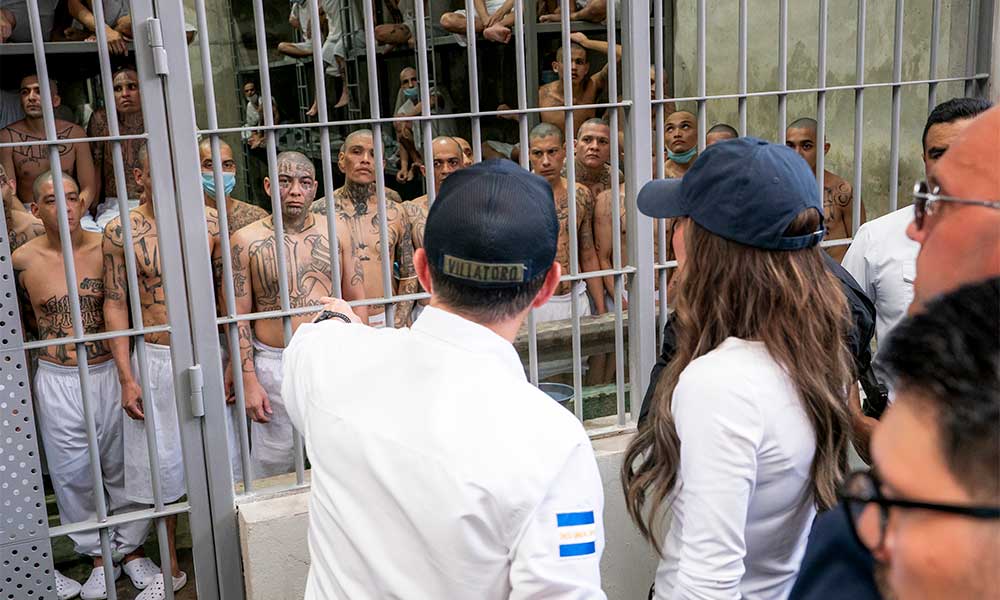
What sets Trump apart is the drive to treat the unwanted like dirt. Consider the Hollywood-style production values in the viral video of Venezuelan immigrants being flown to a notorious high-security prison in El Salvador. This is political theater designed to deliver the message that this president is kicking out the bad guys. The images of El Salvador’s Terrorism Confinement Center are as frightening as they are designed to be—the prisoners dressed alike in white, their heads shaved, their bodies folded into one another, their eyes averted from their menacing keepers. They are silenced, their individuality stripped away.
It’s only natural that the Nazi comparison arose immediately. Along with its unfathomable scale, one keynote of the Holocaust was its incessant cruelty, designed to dehumanize people because of who they are.
Yes, Trump and his domestic policy chief Stephen Miller promise to deport millions of people who arrived illegally. Yes, the Trump administration is vastly enriching the U.S. companies building the infrastructure of deportation—for instance, it plans to spend up to $45 billion creating tent cities to store immigrants before deporting them. The Trump initiative prides itself on its lawless manner, its cavalier disdain for those who insist on due process. As ICE raids spread and Trump makes other moves toward governing by force, not law, concerns about a slide toward authoritarianism easily slip into outright Holocaust comparisons.
But there is a reason historians insist on the singular nature of the Shoah. What distinguished the Holocaust from so many other pogroms and purges through history was its industrialization of officially sanctioned murder. And as Israel’s Yad Vashem museum puts it, “The Nazis’ goal was to murder every single Jewish person in Europe, and ultimately in the world.” This is a difference in kind, and it’s still worth respecting.
Language matters. When I lived in Germany as bureau chief for The Washington Post shortly after the Berlin Wall opened, Germans were constantly confronted with analogies between contemporary behavior and the Nazis’ actions. When extremist neo-Nazis lashed out against immigrants, or when the West German government proposed to build large camps to house refugees from Eastern Europe and the Middle East, the use of Nazi-inflected language inflamed emotions.
I played a small role in fueling one such fire. In the early 1990s, the German government created a new word to describe these planned shelters: Sammelunterkünfte, literally, “collection lodgings,” which makes little sense in English. In news stories I wrote for the Post, I joined other English-language reporters in translating the word as “collection camps.” Since the German officials had coined their term expressly to avoid any connection to Konzentrationslager (concentration camps), they went ballistic over my translation.
The Germans were right to be horrified by any analogy to concentration camps; they sought to house a sudden influx of refugees humanely, not to kill or enslave them. Yet I was also right to raise the specter of the Nazi time. Memory has been a good and necessary check on German behavior since the war.
The resort to Holocaust language helped create a public backlash against the collection camps, and the government soon dropped the proposal. Still, deploying the language of the Holocaust against Trump’s extreme tactics could also backfire, bolstering his base’s belief that he is unfairly maligned by the other half of the country. The path back to an essential trust in democracy and equality lies not in name-calling but only in seeing Trump’s cruelty for what it is, on its own, here and now.
Marc Fisher, a Washington Post columnist, is coauthor of Trump Revealed, a biography of the president.
2 thoughts on “Opinion | Invoking the Holocaust? Proceed with Caution”
It is not what the 3rd Reich did to us in 1939-1945 that frightens me so; it is the events that occurred in the ten years prior to that. That is where the dehumanization began, the blame, the labeling. It was the normalization of myths and prejudices. It was the gradual weakening and eventual death of German democracy. It’s how the average German citizen thought that, in spite of his tirades and exaggerations, Hitler had some good ideas in bringing Germany back to the place it rightfully belonged. Yes, there were the killing fields in Cambodia and the Cultural Revolution in China and Stalin and ….but as a Jew, when I hear the person who is now president of my country refer to human beings poisoning the blood of Americans: my DNA remembers that this was said about MY people a mere two decades before I was born.
I totally agree with Rochelle Kanell! Mr Fisher’s opinion piece is already outdated. Many things have changed. We have GOP members calling themselves Nazi admirers and Hitler lovers. Protesters are being attacked by untrained government paid thugs. Civil rights are being abandoned. The Constitution, the law of the land, is under attack. People are being proven liars. Is there showmanship? Plenty! I believe there are funds to actually pay troops and for SNAP! It’s a threat to place blame on a particular group. It is all revenge taken by the Administration. YES PEOPLE ARE BEING KILLED! Legal American citizens are being attacked on the streets, there homes are mistakenly invaded, and worst of all people are being killed. Not our citizens but but South Americans who may or may not be innocent. The U.S. is firing on small boats without warning. Perhaps one could say they now have had warning by the exploding of previous boats? Either way there is the possibility that this could provoke a war!