
Leading up to Super Bowl LX, there were two major moments I anticipated. One was Puerto Rican reggaeton star Bad Bunny’s halftime show, which had been touted for months and was only made more exciting by his Album of the Year Grammy win just one week before. The second was the airing of an ad, an extended cut of which was released early, funded by billionaire New England Patriots owner Robert Kraft. In it, snickering teens slap a “Dirty Jew” Post-it on the backpack of a high schooler, David, who sees it only while putting his backpack away. “Do not listen to them,” Bilal, a Black teen, says as he sticks a blue square over the note, then another on his chest. “I know how it feels.”
To me, the ad was exhausting, cringey in a way that felt dated and reminiscent of Hilary Duff chiding two girls for saying “That’s so gay” or Kendall Jenner handing a cop a Pepsi. People rightly critiqued it for relying on the “weak Jew” stereotype or as unreflective of how antisemitism manifests—something the Blue Square Alliance tackled much better in their ad last year. (Also, how do you hashtag a blue square? Is it their own version of 2020’s black square?)
Adam Katz, the president of the Blue Square Alliance, defended the new ad in a piece for the Forward, which described their various types of advocacy. “Unity Dinners” that foster Black-Jewish relations and partnerships with interfaith organizations to reduce widespread hate is worthwhile, so why did this ad choose such a sentimental scene to represent their work?
To be fair, it would be a difficult challenge to create an uplifting ad about antisemitism. But one could look to Bad Bunny’s performance to see how to tackle a current moment with a lighter touch and a message of solidarity that feels less contrived and more refreshing. The 15-minute show obviously takes a much different form and framing than an advertisement, but its focus on joy and togetherness made it a powerful moment in centering his culture.
When the Puerto Rican artist was announced to headline the halftime show, conservatives pledged to boycott the NFL over someone they deemed a Spanish-speaking outsider. (Puerto Rico is a United States territory, and Bad Bunny is an American citizen.) Kristi Noem said that ICE agents would be “all over” the Super Bowl (she’s better there than at the Puppy Bowl, at least). Turning Point USA, Charlie Kirk’s organization, put on an alternative “All-American Halftime Show” that paled in ratings and featured “stars” like Brantley Gilbert and Gabby Barrett. Kid Rock, the headliner, wore jorts.
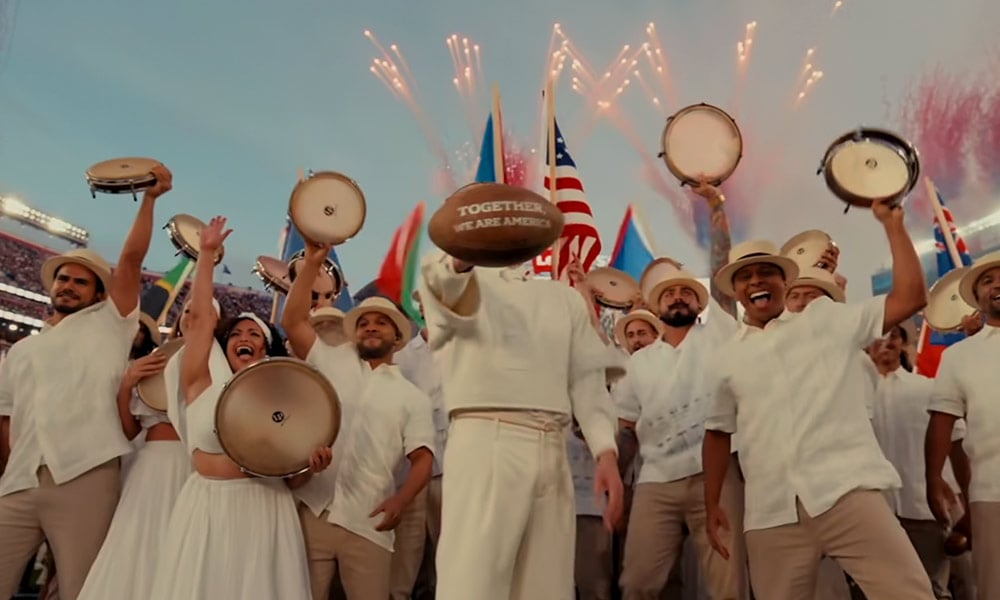
The dinky concert was no match for the actual show, a spectacle that was filled with stars, dancing, a (real!) wedding ceremony, a tribute to the star’s childhood self and, at the end, a parade of flags representing all the countries of America—North, Central and South. Fellow Puerto Rican Ricky Martin popped in to sing Bad Bunny’s “LO QUE LE PASÓ A HAWAii” and Lady Gaga sang a strange but not unwelcome salsa-inspired “Die With a Smile.” Showcasing Latin culture was the message in and of itself—it’s impossible to divorce the performance from the current cultural moment, where ICE agents are shooting American citizens and detaining anyone who in their minds doesn’t look like one. Bad Bunny’s being there was enough, no statement required.

But two statements did come at the end. “The only thing more powerful than hate is love,” read a massive billboard. And the singer punted a football reading “Together, we are America,” kicking off the chanting of his hit “DtMF.” Sure, the slogans were pithy, but Bad Bunny’s show communicated more effectively than a blue square. He didn’t over-explain or proselytize; you knew what he was talking about. He gestured in every direction, while the Kraft ad narrowed its own scope.
Bad Bunny’s performance probably won’t change anyone’s tune—Trump posted on Truth Social that it was a “slap in the face” and his lackeys are already lying about ratings—but it felt nice, for a bit, to ignore all that and enjoy an American man saluting his culture and his country. It was a celebration rather than a lament. It’s easy to see which one is more effective.
Top image: Screenshot of Superbowl LX halftime show.
2 thoughts on “Opinion | Two Paths to Protest”
I love ❤️ this piece! We need a Jewish Bad Bunny, to showcase our joy, values and music.
I wouldn’t overdo the praise of “Bad Bunny” whose song was basically an obscene rant, like so much of the musical trash we call “culture” in order not to be condemned as “racists”, when we actually are, by patronizing vulgarity. I am sure that “Latin Culture” is much more than this.