
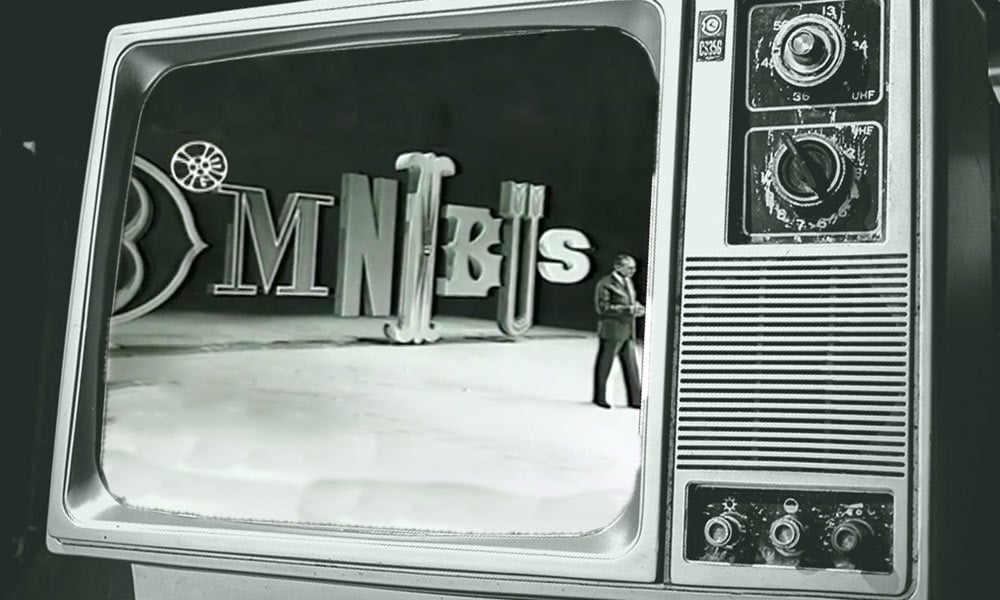
On a Sunday afternoon in November 1952, somewhere in the middle of the CBS schedule, a host with a transatlantic accent and a tweed jacket sat down in front of a camera and introduced 90 minutes of television that had no business existing on a commercial network. The program was called Omnibus. The host was Alistair Cooke. The producer was Robert Saudek. The money, at least at the start, came from the Ford Foundation. The proposition, never spoken aloud but legible in every cut and every cue, was that a mass audience in postwar America could stay tuned for a string quartet, a Shakespeare scene, an original play, a science demonstration and a documentary on the American presidency—all on the same Sunday broadcast.
The audience that turned up for that proposition week after week, putting Omnibus on the cultural map, overlapped heavily with subscribers to the New York Philharmonic, readers of Commentary and the Partisan Review, season-ticket holders at the Metropolitan Opera, and parents who pushed piano lessons and SAT prep and Saturday-morning museum visits. Given those overlaps, it’s fair to say the show had a large Jewish audience. They were part of the show’s nationals following, which would, a generation later, become the demographic spine of public television membership.
This is not a small detail. It is the story.
The Show That Shouldn’t Have Aired
In 1951 the Ford Foundation, through its newly created TV-Radio Workshop, decided that American commercial television — barely five years into mass adoption — was already settling into habits that would be hard to break. The Workshop’s gamble, under Saudek’s direction, was to place a serious cultural program on a commercial network, in prime weekend real estate, and to demonstrate that the audience was larger and more curious than the networks believed.
The gamble worked, at least at first. Omnibus premiered on CBS in November 1952 and promptly won a Peabody for its first season.
Over the next nine years it would move to ABC and then NBC, and it would put on the air Leonard Bernstein explaining the first movement of Beethoven’s Symphony No. 5, Orson Welles directing his own King Lear, Laurence Olivier in The Skin of Our Teeth, James Agee’s five-part series on Abraham Lincoln, and Jacques Cousteau diving under the sea. It carried original drama by William Saroyan, Maxwell Anderson, and Gore Vidal. It also gave American television viewers their first looks at Agnes de Mille, Leopold Stokowski, Mike Nichols and Elaine May, Pablo Casals, Artur Rubinstein, Marian Anderson, Isaac Stern, Yehudi Menuhin, Igor Stravinsky, Glenn Gould, Danny Kaye, Yo-Yo Ma, and Dr. Seuss.
Saudek did not chase the famous. He commissioned the curious.
Read that roster with the Jewish spine in view. Bernstein, Rubinstein, Stern, Menuhin, Stravinsky, Stokowski and Kaye comprised an émigré and second-generation cohort that had spent the previous decade arguing that American mass culture might be a place where serious work could live. Omnibus was their proof of concept.
The conventional wisdom in 1952 was that high culture belonged to the unsold hours the networks gave away to demonstrate good citizenship to the FCC. Saudek’s wager was that high culture could be sold, and that underwriters like Alcoa, Union Carbide and Greyhound could be persuaded that the prestige of association was worth more than the rating point.
For a while, it was.
Saudek’s Method, and the Omnibus Audience
What made Omnibus work was not the highbrow inventory. It was Saudek’s editorial sensibility, which has been badly served by the shorthand of “middlebrow” that later critics affixed to the program.
Saudek had absorbed the instinct the great radio producers shared: that an audience would sit through almost anything if the next segment were around the corner, if the host could be trusted, and if no single piece outstayed its welcome. A 90-minute Omnibus episode might contain six or seven segments of wildly different tone. The assumption was that the viewers who came for Bernstein would stay for Agee, and the viewers who came for Cousteau would discover, almost against their will, that they had just watched 20 minutes of Shakespeare.
That assumption tracked the cultural sociology of postwar American Jewish life with uncanny precision. The Jewish bargain with American mass culture in the years after the war was a wager that fine art and popular art could read Lionel Trilling in the morning and watch Sid Caesar at night, that there was no contradiction between aspiration and accessibility. Omnibus was that wager broadcast into living rooms. Bernstein on the podium in one segment, a comic monologue the next, an Agee documentary the next. The viewer who could move comfortably across that range was, in significant part, the same viewer who had grown up moving across Yiddish vaudeville and the Metropolitan Opera, the Catskills and Carnegie Hall.
Saudek refused to flatter the audience by pretending the material was easier than it was, or harder. He treated the home viewer the way a good Sunday paper treated its reader: as someone whose curiosity was wider than his or her training, and whose attention was a gift to be earned, segment by segment. He did not chase the famous. He commissioned the curious.
What he also understood, and what public television would not fully internalize until the 1970s, was that editorial independence on commercial television was a structural question, not a personal one. Omnibus could put difficult material on the air because the Ford Foundation, not the sponsor, controlled the content. Once the Foundation phased out, given its treatment of the Workshop as a demonstration project rather than a permanent subsidy, the structure that protected the editorial mission went with it. The show that followed was thinner, and everyone in the room knew why.
Public Television’s Precursor
Here is where the conventional history goes quiet, and where it shouldn’t.
When the Carnegie Commission on Educational Television (with Saudek as a member) issued its 1967 report, and Congress passed the Public Broadcasting Act later that year, the architecture of American public television was assembled, in part, from blueprints Omnibus had drawn 15 years earlier on commercial time. The Ford Foundation’s TV-Radio Workshop was a public television underwriting model. The use of a host as an editorial intelligence rather than a personality was an Alistair Cooke inheritance. The willingness to mix the sciences with the arts, the documentary with the drama, reflected a magazine sensibility migrated almost intact to The Great American Dream Machine and the early years of Masterpiece Theatre and Great Performances.
It migrated, too, on the strength of the audience Omnibus had identified and trained. The American public television membership rolls of the 1970s and 1980s were the people who pledged during the spring drive and paid for I, Claudius and Brideshead Revisited. They were the same demographic that had sat down on Sunday afternoons 20 years earlier for Bernstein and Agee. They skewed urban, college-educated, and professional. WNET in New York and WGBH in Boston built their donor bases on them. Public television’s economic model was established on the willingness of a culturally aspirational audience to pay for what commercial television would not provide, and that audience had been first counted, named, and cultivated by Omnibus.
Omnibus did not fail because the audience rejected it. It failed because the commercial structure could not sustain editorial independence on a weekly 90-minute scale once the underwriting that protected it was withdrawn. Public television was the institutional answer to a structural problem Omnibus had identified but could not solve from the inside. The audience that funded the answer was the audience Omnibus had recruited.
The Curator’s Second Act
I have a personal stake in the institutional sequel worth noting. Saudek’s career did not end with Omnibus. In 1975, when CBS Chairman William S. Paley, himself the son of Jewish immigrants from Ukraine, founded the Museum of Broadcasting in New York, he asked Saudek to be its founding director. It later became the Museum of Television & Radio, where I served as president and CEO, and is now The Paley Center for Media. After the Museum, Saudek went on to head the Motion Picture, Broadcasting and Recorded Sound Division at the Library of Congress, which is the country’s largest collection of broadcast material, including, with a tidiness history rarely supplies, the kinescopes of Omnibus itself.
The man who had produced the most ambitious cultural program on commercial television then built the institution that preserved commercial television’s cultural record, then ran the federal repository that preserved it again. This was not three careers. It was one career, conducted in three rooms, animated by the same conviction: that broadcasting was an art form whose ephemera mattered, and that the work of preserving it was continuous with the work of producing it.
That conviction has a recognizable cultural pedigree. The impulse to build an institution around the insistence that the ephemeral deserved an archive and a reading room is the same impulse that built, for example, The Jewish Museum out of the Jewish Theological Seminary’s collection; YIVO out of émigré salvage; the Schomburg Center for Research in Black Culture in Harlem; and the Leo Baeck Institute out of the wreckage of German Jewry.
Omnibus was more than a show. It was a curatorial proposition, a weekly argument that the American home audience could be trusted with the same range of material a good museum offered a good visitor. The Museum of Broadcasting was that proposition made physical. The Library of Congress chapter was that proposition made permanent.
What We Lost When We Lost the Sunday Afternoon
It is fashionable now to argue that streaming has finally given American audiences the cultural seriousness broadcast denied them; that the prestige limited series and the international auteur drama have at last vindicated the Omnibus premise on a scale that Saudek could not have imagined.
There is something to this. But Omnibus was appointment television in the deepest sense: a fixed hour and a half on a Sunday afternoon when a national audience watched the same lecture and the same documentary at the same time and could talk about it on Monday with the conviction that the conversation was shared. The streaming era cannot produce that synchronous national audience.
It has also, more quietly, dissolved the cultural conditions that produced that audience in the first place. The Jewish-American household of 1952 that turned the TV dial to CBS at 4:30 p.m. on Sunday was operating inside a dense network of obligations to seriousness: Hebrew school in the morning, the Times on the table, the season ticket to the symphony. Omnibus fit into that network because the network already existed. But today, the household is smaller, more secular, more dispersed. Its descendants still fund the prestige series and make pledges to the public stations, but they do so as individuals scrolling alone, not as a cultural cohort gathered around a single broadcast.


The lesson in Saudek’s career is that cultural seriousness on a mass medium is always a structural achievement, never a personal one. Omnibus existed because a foundation underwrote it, a producer protected it, a host carried it and commercial networks tolerated it. And an audience, cultivated over generations to believe that seriousness was its own reward, kept showing up. When any of those conditions failed, the show failed. The question for our own moment is not whether we have the talent to make another Omnibus. We obviously do. The question is whether we still have the audience.
Saudek answered that question for his generation. We have not yet answered it for ours.
Go here for more on Omnibus.
Stuart N. Brotman, who served as the inaugural Visiting Professor of Entertainment and Media Law at Harvard Law School, is working on a new book, “Televisionaries: How TV’s Architects Rewired America’s Mind.”