

Jewish Politics & Power is published every other week. Sign up for our newsletter for updates.
1. A double protest
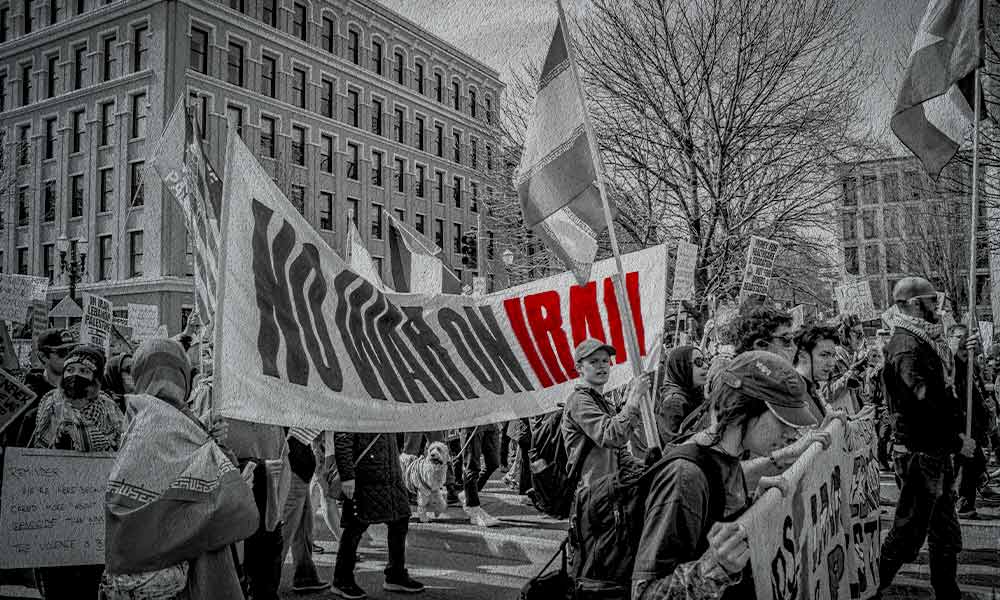
A scene from Saturday’s No Kings protest in Washington, DC:
A person dressed as Donald Trump, a leash around his neck, walked around the crowd, led by a person in a Benjamin Netanyahu mask. The message of this little political performance was clear: Israel has dragged the United States into the Iran war.
Signs carrying the same message popped up all across the colorful protest on the National Mall at the footsteps of the Capitol, though most focused on Trump. One such sign showed photos of Netanyahu from 2003 and from 2026, arguing that “Israel fooled the U.S. twice,” presumably to launch the war in Iraq two decades ago and now the war against Iran.
“Netanyahu wants this war because he thinks it will keep him out of jail,” said a young man carrying a homemade sign reading: “F– off Witkoff,” a reference to Steve Witkoff, Trump’s negotiator in charge of the pre-war talks with Iran. Donna Hershey, a Washington resident with a hand-painted “Not Our War,” sign, said that “Trump was pressured by the Israel lobby and his son-in-law Jared Kushner because getting rid of Iran helps Israel, but it’s not the U.S.’s interest.”
The notion that Israel, and specifically Netanyahu, are responsible for dragging the United States into a faraway war, which is costing American lives and fortune and has no end in sight, seemed widespread among Trump’s critics from the left. In a way, it echoed similar claims made on the far right by Tucker Carlson, Marjorie Taylor Greene and others.
Those who care about U.S.-Israel relations could, and probably will, brush aside these concerns, viewing them as no more than voices of extremists on both sides who are blinded by their hatred of Israel. But arguments dominating the discourse on the far ends of either political side have a tendency to creep into mainstream politics. The longer the war is drawn out, the more traction these accusations will receive.
2. In other circles, Trump and Bibi are still the heroes
The next day, at the exact same spot on the National Mall, another group came to make their case. These were mostly Iranian expats who had heeded the call of Reza Pahlavi, the son of Iran’s last shah, to take to the streets in support for regime change in Iran.
It was a mirror image of the No Kings rally.
Many carried Israeli flags alongside those of the United States and of pre-Islamic revolution Iran. Others held signs thanking Trump and Netanyahu for launching the war and heaped praise on the two leaders. “They are the only ones who stood with the Iranian people,” said Ahwaz Sigachi, who held a sign depicting Trump, Netanyahu and Pahlavi with the caption “Make Iran Great Again.” “This is not a war for Israel, this is a war for the entire world,” she added.
The crowd of thousands who showed up to the rally was energized, all chanting calls in Farsi for the demise of the Ayatollahs’ regime and for the return of the Pahlavi dynasty.
But politically, this show of support for the war, for Trump and for Bibi doesn’t make much of a difference. While the Iranian expat community is active and vocal in supporting the military operation, their numbers are limited and so is their political clout. Support from the Iranian-American community provides a sense of moral backing for the war and the leaders behind it, but does little to change the greater political trend of strong opposition and of viewing Israel as the driving force behind it.
3. Settler violence finally gets attention
Settler violence against Palestinians in the West Bank has been on the rise in the past year, but the past few weeks have been the worst, with daily raids by extremist Jews against Palestinian villages, unprovoked attacks on residents tending to their fields and organized efforts to drive Palestinians off their lands.
In most cases, the Israeli military, which controls the West Bank, either came late or didn’t show up at all. Most events went unprosecuted, and the government remained largely mum and refrained from taking on the issue.
And then something changed. The U.S. administration decided enough is enough.
An angry phone conversation between Vice President JD Vance and Netanyahu made clear that America wants to see an end to the violence. U.S. ambassador to Israel Mike Huckabee called on Israel to “aggressively investigate” the murder of a U.S. citizen of Palestinian origin who was beaten to death by extremist settlers. “There must be accountability for this criminal and terrorist act,” he wrote on X. Secretary of State Marco Rubio publicly expressed America’s concern and expectation that the Israeli government take action.
The message made it through to Israeli ears.
“There are people in Washington who are definitely distancing themselves from Israel because of this,” Israel’s ambassador to Washington Yechiel Leiter warned in an interview. “It’s as if those same people who want to support us—we are, with our own hands, pushing them away.”


And just like that, the Israeli government changed course. Netanyahu and senior cabinet members suddenly spoke out against settler violence, and the military pledged to crack down on violence after a Palestinian man was killed by the IDF last week.
Israel, to be clear, is headed by the most right-wing, pro-settler government in its history. The United States is led by an administration that broke rank with previous policies and has practically embraced the idea of Israeli settlements in the West Bank. But even the most pro-settler, anti-Palestinian governments on both sides of the Atlantic understand that the unchecked violence, growing more brutal by the day, endangers the relationship between the two countries and risks igniting the West Bank, which is the last thing either Israel or the United States wants right now.
4. How toxic is AIPAC?
To claim that the American Israel Public Affairs Committee (AIPAC) is no longer seen as a bipartisan lobby would be stating the obvious. AIPAC’s increased efforts in recent years to pour massive amounts of cash through its affiliated super PACs to defeat progressive Democrats—and any Dem willing to consider conditioning military aid to Israel—have driven many in the party away.
But now, rejecting AIPAC’s support has become mainstream among Democrats. Politico recently noted that top Democrats, including those being mentioned as potential 2028 presidential contenders, are making a point of announcing they will not take any campaign funding from AIPAC. The list includes New Jersey Senator Cory Booker, who in the past had received donations through AIPAC; California Governor Gavin Newsom;
Arizona Senator Ruben Gallego; Kentucky Governor Andy Beshear; former Chicago mayor Rahm Emanuel; and Connecticut Senator Chris Murphy. Even Pennsylvania Governor Josh Shapiro, arguably the most pro-Israel Democrat currently, made it clear he had never received any support from the lobby. Illinois Governor JB Pritzker, a former AIPAC donor, said “AIPAC really is not an organization that I think today I would want any part of.” The latest blow came over the weekend, with reports that next month the DNC will consider an anti-AIPAC resolution. The proposed resolution condemns “growing influence of dark money and corporate-backed independent expenditures in Democratic elections,” but the only group named is AIPAC. And while there is no certainty the resolution will be adopted, it definitely points to a trend.
5. The Rahm factor
The 2028 presidential elections are still far away but not too far for candidates testing the waters. The Democratic list of hopefuls includes Jewish governors Shapiro and Pritzker, and potentially another Jewish name: Rahm Emmanuel. The former congressman, mayor, Obama’s White House Chief of Staff, and ambassador to Japan under Joe Biden seems to be showing interest. Emmanuel is all over the press, speaking his mind in podcasts and interviews, and doing campaign-style tours.
The idea of Emmanuel joining the race is stirring up the Democratic field, where some believe that his very direct style and centrist views on social issues will overwhelm the system and shape the entire race, even though not many believe he actually stands a chance of winning the nomination. That is, if he even decides to run.
(Top image credit: Ian M. (CC BY-SA 4.0))