
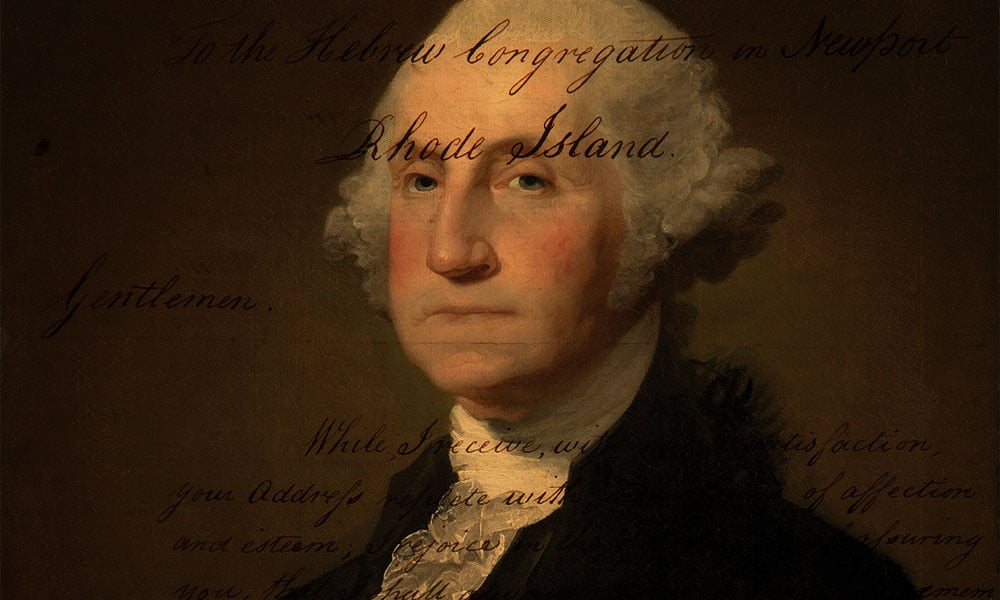
Newport, Rhode Island, in August 1790 was a city on the edge. A bustling and wealthy seaport in the colonial wea, it had suffered grievously during the American Revolution, when occupying British forces burned hundreds of local buildings and destroyed much of the waterfront. The postwar recovery was proceeding slowly and fitfully. The population had fallen by a third since the prewar days, and the remaining residents were unsure of their place in the new nation, politically as well as economically. Rhode Island was the last of the 13 states to ratify the Constitution, its legislature having reluctantly given its agreement just that May and then only by a two-vote margin and under the threat of a trade embargo by the U.S. Congress.
Anxiety was especially high in the remnant of Newport’s small Jewish community. Angered by the denial of citizenship rights to non-Christians under British rule, the Jews of Newport had largely been supportive of the American Revolution, and many of them fled when British forces arrived. As Sephardim, they carried the ancestral awareness of Inquisition terror in Spain and Portugal, and the thought of life under a foreign occupation was unnerving. Their glorious synagogue, Jeshuat Israel, built in 1763, had been used as a field hospital by the British forces and had fallen into neglect. With the triumph of the Revolution, some Jews returned to Newport, but by 1790 the community consisted of barely 20 families, fewer than lived there before the Revolution. The Torah scrolls were still in storage for safekeeping; a printed book was used for the weekly readings. Moreover, the first years of independence had proved disappointing. Despite Rhode Island’s reputation for promoting religious liberty, Jews in the state found that their right to vote and hold office was still in dispute, as it had been in the colonial era.
With the announcement in early August that George Washington was coming to visit, Newport was overjoyed. The new president had toured the other New England states the previous year, but he deliberately bypassed Rhode Island because of its refusal to ratify the Constitution. That problem now resolved, Washington sailed from New York on August 15, accompanied by Thomas Jefferson, his secretary of state, as well as George Clinton, the governor of New York, U.S. Supreme Court Justice John Blair and others. The mission was to welcome Rhode Island into the Union. As their ship came into sight in Newport harbor on the morning of August 17, a gun salute was fired from nearby Fort Washington, and bells in the town began to ring.
The presidential party was met at the docks by the town leaders and notable clergymen. Among them was Moses Seixas, a prominent merchant and the gabbai (lay warden) of Congregation Jeshuat Israel. The group escorted Washington and his party on a tour of the town, where they were greeted by cheering throngs. At six-foot-two, with a lean physique shaped by years of military service, Washington had a confident and commanding physical bearing, and the Newport townspeople who followed him were awed in his presence. At a dinner later that same day, Washington offered a toast in recognition of Rhode Island’s belated ratification: “May the first be the last.”
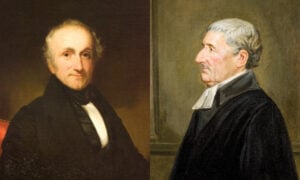
Moses and Gershom Seixas. Credit: The American Jewish Historical Society’s John L. Loeb, Jr. Database of Early American Jewish Portraits
Moses Seixas and other religious leaders from Newport met again with Washington the following morning. Seixas used the occasion to deliver a beautifully handwritten letter to the president on behalf of his fellow Newport Jews. After some warm words of welcome, the letter went on to inform Washington, albeit delicately, of the community’s political situation and their expectation of change. “Deprived as we heretofore have been of the invaluable rights of free Citizens,” Seixas wrote, “we now…behold a Government, erected by the Majesty of the People—a Government which to bigotry gives no sanction, to persecution no assistance—but generously affording to All liberty of conscience, and immunities of Citizenship.”
The democratic vision laid out so eloquently in the Seixas letter shows how American Jews in the late 18th century, though few in number, were ready to stand at the forefront in the struggle for religious liberty. At the time, Jews in Rhode Island and other states did not have full civil rights. In his book A Promised Land: Jewish Patriots, the American Revolution and the Birth of Religious Freedom, Auburn University historian Adam Jortner writes that Newport Jews “did not know whether their new government would protect their rights.” The Seixas letter, he says, was “not a statement of fact. It was a hope and an aspiration.” Brandeis historian Jonathan Sarna, author of American Judaism: A History, takes a similar view. “They knew from long experience that law was one thing, and practice was sometimes very different,” Sarna says. “They wanted to hear it from the president himself.”
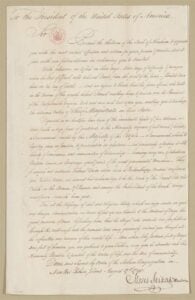
Letter to Washington from Moses Seixas. Credit: Courtesy of the Morris Morgenstern Foundation
And they did. President Washington was receiving dozens of congratulatory letters on a daily basis, but the letter from the Newport Jews apparently struck him as special. Back in New York, he crafted—or dictated—a lengthy response, answering the Newport petition affirmatively by repeating Seixas’s very words and then adding a few of his own. Of U.S. citizens, Washington wrote, “All possess alike liberty of conscience and immunities of citizenship. It is now no more that toleration is spoken of, as if it was by the indulgence of one class of people, that another enjoyed the exercise of their inherent natural rights. For happily the Government of the United States, which gives to bigotry no sanction, to persecution no assistance, requires only that they who live under its protection should demean themselves as good citizens…”
By reiterating what Seixas had written, Washington endorsed the Newport Jews’ aspiration. It is the comment he added on his own, however, that most impresses Sarna, whose forthcoming book is about the Washington letter. “He says toleration is insufficient,” Sarna notes. “There were plenty of Jews around the world at that time who quite happily would have accepted tolerance, being able to practice their religion in peace. But Washington felt that toleration suggests one group is inferior to the other, as if it were [only] by the indulgence of a group that another enjoys its rights. Washington was saying religious liberty is an inherent natural right, so it cannot be taken away. To my mind, that’s the most revolutionary thing in that letter.” Notably, it was an appeal from a small Jewish congregation that prompted Washington’s letter, a letter that would come to be seen as one of the most explicit commitments to genuine religious freedom in American history.
For American Jews, religious freedom in their new nation meant having the same civic rights enjoyed by Christians. Jewish religious leaders were steadfast in their opposition to Christian domination, and in that effort they had the firm support of America’s founders, most notably Washington, Jefferson and James Madison. Though the American Revolution set the stage for the achievement of religious liberty, it would take years of struggle. Christian nationalism would emerge repeatedly as a significant force in U.S. history, as it has again today.
In Britain, Anglicanism was the official state religion. Anyone unwilling to take an oath of loyalty to the Church of England was barred from voting or holding public office. Similar rules were enforced in the American colonies, which is one reason most Jews supported the move for independence. Prominent among them was Gershom Seixas, the younger brother of Moses Seixas in Newport. Though he had no formal rabbinical training, Gershom served as the hazan, or worship leader, at Congregation Shearith Israel in New York City, the first Jewish congregation in the American colonies. He soon emerged as one of the leading voices in American Jewry and a tireless advocate for Jewish rights.
In May 1776, as violent conflict with British forces loomed, Gershom Seixas led his New York congregation in prayer, asking God to intercede with King George III and his counselors “to turn away from their fierce wrath against our countrymen.” Three months later, as British forces occupied New York, Seixas gathered up the Torah scrolls from his synagogue and led his followers out of the city, first to Connecticut and later to Philadelphia, where he became the hazan of Mikveh Israel, a congregation known for its political activism during the post-colonial years and later dubbed “The Synagogue of the American Revolution.”
To the dismay of Moses and Gershom Seixas and other Jewish patriots, the triumph of the Revolution in 1783 did not immediately bring the religious freedom they sought, which was why Moses Seixas in Newport felt the need eight years later to appeal personally to George Washington. In the immediate aftermath of the Revolution, New York was alone among the 13 states in being willing to afford Jews full civil rights. Many state constitutions still required office holders to promise to uphold Christianity. Pennsylvania’s constitution, for example, drafted shortly after the Declaration of Independence, stipulated that no one could hold public office unless they swore to a belief that the New Testament was a result of “divine inspiration.” An earlier, more lenient version had only required belief in “one God, the Creator and Governor of the Universe,” but it was vigorously and successfully opposed by Henry Melchior Muhlenberg, a Lutheran pastor who would become known as the patriarch of American Lutheranism. The more restrictive version was approved after Muhlenberg met with state and religious authorities, arguing it was inconceivable that Christians in his state could be ruled by “Jews, Turks, Spinozists, Deists.” The Pennsylvania test oath would remain in force for years to come.
In January 1783, Gershom Seixas in Philadelphia launched a review of all the “test oaths” then being used across the states, from Massachusetts to Georgia. He procured a small book that included the texts of all the state constitutions and studied the relevant provisions and laws in each state pertaining to religion and the rules regarding elections to public offices. A copy of the book includes notes in the margins, suggesting how they might be bypassed. In his book on Jewish patriots, Adam Jortner says Gershom Seixas (or another writer) noted that New Jersey limited office-holding to those persons who subscribed to the “protestant sect,” meaning that Catholics would be excluded. Jews were not Catholics, so they might qualify as “protestants.” Seixas then organized a committee of his congregation members to lobby Pennsylvania authorities on the Jews’ behalf, presenting a petition in December to the state entity responsible for overseeing implementation of the state constitution. The group tabled the appeal, but not before it was given widespread publicity in Pennsylvania newspapers.
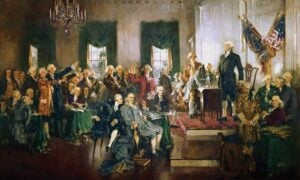
The scene at the signing of the Constitution of the United States. Credit: Architect of the Capitol
In Virginia, the drive for religious freedom was more successful. Patrick Henry, then the governor, and other prominent Virginian lawmakers set out in 1784 to establish Christianity as Virginia’s official religion. Among their proposals was “A Bill for Establishing a Provision for Teachers of the Christian Religion.” It would have taxed Virginians to subsidize ministers and churches of every Christian denomination. James Madison, recently elected to the Virginia House of Delegates after a term in the Continental Congress, was outraged by the proposal and took the lead in opposing it. Back home in Montpelier, he composed a lengthy memo titled “Memorial and Remonstrance Against Religious Assessments.” The document was a fierce criticism of measures that favor some religious beliefs and practices over others. Henry’s bill, Madison argued, “violates equality by subjecting some to peculiar burdens” and grants to others “peculiar exemptions.” He made a forceful argument against any alliance whatsoever between “ecclesiastical establishments” and the government. “During almost fifteen centuries has the establishment of Christianity been on trial,” he observed. “What have been its fruits? More or less in all places, pride and indolence in the Clergy, ignorance and servility in the laity, in both, superstition, bigotry and persecution.” Historian John Fea, author of Was America Founded as a Christian Nation? notes that the Madison memo “challenged a European tradition of church-state relations that was over a thousand years old.” Madison wrote the memo in the form of a petition and secured 1,552 signatures. In part because of the memo’s fiery tone, he released it anonymously.
George Mason, the prominent Virginia planter and patriot, sent a copy of Madison’s memo to George Washington at Mount Vernon, telling Washington he agreed with the sentiments in the memo but could not reveal the author. A day later, Washington said in response that he had not seen Henry’s proposed bill but that he was not in principle opposed to having taxpayers support religious institutions—as long as all sects were treated equally, including “Jews, Mahomitans [Muslims] or otherwise.” He nevertheless thought Henry’s proposal was “impolitic” and hoped the bill would “die an easy death.” He did not have the time to say more, he said, because he had company. (“The Dinner Bell rings,” he noted.)
Madison’s “Remonstrance” memo had the desired effect. Patrick Henry’s proposal went nowhere, and in the aftermath Madison saw an opportunity to reintroduce a bill Thomas Jefferson had proposed in 1779 “for establishing religious freedom.” At the time, Jefferson was in Paris, serving as the U.S. ambassador to France, so he was unable to advocate for the bill personally, but it passed both houses of the Virginia General Assembly in 1786 with minimal textual changes.
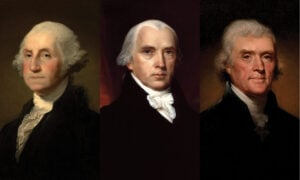
George Washington; James Madison; Thomas Jefferson.
Credits: Clark Art Institute / The White House Historical Association
The statute stipulated that “no man shall be compelled to frequent or support any religious worship, place, or ministry whatsoever.” Were it still in force today and applied nationally, it would presumably prohibit the kind of tax funding for religious schools and other facilities that is now widely promoted, though still hotly contested. (The statute is still officially on the books in Virginia, though in practice it has been largely superseded by the First Amendment, which came two years later and whose language regarding religious freedom and church-state separation is far less explicit.) The statute went on to say that no one “shall be enforced, restrained, molested, or burthened in his body or goods nor shall otherwise suffer, on account of his religious opinions or belief.” Jefferson considered the statute so key to his legacy that he cited it on his tombstone.
Advocates for Christian supremacy soon found themselves on the defensive. In 1787, delegates to the Constitutional Convention, meeting in Philadelphia, approved the U.S. Constitution, including Article VI specifying that “no religious Test shall ever be required as a Qualification to any Office or public Trust under the United States.” The document made no reference to God. On the following Fourth of July, the Constitution’s enactment was celebrated in Philadelphia with a big parade. The Mikveh Israel hazan at that point, Jacob Raphael Cohen (Gershom Seixas had returned to Shearith Israel in New York City) was invited to participate, along with other local clergy. Benjamin Rush, the prominent Philadelphia revolutionary and signatory of the Declaration of Independence, was impressed by the display of ecumenism. “The rabbi of the Jews, locked in the arms of two ministers of the gospel, was a most delightful sight,” he wrote. “There could not have been a more happy emblem contrived, of that section of the new constitution, which opens all its power and offices alike, not only to every sect of Christians, but to worthy men of every religion.”
The “no religious test” provision applied only to the holding of national office, so religious requirements at the state level were not immediately affected. Many states nevertheless dropped their test oaths in the ensuing years. Georgia’s went first in 1789. South Carolina’s fell in 1790. So did Pennsylvania’s, thanks in part to the advocacy of Gershom Seixas, Jacob Cohen and other Jewish patriots. Delaware dropped its test in 1792. States with only a small population of Jews or other non-Christians maintained religious oaths for several more years, but all were eventually dropped.
The Bill of Rights, with its First Amendment prohibiting Congress from making any law “respecting an establishment of religion,” largely drafted by James Madison, did not get final approval until 1791. When Washington visited Newport in 1790, he was in the midst of rallying support for its ratification. Because Jefferson accompanied him on that trip, and was such an ardent supporter of religious liberty, some historians have suggested that Washington’s eloquent letter to the Newport Jews was actually crafted by Jefferson. The sentiments Washington expressed in that letter, however, are consistent with those he had expressed on other occasions. In June, two months earlier, he wrote to the “Hebrew Congregation” in Savannah, Georgia, saying that “a spirit of liberality and philanthropy is much more prevalent than it formerly was” and that “your brethren will benefit thereby.”
Moreover, Washington had expressed that same “spirit of liberality” in remarks over the years about immigrants of all religions and national backgrounds. While celebrating the British Army’s evacuation from New York in November 1783, Washington gave a farewell toast to his officers and then joined in a series of 13 toasts, one for each of the 13 colonies. Number 11 was “May America be an asylum to the persecuted of the earth.” Just a week later, in a message to an association of Irish immigrants during a time of fierce anti-Catholic prejudice in the country, Washington said, “The bosom of America is open to receive not only the opulent & respectable stranger, but the oppressed and persecuted of all Nations & Religions.” In 1788, Washington wrote Francis Adrian van der Kemp, a Dutchman living in exile, “I had always hoped that this land might become a safe & agreeable Asylum to the virtuous & persecuted part of mankind, to whatever nation they might belong.”
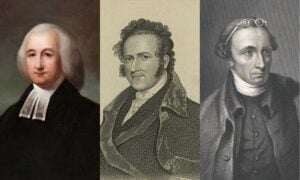
Henry Melchior Muhlenberg; Ezra Styles Ely; Patrick Henry. Credit: New York Public Library
That spirit of generosity, of course, did not extend to the people Washington enslaved. He personally managed nearly 400 enslaved people on his Mount Vernon plantation and other properties. (Jefferson enslaved a similar number; Madison enslaved about 100.) Washington biographer Ron Chernow says by the end of his life, Washington had become “disgusted” by slavery and intended to free his enslaved people upon his death; his plan was undercut, however, by his stronger desire to pass wealth on to his wife. At the time, almost all the northern states had abolished slavery, and abolitionist sentiment was widespread.
Far clearer in Washington’s legacy is his demonstrated opposition over the years to Christian supremacist thinking. He studiously avoided references to Jesus Christ or Christianity in his public statements. The only known instance of him citing Christ is in a letter to the Delaware Indians in which he advised them to learn “the religion of Jesus Christ.”(The letter was in the handwriting of an aide.) Likewise, Washington almost never referred to “God,” preferring more generic words like “Providence” or “All Wise Creator” or “Grand Architect,” the latter a term used in Freemasonry, of which Washington was an adherent. Historians John Fea and Chernow both write that the familiar story of Washington praying at Valley Forge (cited recently by Defense Secretary Pete Hegseth) was unlikely to be true. Chernow argues as well that Washington’s 1790 message to the Jews of Newport showed “he had no notion of foisting a Christian state on the nation.”
The rejection of Christian rule by America’s most important founders did not mean the idea was definitively put to rest—certainly not as far as Jews were concerned. Adam Jortner describes “an uptick of anti-Judaism” in the early years of the 19th century. “Having secured freedom in the 1790s,” he writes, “by the 1820s American Jews were being challenged as citizens…[and] faced an organized anti-Semitic movement to withhold their rights.”
An especially vicious campaign emerged in Maryland, one of the states that had retained a Christian requirement in its state constitution. In 1823, the question of whether to drop that requirement became a huge issue in a state legislative election. When one candidate, Thomas Kennedy, argued for its removal, he was savagely attacked by his opponent, Benjamin Galloway, who asked whether Kennedy wanted “to arm Jews with power to act in our Christian state?” Kennedy’s proposal to drop the test oath became known as the “Jew Bill,” due to its promotion of Jewish civil rights. Opponents of the bill ran collectively as the “Christian ticket.” The bill lost overwhelmingly in its first legislative test, though two years later its supporters managed to sneak a revised version through in the last day of the legislative session, after many of the legislators had left for home. Still, it was clear that the advocates of America as a “Christian nation” retained substantial power.
The “Second Great Awakening” of Christianity in the aftermath of the Revolutionary War and the first years of the 19th century brought a transformation of the traditional Protestant sects of Calvinism, Congregationalism and Episcopalianism, giving rise to evangelical fervor and the idea that Christianity should have a more direct influence in governmental affairs. Among the leading proponents of this movement was Ezra Stiles Ely, a Presbyterian minister in Philadelphia and a friend and confidant of Andrew Jackson. In a sermon on July 4, 1827, Ely said it was “the duty of all rulers and citizens of these United States…to honor the Lord Jesus Christ.”
Ely was careful to emphasize that he was not asking for the continuation or restoration of religious tests for public office, but he called for the creation of a “Christian Party” that would have as its mission the empowerment of Christianity and the election of Christian politicians. “All who profess to be Christians of any denomination ought to agree that they will support no man as a candidate for any office who is not professedly friendly to Christianity and a believer in divine revelation,” he said in that July 4 sermon. “Surely all sects of Christians may agree in opinion that it is more desirable to have a Christian than a Jew, Mohammedan or Pagan in any civil office,” he said. “We are a Christian nation; we have a right to demand that all our rulers in their conduct shall conform to Christian morality.” (Despite their friendship, Andrew Jackson did not support Ely’s proposal for a Christian party.)
Those years also brought new jurisprudential challenges to conventional interpretations of the Founding Fathers’ beliefs regarding religious freedom and the First Amendment. The notion that government, at any level, should not favor one religion over another, or even religion generally over secularism, was disputed anew. Supreme Court Justice Joseph Story led the way. In an influential text published in 1833, Story questioned whether the First Amendment’s Establishment Clause was intended in part to protect “Mahometanism [Islam], Judaism, or infidelity” against Christian domination, as had previously been argued. The purpose instead, he argued, was merely to prohibit the government from establishing a national religion, leaving such a decision “exclusively to the state governments, to be acted upon, according to their own sense of justice, and the state constitutions.” Even so, Story said Christianity could and should be favored. “It is impossible for those who believe in the truth of Christianity as a divine revelation,” he said, “to doubt that it is the especial duty of government to foster and encourage it among all citizens and subjects.”
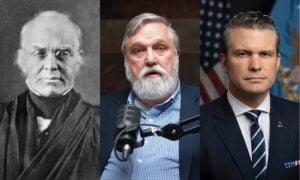
Joseph Story; Douglas Wilson; Pete Hegseth. Credits: LOC / Screenshot / U.S. Department of Defense
Justice Story’s 1833 interpretation later fell into disfavor, as courts ruled that the Fourteenth Amendment, prohibiting states from depriving any person of “life, liberty, or property, without due process of law,” meant that the First Amendment restriction on religious establishment applied to state legislatures as well as Congress. In recent years, however, with the rightward drift of Supreme Court jurisprudence, Story’s commentary has come back into fashion. Chief Justice William Rehnquist cited it in his dissent from a 1985 opinion that affirmed church-state separation. Subsequent rulings by the Roberts Court have strengthened the power of states to set their own laws and policies regarding religious practice.
More recently, Justice Story’s claim that it is the “especial duty of government to foster and encourage” the “truth of Christianity” has found an echo in the arguments of influential Christian nationalists such as Douglas Wilson, the right-wing pastor who advocates for explicitly Christian governments at the local, state and national levels. Wilson has actually suggested that the U.S. Constitution be amended to include the Apostles’ Creed, the basic Christian profession of faith. Among Wilson’s followers is Timon Cline, the editor-in-chief of American Reformer, a journal loosely affiliated with Wilson’s church confederation known as the Communion of Reformed Evangelical Churches. In January 2025, the journal reprinted Ezra Stiles Ely’s 1827 sermon calling for a Christian Party in opposition to “Turks, Jews, and Infidels.” An unsigned editor’s note described the sermon as a “comparatively moderate, Scripture-laden vision for a Christian nation” and said it “should prove compelling to all well-meaning and reasonable Christians today.”
With the Trump administration directing the celebration of the 250th anniversary since independence, Christian nationalist arguments that were once on the political margins have found mainstream champions. Pete Hegseth, a member of one of Douglas Wilson’s churches, affirmed Wilson’s vision for America at the National Prayer Breakfast in February 2026. “America was founded as a Christian nation,” he said. “It remains a Christian nation in our DNA, and as public officials we have a sacred duty 250 years on to glorify Him.” With that, he pointed a finger to the heavens.
Such a public proclamation coming from George Washington, Thomas Jefferson, James Madison or other American Founders would have been virtually unimaginable.
One thought on “George Washington, Rhode Island’s Jews & a New Nation For All”
This was such a wonderful documentation of the Jewish struggles during this period and a reminder that we always had to fight for our beliefs. It is heartwarming to know our founding forefathers practiced their beliefs of freedom despite the irony of their persistent practices of slavery.