
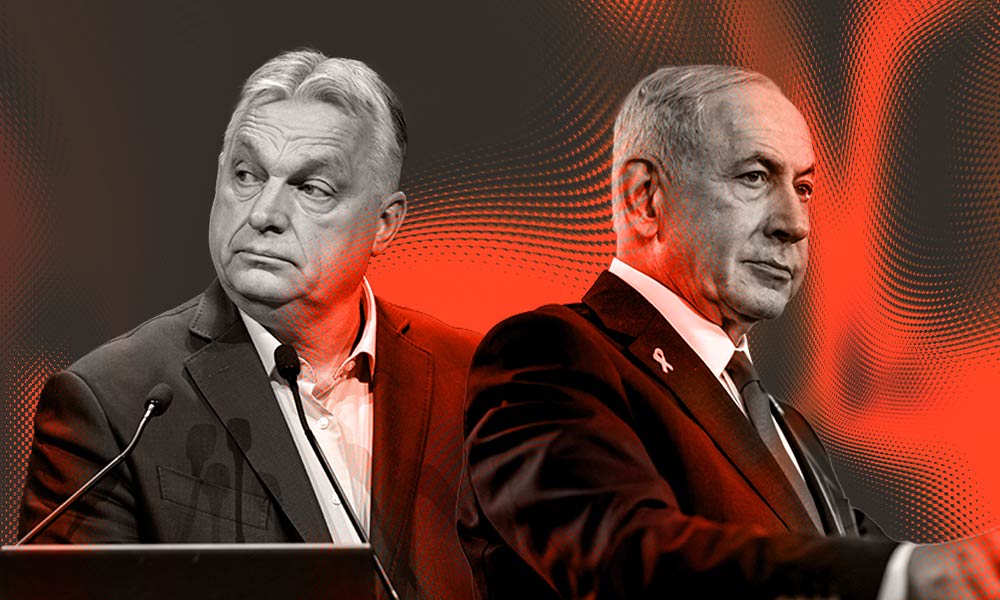
By overtly supporting Viktor Orbán in the recent Hungarian general elections, Israeli Prime Minister Benjamin Netanyahu bet on the wrong candidate. On April 12, Orbán lost to Péter Magyar, who pulled in an astounding two-thirds of the seats in the Hungarian parliament. And Netanyahu’s miscalculation may have strategic, tactical and symbolic implications for Israel’s relationships with the European Union and its overall geopolitical and diplomatic future.
For years, Netanyahu has based his foreign policy on alliances with populist and illiberal countries—in Europe and in South and Latin America, Asia and the Gulf. This reflects Netanyahu’s view of global politics, best articulated by former Israeli Ambassador to the United States Michael Oren, who has said he believes that Europe is more inclined to pressure Israel diplomatically than to support it in international forums. This, Oren argues in his writings, is because Europe is increasingly post-national, rights-focused and critical of military power, a worldview that conflicts with Israel’s view of itself as a nation-state under persistent security threat. He adds that this includes a domestic component, since this broadening of alliances suits the views of Netanyahu’s right-wing base, many of whom are Mizrahim (that is, their heritage is from the Arabic speaking countries) and view liberal internationalism and human rights institutions as dubiously hypocritical.
Furthermore, Israel’s signing of the Abraham Accords reinforced this idea: Israel can build meaningful partnerships outside Europe’s orbit.
For Netanyahu, this has been a way to bolster Israel’s positions in international bodies; in return for their support for Israel, these countries have been able to secure arms deals with Israel and to flaunt their relationship with Israel as a means to launder their historical and current antisemitism.
Within Europe, for example, Netanyahu has long allied himself with the so-called Visegrad Group (Poland, the Czech Republic, Slovakia and Hungary, with external support from Austria, which is not a formal member) rather than with the Western European nations.
This is the background to Netanyahu’s relationship with Orbán, which is based on shared ideology and interests. Since EU foreign policy requires unanimity, Orbán repeatedly used his veto power to prevent or dilute EU statements critical of Israel, especially on Israeli settlement policy, blocked condemnations of Israeli military operations, and prevented censure and sanctions at the UN. Orbán was also the only European leader who has allowed Netanyahu to visit regularly, despite outstanding warrants for his arrest, issued by the International Criminal Court.
In return, as Jerusalem Post senior columnist Herb Keinon notes, Orbán knew that his close ties with Israel strengthened Hungary’s standing, particularly during periods when Budapest’s position in Western capitals was strained, and, in addition to Orban’s own close ties to American conservatives, has provided Hungary with access, influence, and channels into those American political circles where Israel’s voice carried particular weight.
Furthermore, as his membership in the Visegrad Group reveals, Orbán has sought to diversify his reliance on Western European countries, perhaps hoping that Hungary, despite its failing economy and lack of military strength, could become a leader in a different geopolitical constellation than the prevailing one. Orbán has long complained that the EU has not accorded Hungary the respect and position it deserves, especially after some 15 billion euros of EU funds were frozen over rule-of-law breaches and corruption. “Hungary’s peace and development are guaranteed by membership of the European Union and NATO,” Orban fumed, demanding that Hungary be treated as full partner in Europe and not as if it were merely a “Russian puppet state,” due to his close ties to Putin.
Over the years, as Orbán and Netanyahu increasingly degraded democratic institutions and drove their respective countries towards illiberal and majoritarian democracies, they seemed to have been operating out of the same manual. Both of them focused on stifling the media, delegitimizing opposition, weakening and politicizing the judiciary, and targeting civil society organizations. Both of them have allowed crony capitalism to replace real economic progress. Furthermore, both have been widely accused of corruption: While Netanyahu is currently on trial for breach of trust, accepting bribes and fraud, Orbán is facing multiple high-level investigations and legal actions from the EU and other bodies, focusing, among other issues, on the rule of law and corruption.
And so, it is hardly surprising that, like U.S. President Donald Trump, who sent Vice President JD Vance to stump for Orbán, Netanyahu did all he could to endorse Orbán in the elections. He appeared virtually alongside other far-right European leaders at Orbán’s campaign kickoff and at the recent CPAC conference in Budapest—despite Israel’s policy to not officially engage with these parties due to their neo-Nazi ties. Netanyahu also gave an interview to a fringe evangelical magazine published by a church in which Orbán’s son serves as a priest, praising Orban as an essential partner in safeguarding the “Judeo-Christian” alliance. Netanyahu’s son, Yair, who is often seen as his father’s spokesman, visited Budapest on the eve of the election and remarked that “Hungary is my second home.”
But Orbán lost abysmally. And supporting the other side just may cause resentment among the winners when they take power.
Magyar has yet to present his full plan for the future, although since he only recently broke away from Orbán’s party, Fidesz, in order to run, it is unlikely that he will make sweeping changes in social policies. He appears to have conservative views on the status of women, LGBTQ+ rights and human rights, including education, and he is known to be a fierce opponent of immigration. However, most observers assume that Magyar will, at least at the beginning, engage in a less-confrontational approach toward the EU and be more aligned with mainstream EU positions.
In this context, Magyar may not be as willing as Orbán was to oppose EU positions on Israel. According to Maya Sion-Tzidkiyahu, Director of the Israel–Europe Relations Program at Mitvim, the Israeli Institute for Regional Foreign Policies, who was recently interviewed in The Guardian, where she noted that Hungary has been blocking the European Union for over six months from imposing new sanctions on seven Israeli settlers and organizations promoting settlement expansion, conditioning its support on the EU also sanctioning members of Hamas and affiliated entities.
Furthermore, Magyar will likely want to take advantage of the initial good will he will enjoy in order to recoup some of the funds held by the EU, for which the Hungarian economy is desperate. He is therefore unlikely to be as disruptive as Orbán and more likely to support traditional European policies, including commitment to a two-state solution.
And despite his conservative political party background, he is also more likely to support human rights and liberal values, at least on a declarative level. In a recent press conference, when asked if he would call for Netanyahu’s arrest if he were to land in Hungary, Magyar responded, “If a country is a member of the International Criminal Court and a person who is subject to an arrest warrant enters its territory, then that person must be taken into custody…I do not need to explain that any further.”

As anti-Israel sentiment in Europe surges even stronger over the wars in Iran and Lebanon, even former staunch friends of Israel may find it necessary to navigate between domestic politics and international interests. For example, Giorgia Meloni, the right-wing leader of Italy, has recently announced that Italy is ending her country’s defense agreement with Israel. This is of particular concern, since Italy has been thought of as one of Israel’s best and last friends in Europe. Until now, Italy had rejected the moves made by other European governments, including suspending arms sales, expelling Israel from defense industry fairs and recognizing a Palestinian state. Former ambassador Oren referred to Meloni’s decision as the “coup de grace to Israel’s relations with the continent.”
Another issue in which Hungary’s support for Israel has been crucial relates to potential moves to cut the EU-Israel Association Agreement, which governs trade ties and the Horizon scientific research program. Last week more than 390 former EU ministers, ambassadors and top officials urged the EU to suspend the EU-Israel association agreement in whole or part, including former EU foreign affairs chief Josep Borrell, the former Swedish foreign minister and UN weapons inspector Hans Blix, and the former European Commission vice-president Margot Wallström. These issues require a majority rather than unanimous agreement, and while Germany and Italy are expected to oppose such measures, that alone would not be enough, Sion-Tzidkiyahu told The Guardian. “If Hungary and the Czech Republic join the opposition [to cutting the agreement], there is no qualified majority for the decision to pass.” She warns, however, that without Hungary, under Magyar, opposition from additional countries such as Austria, Romania or Bulgaria would be needed—and it is unclear whether they would agree.
Sion-Tzidkiyahu also points out that ties with Europe underpin Israelis’ standard of living. Two-thirds of Israelis see the EU as an adversary, and only 14 percent see it as a friend, an August 2025 survey carried out by Mitvim found. “All Israelis know that we are dependent on the U.S. for security issues, but they don’t understand that we are dependent on the European Union for economic issues,” she says. “We have managed to diversify trade, but the EU is still the largest bloc we are exporting to and importing from.”
(Top image credit: Vox España / The White House)