
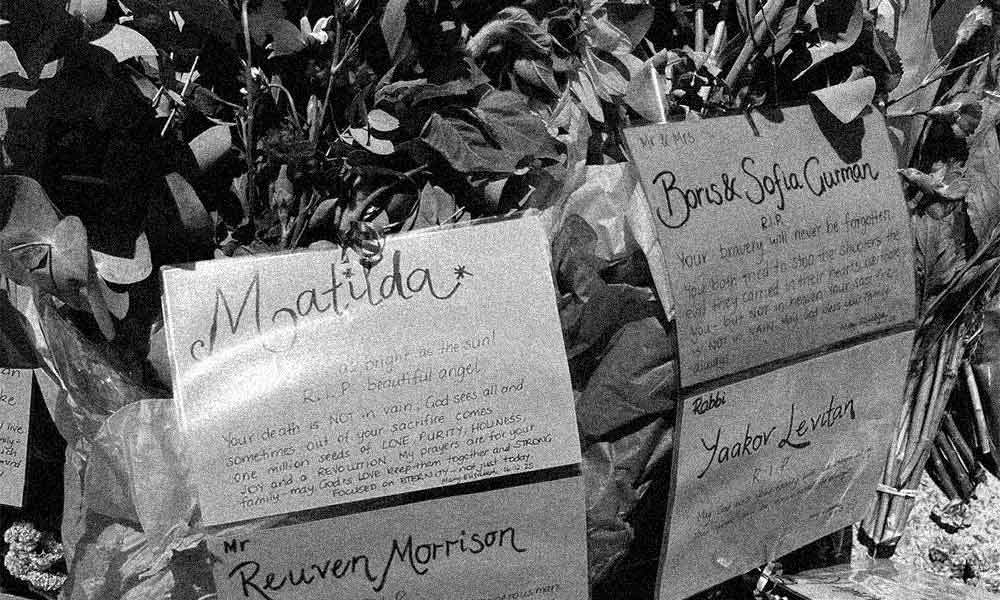
Nechama Shemtov is an internationally acclaimed speaker and educator, columnist, coach and community leader who was born and raised in Sydney, Australia. Currently based in Washington, DC, she is the director of Education and Women’s Issues at American Friends of Lubavitch (Chabad) and the founder of AURA Jewish Women. Moment caught up with Shemtov days after the shooting at Bondi Beach during the first night of Hanukkah.
Thank you for speaking with me, I really appreciate it. How are you feeling right now?
Still shaken. I grew up literally five minutes from Bondi Beach and I’m incredibly familiar with that landmark. Among the victims, the wounded and the participants, were relatives, friends, and friends of my siblings, so it’s actually incredibly personal to me.
So you knew most of the people at the event?
Not most, but many. The Australian community is very intertwined and connected. There are about 40-50,000 Jews in Sydney, and even if they’re not all practicing Jews, they’re affiliated and proud Jews. It is a community I grew up with, and more specifically it was a Chabad event. So the ones who organize[d] it are all dear friends and people that we know.
What did it feel like in the moments when you found out what was happening?
I actually wanted to throw up—that was my body’s reaction. My husband woke me up in the middle of the night, saying I needed to check in with family. I didn’t know what he was talking about, and he said there was a shooting on Bondi Beach. I realized it was a Hanukkah celebration that had been targeted. My first reaction was disbelief, my second was terror: Please tell me it was no one that I know, please tell me everyone I love and care for is okay. And then my third reaction was immense sadness. No one deserved to die, no one deserved this trauma. My brother-in-law was there with his kids—he left 30 seconds before it happened. As they were driving out they heard shooting, and they thought it was fireworks. It’s summertime in Australia; they figured it was the finale for the event. They didn’t even process what was going on. My nephew was at the event, holding his three-year-old child, arms wound tightly around her, bullets grazing past his ears. He said that he was thinking, I’m next. My husband’s cousin was shot and remains in the ICU in critical but Thank Gd, stable condition.
Everybody in Australia is in a state of shock. And anger, obviously, but no one wants to really dwell on that to begin with. There are a lot of questions that need to be answered about how we got to this point and why the response was so lame.
What was the response?
It took at minimum, by all accounts, ten minutes for the police to engage the shooters. There’s a police station that’s maybe two minutes away, directly up the beach. Think about how many bullets and how many shots can be fired…It was an epic failure on behalf of the New South Wales authorities in terms of how that was handled.
What have you heard out of the community in Australia, non-Jews included?
Everybody’s very supportive, not just from the Jewish community, but beyond. I think everyone realizes that the Jew-hatred that we’ve seen in Australia…I think this was a tipping point. It’s one thing to have the rhetoric be so anti-Israel, which is a comfortable way to be anti-Jewish, and at the same time, think that everyone’s going to be safe when you speak that way. It’s just become acceptable for there to be so much hate surrounding Israel. Antisemitism has been felt there pretty strongly for the past couple years, but now I think they’ve realized something’s got to give, something’s has to change. In Australia, the community—both Jewish and beyond, is rallying together.
“We have faith in Hashem, we believe that He’s got a reason for why things happen. It doesn’t mean we don’t question, and as Jews we’re encouraged to, but while we’re questioning, we keep acting, we keep doing, we keep brightening the world.”
Do you feel like the issue of antisemitism and Jewish safety has risen in the past years, or even months?
I think you would have to be blind not to pick up on what’s going on. It’s definitely risen. You can say it’s just social media that has amplified the antisemitism, and maybe it’s as bad as it’s always been, and this is just the iteration for this generation, but I don’t know if that makes it more comforting. Because even if it’s been at the same level it’s been at for previous generations, we’ve seen where that has led us.
Do you think Chabad is targeted in particular?
I don’t know that Chabad is targeted in particular, but I do believe that Chabad is probably, today, the most prominent and active Jewish organization that’s out there. So therefore, if you want to target somebody, Chabad might be a good option, Gd forbid. If you want to target a bigger event, who’s making one? Chabad. However, it’s not just Chabad; look at what happened in DC a couple of months ago when two Israeli embassy staffers were shot outside the Capitol Jewish Museum. So, I don’t know if they wake up and say “Let’s target Chabad,” I think they wake up and say “Let’s target Jews,” and then they find the most visible or large or well-known Jewish event, and in some cases it might be Chabad.
How is Chabad handling this tragedy? I know two of their rabbis were the ones killed.
The rabbis were actually instrumental in the success of that particular Chabad group in Bondi Beach. How does Chabad handle this? The way we always handle this, the way we handle everything: We turn towards the teachings of the movement, Rabbi Schneerson, who always taught that in the place of darkness, you light a candle. In place of darkness, you react by bringing light. We’re not the kind of group that cowers and says—as a result of this, we’re shutting down, closing shop, diminishing our activities. On the contrary, it motivates us all to say that we’re moving forward, we’re going to become stronger and more vibrant and more resilient than ever before. That’s sort of our mission statement, so to speak, to keep doing, keep bringing light. We have faith in Hashem, we believe that He’s got a reason for why things happen. It doesn’t mean we don’t question, and as Jews we’re encouraged to, but while we’re questioning, we keep acting, we keep doing, we keep brightening the world.

What do you think needs to happen to protect Jews and their places of worship?
I think more guards, obviously. It is definitely a deterrent, especially for an amateur. I believe it would be wonderful if we had a way to fund more security, so that much of it wouldn’t have to come privately from within the institutions, and Houses of Worship wouldn’t have to think twice about what gets secured and what doesn’t. Governments across the world understand that Jews are being targeted. Don’t wait until after an incident to react; instead, let’s really beef up security everywhere. If only the government could shut down antisemetic rhetoric. I know that’s a pipe dream—for now—but hopefully it can become more of a reality.
You are a community leader who teaches wisdom from the Torah. What would you say to people who are scared right now?
You know, the most common phrase in the Torah isn’t “believe in God,” it’s al tira (“do not be afraid”), which is very interesting, and it’s very appropriate. God is telling us, “Don’t be afraid when they try to bring you down”, “Don’t be afraid when people don’t respect who you are.” “Don’t be afraid of someone mocking you for your Jewish identity.” Don’t be afraid to espouse your values.” As Jews, our way is to try to educate, to bring love, and hopefully impact others to follow in our path. To continue to be an Ohr leGoyim, a light unto the nations, to not be afraid and to shine our light and hopefully brighten the world a little more.
What is your family doing to cope and process the trauma?
We text and Face-time each other at 3am in WhatsApp groups. I come from a family of rabbis; we’re all in the same industry, we all do outreach. I have ten brothers and sisters, and nearly all of us are in the same line of work. We’re consoling others, we’re helping others, we’re trying to be the lighthouse in the sea of fear and uncertainty. I truly believe that when you reach out and help others, you actually get the help yourself. By giving and being there, and encouraging and supporting everybody else, Hashem in turns gives us the strength that we need to live another day and keep moving.
Anything else I didn’t touch on you want to add?
I do want to say that the person who brought down one of the terrorists was a Muslim individual. The world isn’t black and white. It was beautiful to see that someone who had nothing to gain by defending us, risked his own life to save many, and we’re deeply grateful. It’s very encouraging, because there really is hope. We’re told that at the end of days when the moshiach [messiah] comes, the world will live in peace. And to me, that was a glimmer of the days of moshiach coming. The potential is there for us to live in peace, and I hope that day will come soon.
This interview has been lightly condensed and edited for clarity.
(Top image credit: WWBG via Wikimedia Commons)