
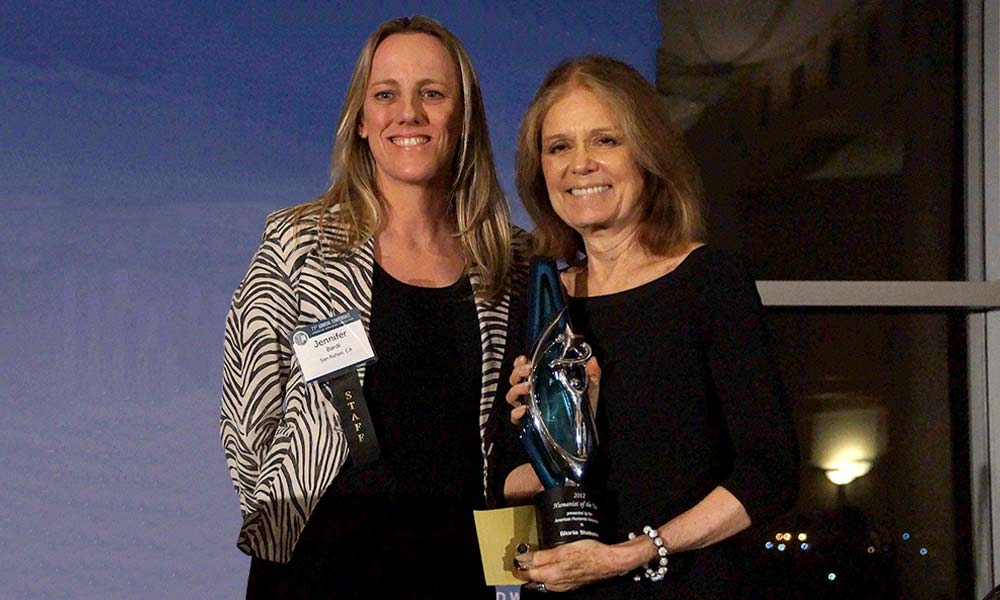
It was the honor of a lifetime to present the Humanist of the Year award to Gloria Steinem in New Orleans in 2012. I was the editor-in-chief of The Humanist magazine at the time, and she sat with me for a wide-ranging interview earlier in the day, in which we discussed religion, reproductive freedom, the power and necessity of humor and so much more.
On the humor front, the subject of what might go on her tombstone arose in talking about the things women get called. This was the early 2010s when Rush Limbaugh was prone to labeling any woman who challenged the patriarchy a slut. I asked Steinem about the power of reclaiming words.
“We can take the sting out of epithets and bad words by using them,” she said, adding that she’d done that with Limbaugh’s brickbat. “I went back to Toledo, Ohio, which is where I was in high school and junior high school. I was on a radio show with a bunch of women. A man called up and called me ‘a slut from East Toledo,’ which is doubly insulting because East Toledo is the wrong side of town…when I’d lived there I would have been devastated by this. But by this time I thought, you know, that’s a pretty good thing to be. I’m putting it on my tombstone: ‘Here lies the slut from East Toledo.’”
It was one of her superpowers, I think: the keen ability to disarm while fighting for what’s right. To comfort the afflicted and afflict the comfortable.
“What I miss most are the editorial meetings. In some sense, to me, life is an editorial meeting, but ours were so free and open and full of spark.”
I asked her about Ms., the magazine she co-founded in 1971 with Letty Cottin Pogrebin (of course familiar to Moment readers), Mary Thom, Patricia Carbine, Joanne Edgar, Nina Finkelstein, Mary Peacock and Margaret Sloan-Hunter. In the introduction to her 1983 book, Outrageous Acts and Everyday Rebellions, Steinem talked about the need for a female-controlled magazine for women and some of the challenges she faced with Ms.—for instance, convincing advertisers that women would look at an ad for shampoo without an accompanying article on how to wash their hair.
“What do you miss most about being involved in the day-to-day operations of Ms.?” I asked.
Without skipping a beat, she replied: “What I miss most are the editorial meetings. In some sense, to me, life is an editorial meeting, but ours were so free and open and full of spark. They included pretty much the whole staff and people who just wandered by and people who were visiting.” (Note to my fellow Moment editors: Does this ring a bell?)
Later that evening 14 years ago in New Orleans, after presenting her with the award and sitting rapt as she gave her acceptance speech, I watched her mingle with banquet attendees until close to midnight. I knew she had to catch a 4 a.m. shuttle to the airport later, which made her stamina, generosity and genuine interest in others all the more inspiring.
The next morning I encountered one of the big donors who had been seated at the VIP table with Steinem the night before. “Wasn’t she great?” I asked him. He nodded tepidly and then cocked his head slightly. “Yeah, but, you know, she looked really tired.” Oh boy. The Laura Branigan song I’d set up to bring her on stage the night before suddenly filled my overheating head: Gloria, I think they got your number. First of all, she looked great—Steinem was gorgeous and fashionable in all black with silver jewelry, beautifully manicured nails and a really cool belt that hung low on her narrow hips. Second, she looked her age. “She’s 80!” I responded, not attempting to hide my exasperation. Unfazed, he shrugged and repeated that he thought she looked tired. What I should have said to him was, “I’m sure she is tired! Tired that after all she’s done and been, this is still what guys like you are thinking about.”
I’m pretty sure Steinem decided on a different message (or none) for her tombstone than the one she joked about that day we met. Maybe “A woman needs a man like a fish needs a bicycle”—a phrase she didn’t coin but popularized. Or “A feminist is anyone who recognizes the equality and full humanity of women and men.” My favorite is “The truth will set you free, but first it will piss you off.” We will be reminded in the coming days of so many other empowering things she said and did. For my part, I’ll just say thank you, Gloria Steinem, for your humor and empathy, for your grace and style, and for your fierceness and wisdom.