

“Is antisemitism a harbinger of democratic decline, or is the decline the cause of antisemitism?”
This was the question Moment magazine Editor-in-Chief Nadine Epstein asked to get things started at the inaugural Moment Institute Fellows Symposium, held on November 17, 2025, the morning after Moment’s 50th Anniversary Gala. The panel was titled “Divided We Fall: Antisemitism and Democracy in Crisis,” and topics included the existence of antisemitism on both the political left and right, the state of the Black-Jewish relationship in the United States, and the rise of Chrisitian nationalism (also the topic of Moment’s November/December cover story).
Seated in high director’s chairs before a Black history exhibit in a skylight-filled room at the DC History Center, Epstein, who is the founder of the Moment Institute, was joined by the magazine’s senior fellows: Ira N. Forman, U.S. Special Envoy for Monitoring and Combating Antisemitism in the Obama administration and former director of Moment’s Antisemitism Monitor; Tom Gjelten, Moment contributor and former NPR foreign correspondent and religion reporter; Dr. Sharon S. Nazarian, vice chair of the National Board of Directors at the ADL and founder of the Y&S Nazarian Center for Israel Studies at UCLA; and Eric K. Ward, civil rights strategist, executive vice president at Race Forward and co-host of Moment’s Wide River Project.
Responding to Epstein’s opening salvo, Ward characterized antisemitism as a signal that pluralism is breaking down in a society and that can also become a tool used to destroy democracy. Like Islamophobia and anti-Black racism, antisemitism is always present, he said, but certain events act as catalysts to give people permission to tap into these forms of hate in more virulent ways. Ward cited the spike in anti-Muslim hate crimes after 9/11 as an example, adding that when President George W. Bush and others in his administration took to the airwaves to condemn such reactions to the Al-Qaeda attacks, anti-Muslim hate crimes dropped quickly. “Leaders have to tamp down sectarianism,” Ward stressed, “and create space for multiple viewpoints…siloing has never moved the needle.”
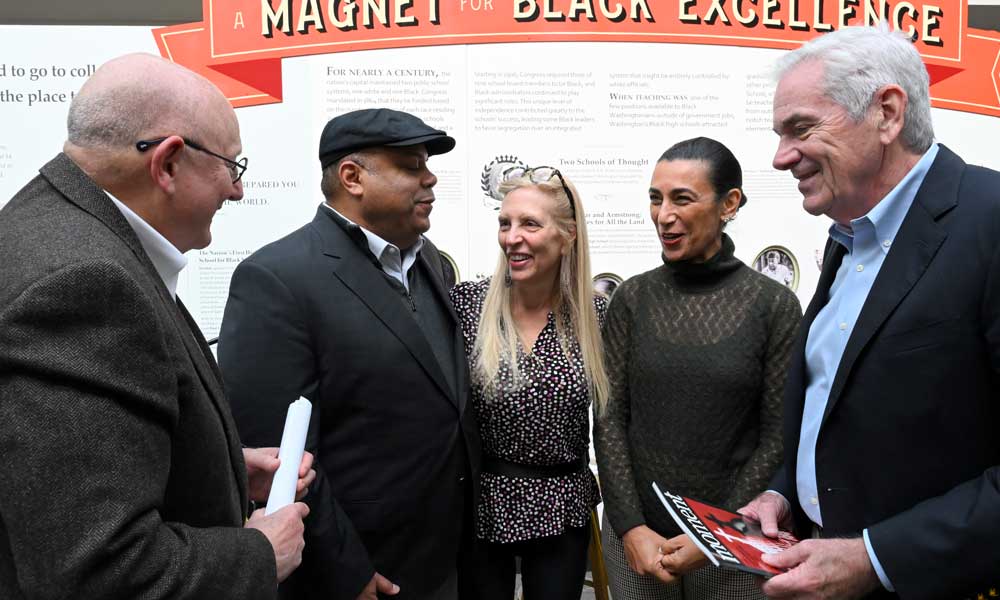
From left to right: Ira N. Forman, Eric K. Ward, Nadine Epstein, Sharon S. Nazarian and Tom Gjelten after the symposium.
Nazarian agreed that antisemitic activity is a leading indicator that a democratic society is headed in the wrong direction. She cited the widely circulated image of the man in the “Camp Auschwitz” T-shirt who took part in the storming of the U.S. Capitol on January 6, 2021, as an example of a catalyzing moment.
Nazarian was born into a Jewish family in Tehran that fled after the Islamic revolution began in 1978. She pointed out what she sees as a parallel between the leftist elites and academics in Iran who backed it and today’s American college students who allied with the Palestinian cause and cast Hamas’s October 7 terrorist attack as justified. The Iranians who embraced revolution watched their country quickly turn to Islamist authoritarianism. Will leftists in the United States, including Jews who support groups like Democratic Socialists of America, wake up to the possibility of something similar happening? Nazarian asked. She also lamented the way antisemitism has been weaponized of late, pointing to the Trump administration pulling academic and scientific research funding from UCLA under the guise of addressing real threats to Jewish students there. “We are in a very strange moment for the Jewish community,” she concluded.

Gjelten’s remarks were informed by his deeply reported cover story for Moment’s 2025 November/December issue: “The New Christian Right, Antisemitism & U.S. Democracy.” The piece details the key goals and players in the National Conservatism movement, founded by two Jews but largely championed by Christian nationalists, including members of Congress and the Trump administration. Noting that antisemitism is an ancient phenomenon, Gjelten called out a “new interest in ethnonationalism, the idea that a nation should be defined by its ethnic identity.” This explains a right-wing Zionist interest in National Conservatism vis-à-vis the Jewish state; however, for its American counterparts, Gjelten explained, it is exclusively a “white, Christian, European heritage” that qualifies someone to be a real American.
Obviously this excludes minority groups, including Jews. This new Christian nationalism, Gjelten added, even rejects the term “Judeo-Christian.”
On the question of the relationship between overt antisemitism and democratic decline, Forman stressed that antisemitism can operate in both democratic and authoritarian societies. He offered Hungary as an example of a country where democracy has been stifled slowly, including through attacks on Jewish elites like George Soros, by corruption in Viktor Orbán’s government, and by elections that are promoted as free but aren’t fair. Given the Trump administration’s closeness to Orbán, Forman posited that Trump and company are perhaps following his playbook.
The panelists also had some tough love to dole out. “The worst thing Jews can do is to be paralyzed by fear about the state of the country, about Israel and about the Jewish people,” Forman said. He also stressed that false charges of antisemitism do not help the problem of combating very real instances of it.
“We point fingers, but we don’t do enough calling out of what we won’t tolerate in our own camp,” Nazarian added.
Speaking about Black-Jewish relations, Ward gave credit to the visionary leaders from both communities who, in achieving the successes of the Civil Rights era, acted as “co-authors.” However, he said, there has been some mythologizing of the alliance; “the majority of the Jewish community didn’t show up for the Black community.” Ward also had some sober words for the largely Jewish audience: “Stop believing Jews are the only victims of antisemitism.” He named mass shootings perpetrated by men fueled by antisemitic bigotry, such as those who murdered Black grocery store customers in Buffalo, NY, and Latino Walmart shoppers in El Paso, TX.
“There’s something about human minds that think about things in very simple ways,” Epstein said, stressing the need to avoid simple narratives. “These issues are complex—there’s so much history to learn.”
Forman’s truth-telling included the statement that “anyone who tells you antisemitism only exists on the right is either ill-informed or they’re lying. And anyone who tells you antisemitism only exists on the left is either ill-informed or they’re lying.”
Proceeding from a premise that antisemitism in America exists on a horseshoe-shaped political spectrum, one might ask: Can a horseshoe be bent such that the two extremes might gravitate closer to the middle? Ward suggested that putting sectarianism aside is key, and that it requires sacrifice. He also urged the audience to stop arguing with the same Jewish family members about Israel-Gaza. “You’re simply reinforcing your respective positions,” he said. “The way to proceed is to be curious about the opposite position—about anti-Zionism, Zionism, non-Zionism.” Debate in the Jewish community can be healthy and robust, he added, but “non-Jews shouldn’t fan the flames of debate over antisemitism.”