
DEBATERS
Haggai Matar is the executive director of +972 Magazine, which is partnering with an Israeli publisher to bring out a BDS-compliant Hebrew translation of Sally Rooney’s 2024 novel Intermezzo.
Maurice Schweitzer is a professor at the Wharton School of Business at the University of Pennsylvania.
INTERVIEW WITH HAGGAI MATAR
Do boycotts produce good policy outcomes?
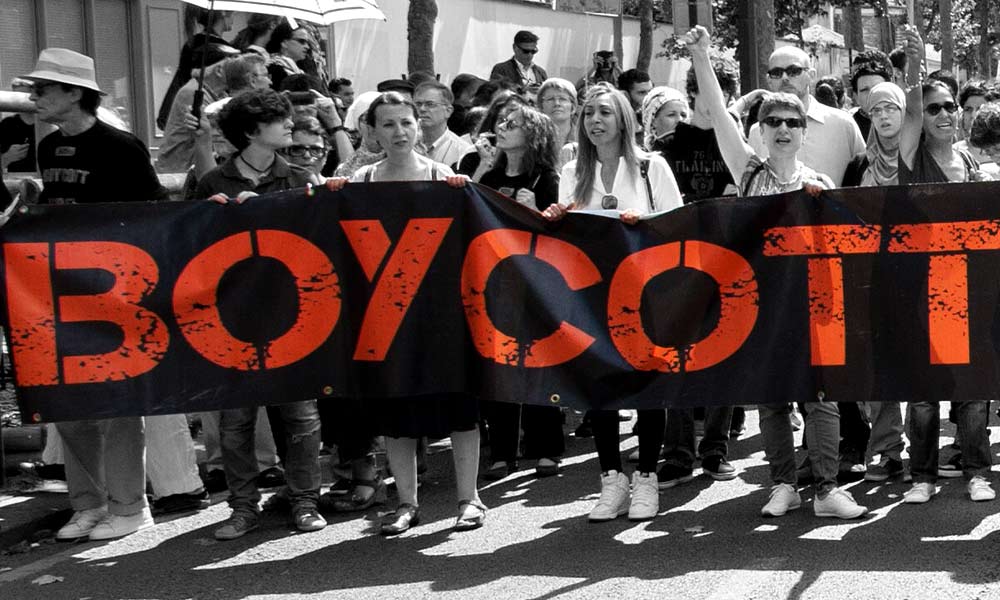
Yes. Consider South Africa during apartheid, or resistance to Jim Crow. I’m vegan, and vegans in essence are boycotting meat and products of the livestock industry, which raises awareness of the torment of animals and also harms those industries financially. Companies that abuse their workers may face boycotts of their products. Boycotts are a tool that’s powerful, nonviolent and popular—in the sense of allowing mass participation—in struggles for justice, liberation and equality. And in Israel/Palestine it’s no different. Like South Africa, Israel’s a small country, highly dependent on its ties with the West, so it’s likelier to respond to a boycott than, say, China or Russia.
What’s distinctive about boycotts that succeed?
First, they have to raise enough support. The Boycott, Divestment and Sanctions (BDS) campaign has lasted over 20 years now, and it hasn’t yielded the results it could’ve because it doesn’t enjoy the mass support it should. Also, does the side that’s being boycotted have alternatives? If the boycott is powerful and the boycotted entity is under genuine pressure, success is likelier.
They’re a powerful, popular, participatory and nonviolent tool in struggles for justice.
The South African activist Zackie Achmat explains that the pressure there was not just financial or cultural but cumulative over time, the sense among South African whites that they had be- come pariahs in Western civilization, the very society they believed they belonged in. They realized they could no longer be the people they wanted to be, or live the lives they wanted to live, and also practice apartheid.
Is the BDS movement typical of such boycotts, and is it effective?
It’s rare for individuals and artists to boycott a country or regime. The South African case is the only equivalent I can think of, and that was highly effective. BDS in Israel is definitely gaining momentum and being discussed more, especially over the last two and a half years. If that continues, Israeli society may come to see that recognizing the rights of Palestinians and ending Israeli apartheid is the only way to avoid these increasing pressures. But right now it’s still a siege mentality. Participating in the boycott is perceived as an act of antisemitism, woke mind virus and cowardice. So many explanations offered in Israeli public discourse are just trying to escape the actual political demands of the boycott movement, to avoid its message and find other explanations for what is happening.
My magazine, +972, is arranging to translate Sally Rooney’s newest novel into Hebrew partly to try to debunk those myths. She was accused of being antisemitic or anti-Hebrew-language when she refused to have her books translated here, and it wasn’t true. She had said from the beginning that the rights to her books in Hebrew were available if a BDS-compliant possibility were found, which we did. The message to Israelis was “We’re not boycotting your identity, just your complicity.” Bringing the book out in Hebrew and in compliance with BDS makes that message more difficult to ignore.
Is there a distinction between boycotts and so-called anti-normalization campaigns, or attempts to anathematize an entire country?
Those are all different. Anti-normalization has to do with relationships between Palestinians and Jewish Israelis. It comes from the very bitter experience of Palestinians, especially in the 1990s, when talk of peace and coexistence was actually weaponized to give Israelis a sense they were moral for talking to the “other” while still oppressing them. I speak from personal experience on this. I went to a summer school with Israeli and Palestinian kids where we became friends. But when we turned 18, all but one of the 20 Israelis in the program went into the army and served as oppressors of the very friends they had come to know. I was the one who didn’t. The Palestinians asked, what was the point of hearing our stories and becoming our friends? That sentiment created a demand among young people not just to talk coexistence but to actively oppose what the government is doing.
As for anathematizing a nation generally, I think that’s very, very dangerous. We’ve seen how in the case of Russia, and maybe during WWII for Japanese Americans, criticisms of a government’s actions created hostility toward people who had nothing to do with those actions. And that’s unwarranted. How were people contributing to a free Ukraine by disconnecting from Russian dissidents, people who live in exile and struggle against their regime?
The BDS campaign states it isn’t targeting people or identity, just complicit institutions. When people randomly isolate or call out or attack Israelis or even Jews, that’s not what the boycott is about, and it risks becoming antisemitism. When synagogues are being attacked, that has nothing to do with engaging in a boycott for a goal.
INTERVIEW WITH MAURICE SCHWEITZER
Do boycotts produce good policy outcomes?
Generally not. For one thing, they usually fail. People get distracted. Attention’s a scarce resource and keeps getting absorbed by new things. For another, they’re costly to the consumer.
Even the boycotts that succeed tend not to be very deeply considered. Take the boycott of Bud Light after it promoted the trans influencer Dylan Mulvaney. It was an attempt to broaden Bud Light’s market appeal, but it ignited a backlash among the company’s core consumers, which cut into sales. There were a couple of reasons the boycott worked. Beer is a socially consumed product, a way we signal identity. And there are easy substitutes: You can get a Coors instead. Most products aren’t like that. So that boycott was effective, but should it have been? Just because a Manhattan-based marketing team misread the political moment? People like using their individual economic power to accomplish things, but the world is full of nuance, and boycotts don’t allow for much nuance. If we want good policy, we should have reasoned debates.
As the public sphere gets more politically divided, the number of boycott calls has shot up. Sometimes the grounds are pretty tenuous, like boycotting L.L.Bean because one of the 50 heirs of the company’s founder—a 2 percent owner—had donated to a Trump campaign. Disney is constantly a target of boycotts, though they don’t gain traction. In 2017, there was a call to boycott Uber. You probably don’t even remember it. The drive to boycott British Petroleum (BP) after the 2010 Gulf oil spill sounds like ancient history, although at the peak, 20,000 people signed a petition supporting it. In 2003, there was even a call to boycott French wine, because France hadn’t supported the United States in the Iraq War.
The world is full of nuance, and boycotts don’t allow for much nuance.
A lot of boycotts also now produce counter-boycotts. In Trump’s first term, for example, some people called for a boycott of Ivanka Trump’s clothing line, and others reacted by running out to buy more of it. Likewise with Chick-fil-A. Some companies make use of this backlash: Nike famously ran an ad campaign featuring Colin Kaepernick, the quarterback who got in trouble for taking a knee during the national anthem at games. I’m sure they had focus-grouped it and figured that some people would be really mad, and then a lot of other people would go out and buy more Nikes. And that’s what happened.
There are exceptions, of course, boycotts that are effective and meaningful, like the Montgomery bus boycott and other social justice boycotts of the civil rights era.
What’s distinctive about boycotts that succeed?
First, they’re sustained. The grape boycott called by Cesar Chavez in 1965 lasted five years. Second, they’re focused. It was a clear cause that was hard to argue against—better conditions for migrant workers. And it was manageable—people could make do with apples and oranges.
Is the BDS movement typical of such boycotts, and is it effective?
It’s a broader, more persistent call to boycott than some, and it’s a long-running enterprise, so you have to take it seriously. It’s also two-sided: Some people find it offensive, and it motivates them to support Israeli academics or products more. And for Israel supporters, that may be one of their top issues. So there’s a lot of pressure on both sides. That makes it unlike the boycott of South Africa. There wasn’t really another “side” in that case that believed passionately in the moral cause of South Africa preserving apartheid.
Is there a distinction between boycotts and so-called anti-normalization campaigns, or attempts to anathematize an entire country?
If you boycott a country, it usually has to be very focused. In 2019 George Clooney and some other movie stars called for a boycott of Brunei, which had passed a harsh anti-sodomy law. The Sultan of Brunei owns a chain of nine high-end hotels. The celebrity class started boycotting them, and the sultan quickly revised the law. It only took a small group of very high-end customers.

Anti-normalizing has a different objective—almost putting a country in a differ- ent moral class. In academia, BDS acts to exclude and ostracize people, sometimes the most liberal, pro-peace people. But boycotts often fail when their objectives are too broad or unclear. With BDS, is the end goal that the country ceases to exist? It’s unclear from much of the rhetoric.
With boycotts, you think about breadth and about depth. How many people out there want broadly to boycott Israel, and how many want to support Israel? And is it one of their top three priorities? Some may have shallower feelings and turn their attention to other things. People talked about boycotting Russia when it attacked Ukraine. And the brutality of that war is unbelievable. But people habitualize to things, their focus drifts, and they move on.
(Top image credit: Jean-François Gornet / (CC BY-SA 2.0))