
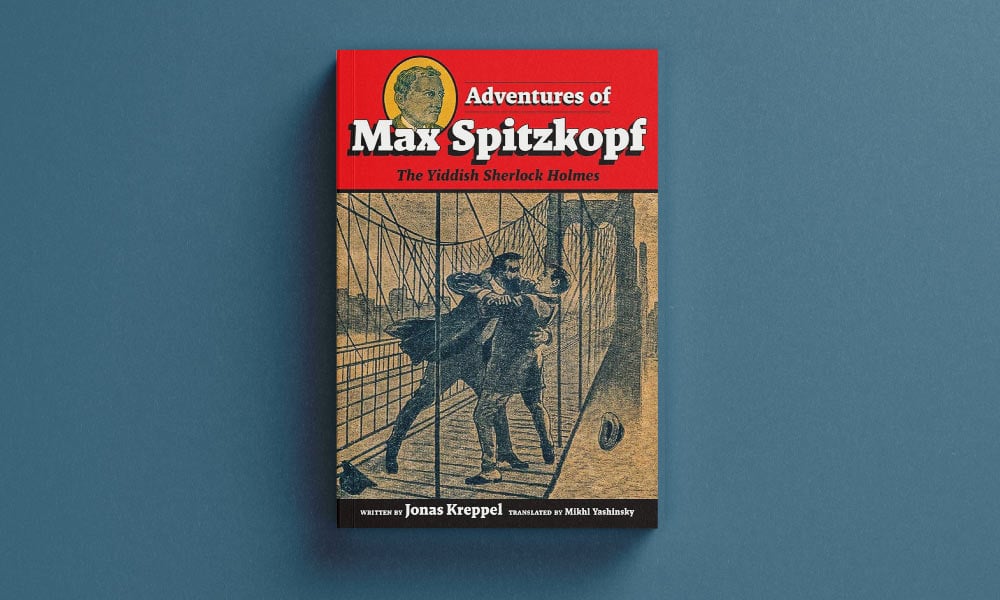
Adventures of Max Spitzkopf: The Yiddish Sherlock Holmes
By Jonas Kreppel
Translated by Mikhl Yashinsky
White Goat Press, 575 pp.
Imagine Isaac Bashevis Singer as a boy, huddled over a detective story, delighting in the adventures of a fictional Jewish sleuth who conquers evil and defends the innocent, most of them Jews. Nefarious plots are foiled by the mastermind Max Spitzkopf, king of detectives, the Jewish Sherlock Holmes. The dangers he battles include pogroms, blood libels and villains who abduct maidens and force them into sex trafficking or conversion, as well as more universal crimes such as robbery, murder, forgery and smuggling. His name, Spitzkopf, means “pointy head” in Yiddish, an acknowledgment of his sharp mind.
These tales really existed. In his memoirs, Singer praised them as high art. Fortunately, they have now been collected, translated and reissued in a delightful volume that resuscitates a little-known strand of early Yiddish pop culture. Jonas Kreppel (1874-1940), the author of these 15 inexpensive pamphlets—all titled The Adventures of Max Spitzkopf—published them in Krakow in 1908 with the house Verlag Fischer. The beginning of each tale featured a detailed drawing of the adventure, whetting the imagination of children coming of age absent television.
Kreppel, whose own surname means “dumpling,” was a learned and versatile writer, working in several languages. At the time there was a young readership increasingly hungry for knowledge of a world beyond the very traditional East European shtetl. Galicia, later to become part of Poland, was a province under the rule of Austria with its capital at Lemberg (now Lviv). Jews there had more protections from the authorities and greater options for upward mobility than their peers in the nearby oppressive Russian Empire. Our resourceful Spitzkopf, based in Vienna, could summon legal recourse and even pack a revolver. In the fictional universe Keppel created for him, Spitzkopf was famous; sometimes, in the stories, he even wielded influence in officialdom.
Like the superheroes of our age, Spitzkopf and his sidekick Hermann Fuchs fight tirelessly against injustice. From their office, located in a posh part of Vienna and staffed with many assistants, our heroes travel far and wide. Each richly crafted, engaging story, with its many twists and dramatic plots, reveals Spitzkopf ready, at the drop of a hat, without recompense, to travel and risk himself and his sidekick in the process. As a character, Spitzkopf is rather one-dimensional. He has a propensity for secrecy, donning many exotic disguises, and is a kind of shapeshifter, becoming at times a peasant or a woman. The contrasts are striking as he travels from high-class Vienna and its cafes, its lavish life, to poor towns, allowing the reader to straddle worlds.
Like the superheroes of our age, Spitzkopf and his sidekick Hermann Fuchs fight tirelessly against injustice.
Most memorable are Spitzkopf and Fuchs’s forays into the Polish shtetls of the time. They go to places that are sadly now devoid of Jews but were then major centers of Jewish life. For a contemporary reader, these are vivid and rare descriptive portraits of the lost world of the shtetl at a time when modernity was creeping in, creating tensions between the old religious order and the new, freer worldview.
The villains of the tales include priests and Christian rabble ready to launch a pogrom. For example, here is Kreppel’s description of a pogrom in the Galician shtetl of Dorokhov in the story “Blood Libel”:
The small-town fire department was making an attempt with its solitary hand-powered pump, but it was no use. The firefighters barely knew where to begin. Meanwhile the plunderers could not be stopped.
The Jews who lived around the Ringplatz escaped through their yard fences into the backstreets and then hid in cellars and attics or in the little tradesmen’s shuls and study houses. They waited, petrified with fear that the fire would reach them where they hid or that the feverish mob, once it finished its work in the Ringplatz, would then proceed onward to the backstreets…The wailing, the shrieks and shouting, were impossible to describe. These Jews looked just how their coreligionists of Jerusalem must have when their Holy Temple was burned to the ground and the Romans slaughtered Jewish children openly in the streets.
Rest assured, rescue came, but only after much travail.
In the first story in the series, the shtetl is described as unhealthy, stifling, miserable. By this unromantic description, Kreppel is teaching his young readers and possibly their parents about the dangers out there. In one case a pious boy is seduced by a missionary who is hired to teach him German and French. In another, a naive girl and her unsuspecting parents, who thought they were arranging a good match, are really sending her into the sex trade. In “The Smugglers,” a factory owner from Warsaw describes the plight of the Jews in the Russian Empire as precarious. In another story, involving the rescue of a damsel in distress, Spitzkopf explains to the shtetl Jews the value of working with the Jewish organization B’nai B’rith.
Spitzkopf and his faithful chief assistant often get beaten up or cast into dark cellars, but they always spring back and sometimes shoot to kill. To achieve their ends, bribery is often required. What a thrill that must have been to their young Jewish readers whose elders were not permitted to use weapons. How relieved the reader is at the end of each tale to find justice restored.

The stories hold up well as thrillers; I could not put them down until I found out what happened. Mikhl Yashinsky’s nimble translation is adept at catching the nuances of social class, and he can ably present varying dialects reflecting nationality or social class. The social context, given the mix of ethnicities involved, would have included the dominant language of German, but also varieties of Yiddish, as well as those speaking Polish, Ukrainian or Russian.
Yashinsky’s rich introduction offers a deeper context for the stories and of the author himself. Kreppel was an Orthodox Jew. He was highly accomplished, living well in Vienna until the Nazis took hold. He, unfortunately, did not have a Spitzkopf to come to his rescue. The Nazis arrested him in 1938 and he died in 1940 in Buchenwald.
Miriam Isaacs is a scholar of Yiddish language and linguistics and has taught Jewish Studies at the University of Maryland.
3 thoughts on “Book Review | Meet the Sherlock of the Shtetl”
Where can I buy these stories?
https://www.amazon.com/Adventures-Max-Spitzkopf-Yiddish-Sherlock/dp/B0F6CLX469
Here! Or seemingly most any other book retailer. https://shop.yiddishbookcenter.org/products/adventures-of-max-spitzkopf-the-yiddish-sherlock-holmes-by-jonas-kreppel