
The sons and daughters of Holocaust survivors born after World War II—the cohort known as 2G, short for “second generation”—are no longer young. I was reminded of this inexorable reality when Ed Miliband, the 56-year-old son of a Holocaust survivor and a refugee from Nazi-occupied Belgium, was named as the new British foreign secretary. And it was borne in upon me even more dramatically when Miliband made international headlines by calling for a “comprehensive reset” of UK policy toward Israel, including a ban on trade with settlements in the West Bank—while maintaining his overall support and even love for Israel. Miliband’s identity as a child of survivors, which he emphasized in a recent speech in the House of Commons, cannot be irrelevant to his nuanced views at a difficult political moment. Nor is he the first 2G to serve as Britain’s foreign secretary. His older brother David, now president of the International Rescue Committee, served in the same capacity from 2010 to 2013.
The youngest 2Gs, in other words, have now reached political maturity, and not just in England. In Israel, where half of all Holocaust survivors settled, two of the political leaders seeking to oust Prime Minister Netanyahu from power in the forthcoming elections, former prime minister Yair Lapid and retired general Yair Golan, are the sons of, respectively, a Holocaust survivor and a refugee from Nazi Germany. On the other side of the Israeli political divide, hardline defense minister and former foreign minister Israel Katz is the son of Romanian Holocaust survivors.
And in Germany, Karin Prien, the federal minister for education, is viewed as a viable candidate for the German presidency in 2027. Prien’s mother survived the German occupation of the Netherlands as a child, and her great-grandmother was killed in the Sobibor death camp. Prien is not halachically Jewish but publicly identifies as “a person with a Jewish biography” and wears a Star of David necklace.
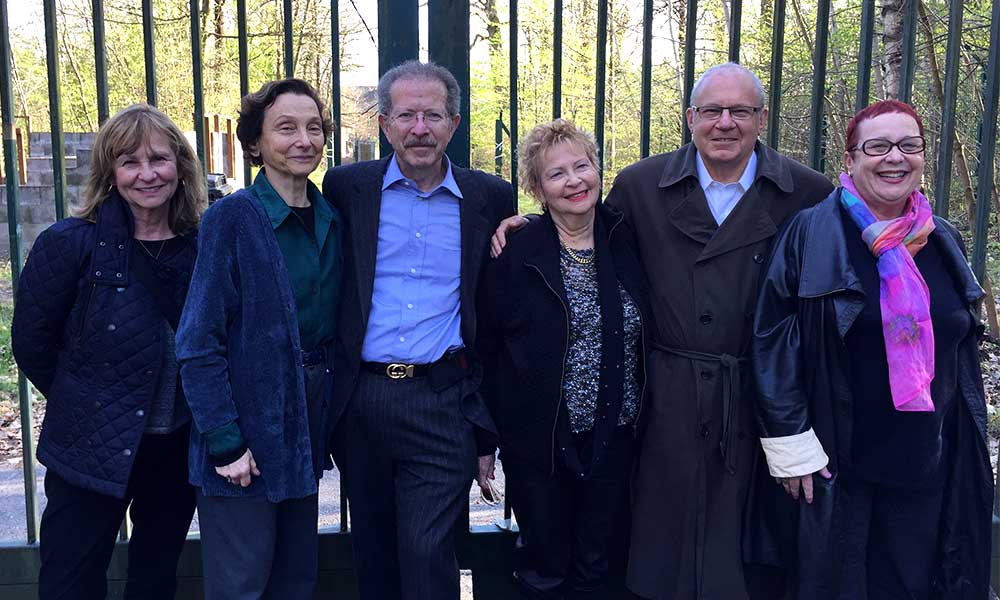
The reunion made me wonder: Who are we, the second generation, and how have we spent our lives in the shadow of our unique legacy and identity?
Indeed, these 2Gs who have attained such prominence, and remain in the prime years of their careers, are at the younger end of the cohort. The oldest members, among whom I include myself, are in their late 70s and early 80s. As we confront our own mortality, it is time to take stock of our unique identity as the bridge between the inferno from which our parents emerged and the light, the far too often flickering light, of a precarious post-Holocaust safety, security and freedom that, they hoped, would spare us and their grandchildren and great-grandchildren any suffering similar to the agonies they endured.
“I was raised in a secular household,” David Miliband has written. “But I know the injunction ‘He who saves one single life, it is as if he has saved an entire world.’ That is the spirit of those who helped my family. It is the spirit I try to honor. And it is the spirit we need to keep alive tomorrow.”
In the same vein, Democratic U.S. Senator Michael Bennet of Colorado, 61, whose mother was smuggled out of the Warsaw Ghetto by her parents as a baby, wrote on X on International Holocaust Remembrance Day this past January 27 that “My mother and her parents escaped the Holocaust but lost nearly everyone else in their family…Never again demands more than remembrance—it requires us to confront antisemitism, hate, and bigotry wherever it takes root.”
I recently attended my 60th high school reunion at the Fieldston School in Riverdale, NY, then as now a secular but predominantly Jewish private school in New York City. While we were all catching up and reminiscing, a handful of us whose parents were survivors of or refugees from Nazi-dominated Europe shared and compared notes on a distinct background we had rarely discussed when we saw one another almost every day.
Our perspective on the ever more turbulent political and social developments of the day was—and is—subtly different from that of most of our other former classmates. What is to a large degree an intellectual abstraction for them is family history and inherited memory for us.
This applies to the burgeoning political influence of extremist far-right, often crypto-fascist or openly fascist elements at home and abroad—in France, Germany and, yes, even Israel—as well as to the emergence of so-called democratic socialists whose anti-Israel rhetoric far too often has a marked antisemitic dimension. Both phenomena evoke childhood memories of our parents and their friends talking about the years that had preceded the cataclysm that engulfed them and their families. Some anti-Israel rhetoric reminds many of us of our parents’ descriptions of Stalinist persecutions and the concerted effort of both pre- and post-World War II European communist regimes to eradicate the Jewish religious and cultural identity.
Our parents, we suspect, would have viewed the anti-Zionist rhetoric of New York City Mayor Zohran Mamdani and like-minded members of the Democratic Socialists of America against the backdrop of Soviet and other European communist government apparatchiks who professed to be opposed to antisemitism writ large but who sought to crush any manifestations of Jewish national or self-identification. Many of us (though by no means all) have inherited this political and ideological sensitivity to those who self-righteously claim not to be antisemitic but who spout slogans that ignite rhetorical and physical violence against Jews.
The reunion made me wonder: Who are we, the second generation, and how have we spent our lives in the shadow of our unique legacy and identity?
To begin with a caveat: I am not a fan of the “2G” label if it is meant as shorthand for “a second generation of Holocaust survivors.” Whatever and whoever we are, we are not survivors. That designation belongs to our parents and their generation and to them alone. By definition, we were born after—after ghettos and death camps, after gas chambers and typhus-ravaged barracks, after survival in hiding, with partisans, on forged identity papers, or in Siberia, after death marches, after liberation at Nazi concentration camps such as Bergen-Belsen, Buchenwald and Dachau. Our parents suffered in the Holocaust; we did not, and it is unseemly for any of us to pretend that we did. For the most part, we grew up in comfort and security. We were given the childhood and adolescence that far too many of the survivors were robbed of.
Some survivors spoke openly and frequently about their experiences in the ghettos and camps; others enveloped themselves and their families in silence, shrouding their past in an aura of mystery and secrecy.
But while our singular identity does not afford us any special rights or privileges, it nevertheless imposes far-reaching responsibilities on us, akin to the religious mitzvot or commandments at the core of the Jewish religion. We were given life and placed on earth with a solemn obligation. Our parents survived to bear witness. We, who grew up with them, who know or knew them better than anyone else, who listened to and internalized their stories, their memories, their silences and their nightmares, are more than their witnesses. We must be their attestors. Together with our own children and grandchildren, we must permanently engrain these stories, memories, silences and nightmares at the core of Holocaust remembrance. We are the guardians of their memories. All else, to paraphrase Hillel, is commentary.
This transmittal of memory into the future takes many forms, and it may skip a generation. Often, the survivors were more open in discussing what they had gone through with their grandchildren than with their children.
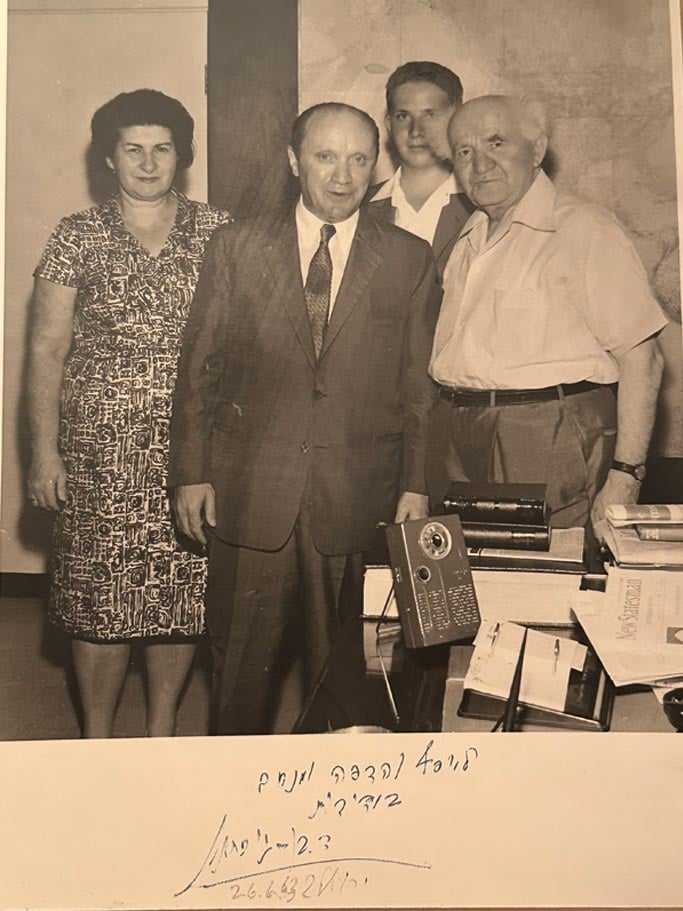
The Rosensafts with Ben-Gurion.
One example among many: My mother, who had survived 15 months at Auschwitz followed by five more at Bergen-Belsen, died hours after the end of Rosh Hashanah in 1997. Six months later, I took our daughter, Jodi, then a sophomore at Johns Hopkins, to Poland for the first time. She and my mother had been extremely close and had always spent a great deal of time together. Jodi and I went to Warsaw and Kraków, and then to Auschwitz. I showed her Block 11 at Auschwitz, where my father was tortured for months, and then we went to Birkenau. It was a cold, grey day, with a constant drizzle. We walked in silence past the decaying wooden barracks. After 15 or 20 minutes, Jodi turned to me and said, “You know, it looks exactly the way Dassah described it.” (This was what she called my mother, Hadassah.) At that moment, I realized that a transfer of memory had taken place. My daughter, born 33 years after the Holocaust, had recognized Birkenau through my mother’s eyes, through her memories that Jodi had heard first hand and absorbed into her consciousness.
Many 2Gs have fulfilled their obligation by chronicling their survivor parents’ wartime experiences. An early example is Michael Korenblit and Kathleen Jager’s Until We Meet Again: A True Story of Love and Survival in the Holocaust (published in 1983). Korenblit follows his parents’ trajectory through hiding, stolen kisses in a ghetto, deportation, Auschwitz and Dachau, liberation and eventual reunion.
In Dreaming of the River, Pauline Steinhorn describes movingly, even hauntingly, how her mother and grandmother refused to become dehumanized in the ghetto of their hometown, in Nazi slave labor camps, and ultimately in the typhus-ravaged Bergen-Belsen concentration camp. In All the Horrors of War: A Jewish Girl, a British Doctor, and the Liberation of Bergen-Belsen, Bernice Lerner tracks her mother’s wartime and immediate postwar experiences with those of one of her liberators.
Dr. Steven Meed, one of the founders of Second Generation New York, retranslated and updated his mother Vladka Meed’s 1948 Yiddish memoir of the Warsaw Ghetto, On Both Sides of the Wall, “to create a new book that was the old book, but with added elements that would make it more alive, more relevant to the reader…I wanted there to be context, and I wanted it to be able to flow as if it were a novel, although everything, including all dialogue, was factual.” In Where She Came From: A Daughter’s Search for Her Mother’s History, Helen Epstein reconstructs her mother’s life in pre-war Czechoslovakia, at Auschwitz and Bergen-Belsen, in postwar Prague, and then in the United States. And in Mamaleh: A Legacy of Loss and Love, Elaine Culbertson movingly blends her mother’s recollections with her own reflections on being “the replacement mother, the replacement sister” as she was growing up.
There is no one form, not even one prevailing form, of this multifaceted and idiosyncratic birthright. In large part, this reflects the homes in which we were raised. Some survivors spoke openly and frequently about their experiences in the ghettos and camps; others enveloped themselves and their families in silence, shrouding their past in an aura of mystery and secrecy. Some refugees from Nazi Germany and Austria talked eloquently about the rise of Nazism and the persecution they had endured; others denied their erstwhile neighbors’ perfidious betrayal. Some survivors emerged from the Holocaust with their faith, whether in God or in humankind, shattered; others were able to maintain an intimate bond with their Creator. Some, who had been atheists, became cynics, while others taught their children that human and civil rights for all, not just for Jews, is a paramount value.
In short, the 2Gs are no more homogeneous than the European Jews who were swept up in and consumed by the Holocaust. These included the fervently observant and the defiantly secular; Yiddishists, Hebraists and many who were so thoroughly assimilated that they barely acknowledged their Jewish roots; the wealthy and the destitute; intellectuals and laborers, rabbis and industrialists, lawyers, doctors, artists, poets, engineers, composers, scientists, athletes and pickpockets.
We have been and must continue to be a bulwark against the ever-increasing incidents of Holocaust denial, distortion, trivialization and inversion.
The children of survivors are equally diverse, and each of us manifests the 2G dimension of our identity in our own individual way. Our politics, too, are diverse. While most of us—myself included—are Zionists who identify with the State of Israel, we recognize that some are not. We watched the events of October 7, 2023, with horror, and most of us, although sadly not all of us, have also been dismayed by the deaths and suffering of Palestinian civilians in Gaza in the ensuing Israel-Hamas war. Our views on Israel’s politics and what should happen there are varied, often diametrically opposed. Ed Miliband, the British foreign secretary, is significantly to the left of his brother. And 2G attitudes toward faith and Jewish religious observance are also vastly dissimilar, ranging from the fervently observant ultra-Orthodox through modern Orthodox, Conservative, Reform, Reconstructionist and Renewal, to the avowedly secular and defiantly atheist.
In 2019, 2G cultural sociologist Henri Lustiger-Thaler, together with photographer Caryl Englander and 2G architect Daniel Libeskind, created a temporary exhibit at the entrance of the Auschwitz-Birkenau State Museum. “Through the Lens of Faith” reflected the experiences of Orthodox, even ultra-Orthodox, Jews who, as described by Holocaust and Jewish studies scholar Michael Berenbaum, “entered the gates of Auschwitz and emerged, some immediately and some after a considerable length of time, with their faith intact, perhaps even strengthened.”
“I don’t know about the faith of my father and my mother after the war,” wrote Dutch Rabbi Lody van der Kamp. “They hardly spoke about their suffering…One thing I do know. They made sure that my sister and I, small Jewish children born after the war, went to synagogue. They made sure that we attended religion classes twice a week. They made sure that the Jewish holidays were observed in our home. They made sure that after the destruction of almost their entire family, a new generation of Jewish children were formed to establish their own Jewish homes.”
Oftentimes, the spiritual and secular dimensions of our intellect merge so seamlessly that we ourselves do not know where one ends and the other begins. “One night I had a dream,” wrote Aviva Tal, who taught Yiddish literature at Bar Ilan University for many years.
I was standing by a deep pit, a mass grave. Instead of corpses, there were layers of Torah mantles, all blue and purple velvet, the golden embroidered words darkened and almost unintelligible. Over them was a layer of Torah scrolls and among them many Yiddish books that had been printed in Warsaw, Vilna, Czernowitz, Odessa, Moscow, New York, and elsewhere. Yiddish words and Hebrew letters. I stood by the grave and felt a life rising up toward me, living letters and living words for me to interpret.
Like many 2Gs, I have struggled and continue to struggle to reconcile belief in an omniscient, omnipotent God with the horrors of the Holocaust. However, I may have found a manifestation of the Divine in the capacity of Jews in the ghettos and camps to resist and transcend dehumanization. In a guest sermon delivered at New York City’s Park Avenue Synagogue on the Shabbat between Rosh Hashanah and Yom Kippur in 2013, I said that perhaps the Shekhina, the mystical divine spark, was within my mother and a group of other Jewish women inmates as they kept 149 Jewish children alive at Bergen-Belsen despite horrific conditions, despite the lack of food and medicine, and despite a raging typhus epidemic and other virulent diseases. Perhaps God was also within every Jewish parent who comforted a child on the way to a gas chamber, and within every Jew who told a story or a joke or sang a melody in a death camp barracks to alleviate another Jew’s agony. Perhaps it was the Shekhina that enabled young Jews like my wife Jeanie’s father to take up arms against the Germans in ghettos and forests. Perhaps God was within the Ukrainian farmer who hid Jeanie’s mother and grandparents, and within all the other non-Jews who defied the forces of evil by saving Jews in Nazi-occupied Europe.
A copy of that guest sermon was sent to Pope Francis, and I was honored to receive an email from the pope in which he wrote that “When you, with humility, are telling us where God was in that moment, I felt within me that you had transcended all possible explanations and that, after a long pilgrimage—sometimes sad, tedious or dull—you came to discover a certain logic, and it is from there that you were speaking to us; the logic of First Kings 19:12, the logic of that ‘gentle breeze’ (I know that it is a very poor translation of the rich Hebrew expression) that constitutes the only possible hermeneutic interpretation.”
At the other end of the religious and theological spectrum is Senator Bennet, who says that he was raised with “two different heritages, one was Jewish and one was Christian. I am proud that both heritages are part of me, and I believe in God.”
Besides carrying our parents’ memories forward, our identity imposes other obligations on us as well. In honor of those memories, we must fight against the forces that made the Holocaust possible so as to prevent its recurrence. We have been and must continue to be a bulwark against the ever-increasing incidents of Holocaust denial, distortion, trivialization and inversion. We owe it to our parents and to the dead to call out and confront all those who seek to exploit or pervert Holocaust memory for political or any other purpose. This is as much the case when anti-Israel activists compare Israel to Nazi Germany as it is when a Jewish U.S. ambassador to Poland cravenly curries favor with the most reactionary elements in that country.
In addition, as long as survivors remain in our midst, albeit in ever dwindling numbers, we must do everything in our power to enable all of them to live out their remaining days in comfort and dignity. Far too many of them, around the world, especially in Eastern Europe but also in the United States and Israel, live a precarious existence and are in dire financial straits. They need more assistance than the meager monthly payments many but by no means all of them have been accorded under the German reparations law.
We also have a moral responsibility not to stand idly by, in the words of Mordechai Gebirtig’s song, “Es Brent” (“It Is Burning”), “with folded arms” (“mit ferleygte hent”), while human beings anywhere in the world are oppressed or persecuted. We have no right to criticize the world for not coming to the aid of our parents and grandparents during the 1930s and 1940s unless we do everything in our power to fight all forms of contemporary racial, religious or ethnic hatred and to prevent contemporary genocides, whether in Darfur, Rwanda, Bosnia, Myanmar or elsewhere. If we learn only one lesson from the Holocaust, it must be that the ultimate consequence of silence and indifference to the dire plight of others was embodied forever in the fires of Auschwitz and the mass graves of Bergen-Belsen.
The perpetuation of Holocaust memory and social and political activism are but some of the initiatives, priorities and achievements of children of survivors. While some of us are part of second-generation groups, others have opted to act in their respective individual capacities. Each of us has sought to come to terms with our shared past in our own way.
This is the case in our family. While I am a law professor at Cornell and Columbia and served in leadership positions at the World Jewish Congress (WJC), my wife Jeanie Bloch Rosensaft is an art historian and director of Hebrew Union College’s Dr. Bernard Heller Museum in New York City. She has curated numerous exhibitions of art by survivors and children of survivors, as well as a traveling photo exhibition about the Bergen-Belsen Displaced Persons camp. My sister-in-law, Gloria Bloch Golan, runs the American Friends of Israel’s Anu Museum of the Jewish People in Tel Aviv.
Other children of survivors have dedicated themselves to a broad range of Jewish political, cultural and advocacy institutions. Not surprisingly, many have played leadership roles in Holocaust remembrance institutions and initiatives. The late WJC executive director Elan Steinberg, for instance, was the strategist behind the successful effort to wrest $1.25 billion of Holocaust assets from Swiss banks. Some 2Gs were deeply involved in the creation of the U.S. Holocaust Memorial Museum in Washington, DC and other museums of remembrance. Others became rabbis and cantors or have made their mark in academia, business and philanthropy.
A considerable number of 2Gs became lawyers. “My life started in a country where there had been no democracy, no rights, no tolerance, no justice,” observed former Canadian Supreme Court justice Rosalie Silberman Abella, who was born in a Displaced Persons camp in Germany in 1946. “No one with this history does not feel lucky to be alive and free. No one with this history can take anything for granted.”
Other 2Gs entered the healing professions, including Pfizer CEO Albert Bourla, who is credited with developing his company’s COVID-19 vaccine; Dr. Hannah Kanety, a leading Israeli biochemist in endocrinology; and psychologist Dr. Eva Fogelman, one of the pioneers of the movement for 2G identity. “Being a daughter of Holocaust survivors exposed me from an early age to my parents’ experiences during World War II,” explains psychologist Dr. Yaffa Singer, an internationally recognized authority on post-traumatic stress disorder in military personnel and veterans. “When I started my professional career and chose to work with trauma survivors, I understood that my special personal history would be an invaluable resource for my therapeutic work and would give me the necessary strength and confidence to believe that these harmed patients would be able to build a future for themselves.”
Prominent 2Gs in the arts include Art Spiegelman, who created the Pulitzer Prize-winning graphic novel Maus based on his parents’ Holocaust experiences; Israeli singer, composer, and lyricist Chava Alberstein who recorded and popularized many Yiddish songs composed and sung in the ghettos and camps as acts of defiance; Israeli singer Yehuda Poliker and lyricist Yaakov Gilad, who wrote the classic Holocaust-themed rock ballad “Ever Ve’avak” (“Ashes and Dust”); Geddy Lee, the lead vocalist, bassist and keyboardist of the Canadian rock band Rush, whose mother’s liberation at Bergen-Belsen inspired the group’s haunting song “Red Sector A”; French singer-songwriter Jean-Jacques Goldman, whose equally haunting hit song “Comme toi” (“Like You”) was inspired by the photograph in a family album of a child murdered in the Holocaust; documentary filmmakers Aviva Kempner and Gaylen Ross; the late novelist Nava Semel, whose books enabled young Israelis to relate to the Holocaust; and Israeli photographer Debbie Morag, whose photo series “indelible” depicts 12 women, wearing identical white dresses, holding a battered brown suitcase on which the Auschwitz number of the 2G’s parent is written in white chalk.
The Argentinian graphic artist and sculptor Mirta Kupferminc, whose parents both survived Auschwitz, “explores the Auschwitz tattoos on her parents’ arms as the ultimate dehumanizing act, and also honors their defiance in retaining them as testimony against historical forgetting,” writes my wife Jean Bloch Rosensaft, who has curated and showcased Kupferminc’s work. “Her artistic process is a metaphor for the infinite human capacity to overcome, survive, create, and help heal the world.”
2Gs in Israeli government have included no fewer than three IDF chiefs and defense ministers and have run the political gamut from far-left former Knesset speaker Avraham Burg to ultranationalist former Knesset member Michael Kleiner. In the United States, Sam Gedjenson, born in a DP camp in Germany, became the first 2G elected to Congress in 1981, representing Connecticut’s 2nd district. Today, Julie Menin, born in 1967, is speaker of the New York City Council, where she made news recently by using her voice to help dissuade the Metropolitan Museum of Art from its ill-considered plan to honor designer John Galliano.
Our ranks also include Lodz-born Solidarity activist Jerzy Warman, who succeeded me at the helm of the International Network of Children of Holocaust Survivors; Maram Stern, who as WJC executive vice president was instrumental in keeping Holocaust remembrance at the forefront of the German government’s agenda; Elisha Wiesel, the son of Nobel Peace Prize laureate Elie Wiesel, who heads the foundation bearing his father’s name; and Israeli astronaut Ilan Ramon, who died when the space shuttle Columbia disintegrated in 2003. These are only a few among countless others.
My own history is relevant to that of the 2G movement. I was one of approximately 2,000 children born in the Displaced Persons camp of Bergen-Belsen in Germany between 1945 and the summer of 1950 when the DP camp was closed. (I have written elsewhere about my father’s role as chairman of both the Jewish committee that administered the Belsen DP camp and the Central Committee of Liberated Jews in the British Zone of Germany.)
The Jewish DPs of Belsen formed a cohesive group, a family to replace their murdered families. They remained close after settling in the United States, Israel, Canada, Australia and elsewhere. In July 1962, my parents invited 145 of the children born in Belsen, then between 12 and 16 years old, to our own get-together in Herzliya, Israel. This meeting was followed by others at which we discussed our shared identity. We also attended commemorative events organized by our parents in our various home countries. In 1965, to mark the 20th anniversary of the liberation, we undertook a project of our own, the Bergen-Belsen Youth Magazine, consisting of 26 essays, short stories and poems. “We who call ourselves the children of Belsen,” I wrote in the introduction, “believe that we are a part of Belsen. We may not have lived through the horrors of the Holocaust, but we can and do feel its tragedy.” Those sentiments remain true 61 years later.
We must be their attestors. Together with our own children and grandchildren, we must permanently engrain these stories, memories, silences and nightmares at the core of Holocaust remembrance.
To the best of my knowledge, the Bergen-Belsen Youth Magazine was the first 2G literary initiative of its kind, followed 11 years later by Living After the Holocaust: Reflections of the Post-War Generation in America, a collection edited by Lucy Steinitz and David Szony.
In the mid-1970s, a number of second-generation groups came into being in different parts of the United States. In Boston, Eva Fogelman and Bella Savran started the first support group for children of survivors, and New York’s second-generation group came into being as a junior auxiliary of the Warsaw Ghetto Resistance Organization. In 1976, I was invited to the first meeting of the New York group. However, my father had only recently passed away, and I was beginning my law studies, and so I stayed away. I felt that I could be effective on my own by writing and lecturing about the Holocaust.
I changed my mind in the fall of 1979 at what was billed as the first-ever Conference on Children of Holocaust Survivors (emphasis mine). Organized by a well-meaning Jewish organization, this conference featured psychologist after psychiatrist after psychoanalyst after an array of other mental health specialists who considered themselves authorities on survivors and their children. In turn, each of them dissected our supposed pathology, inherited vulnerabilities, guilt complexes, group idiosyncrasies and other supposed common characteristics. Helen Epstein, whose book Children of the Holocaust focused largely on intergenerational transmission of trauma, delivered the keynote address. My wife Jeanie and I were in attendance together with some of our friends and we failed to recognize ourselves in the psychobabble to which we were subjected. We were not the only ones to feel this way. Writing about the conference in the New York Jewish World, Yossi Klein—today Yossi Klein Halevi, one of Israel’s foremost political commentators—observed that “We invited speakers to our meetings who told us not of our potential contributions to the Jewish people but of our emotional problems…The leaders we had hoped to become were reduced to subjects for clinical study.”
I am not suggesting that all children of survivors are free of emotional issues. There definitely are those who have been unable to come to terms with their parents’ experiences, or who have grown up in homes in which the dark imagery of the Holocaust was overwhelming. However, those early studies were generally rooted in control groups consisting of individuals who have sought counseling or treatment from a therapist or other mental health professional. Accordingly, any extrapolation of these narrower instances to the population as a whole, such as those presented at the 1979 conference, would be analogous to extrapolating the drinking habits of all adult Americans based on studies of participants in Alcoholics Anonymous.
As it happens, psychologist Dr. Eva Fogelman was similarly critical of some of the psychological stereotypes of children of survivors that were becoming prevalent. “Most of those mental-health professionals whose patients informed them that they were children of survivors were unclear about the therapeutic implications of this information,” she wrote. “Psychoanalysts often interpreted children of survivors as emotionally impaired or colluded in a silence about the subject to protect themselves from hearing graphic death narratives. Misdiagnosis was common. For example, some second-generation patients who expressed mistrust of the outside world were diagnosed with paranoid personality, when in fact, what they were expressing was a worldview that was transmitted to them by their survivor parents.”
In any event, Jeanie and I and some of our second-generation friends decided that we needed to become actively involved in the 2G movement. We believed that there were cultural, ideological and political dimensions of our identity that were at least as important and as relevant as the psychosocial ones featured at the conference. While support groups were clearly valuable and beneficial for their participants, we did not think that it was anywhere near sufficient for us to sit around talking about ourselves and empathizing with one another. We became active in Second Generation New York, and a group of us proceeded to help organize the June 1981 World Gathering of Holocaust Survivors in Jerusalem, at which we held separate sessions for more than 1,000 sons and daughters of survivors. Several months later, we organized the International Network of Children of Jewish Holocaust Survivors.
Early on in the movement, there were discussions about who should be considered 2Gs. Everyone agreed on the children of survivors of the Nazi camps and ghettos, and also those of us whose parents fought with the partisans in the forests of Poland, Ukraine and Belarus, or survived in hiding or on forged identity papers. But what of those of us whose parents spent the World War II years in Siberia, or who had fled the Third Reich before 1939? When we established the International Network of Children of Jewish Holocaust Survivors in 1981, I insisted that the net must be cast widely and inclusively: to wit, anyone whose parents were persecuted, discriminated against or displaced in or by Nazi Germany qualifies as a son or daughter of survivors.
Over the course of the next several years, among other initiatives, we held the first New York citywide rally on behalf of Ethiopian Jewry (1982); convened the first international conference of (as opposed to on) children of survivors in New York City (1984); and played a key role in ensuring the deportation of Nazi war criminal Karl Linnas from the United States to his native Estonia (1987).
In the spring of 1985, we were among the most outspoken critics of President Reagan’s decision to lay a wreath at the German military cemetery of Bitburg where members of Hitler’s Waffen-SS lie buried, and on May 5 a significant number of us traveled to Bergen-Belsen to protest against the appearance there by Reagan and West German Chancellor Helmut Kohl on their way to Bitburg.
I am not suggesting that all 2Gs are either overachievers or altruistic. Many have led and are leading perfectly ordinary, unremarkable lives. And certainly, there are 2Gs who choose not to identify as such for whatever reasons. Still, the number of us who have chosen in one way or other to improve or repair the post-Holocaust world is remarkable. And I fervently hope that future historians and other social scientists will factor this reality into their assessment of the role and impact of a generation that Hitler, Himmler and Goebbels never intended to be born.
So where do we go from here? Other than continuing to do what we are doing, how do we maximize our impact as the transitional generation hovering precariously, often surrealistically between the survivors and the future?
“I have no delusions that the legacy that curls within my sentences and stands beside me at the lectern makes what I do special in any way,” novelist and law professor Thane Rosenbaum has observed. “What was unique, what was miraculous, was that anyone had survived. The fact that the children of survivors built lives of their own based on the contorted architecture of their parents’ suffering is neither surprising nor in any way exceptional. The children were not actually there; they are merely the artifacts of the aftermath, witnesses not to the event itself but to the absurdity of an afterlife at all. Their knowledge is limited in as much as their legacy is nontransferable.”

And yet, Rosenbaum concluded, “The human condition is a canvas, and leaving it blank is not an option. Something must be said. Some things must be written. Some outrages must produce a scream of a deafening frequency. A legacy that goes ignored eventually limps back. We are all, to some degree, answering the call of the concentration camps, not as eyewitness, but as dutiful sons and daughters.”
I have often observed that we, the children of the survivors, live with ghosts. We are haunted in the way a cemetery is haunted. We bear within us the shadows and echoes of an anguished dying we never experienced or witnessed. They are the ghosts of grandparents, siblings, uncles, and aunts we never knew. One of my ghosts is a little boy named Benjamin, my brother, who was murdered in a gas chamber at Auschwitz-Birkenau on the night of August 3-4, 1943. Since our mother’s death in 1997, Benjamin has lived within me. I knew that if I were to forget him, if I were to allow his memory to fade, he would disappear forever.
In my book of post-Holocaust psalms, Burning Psalms: Confronting Adonai after Auschwitz (Ben Yehuda Press, 2025), I tried to imagine Benjamin’s voice in those final moments, his fear as the gas chamber doors slammed shut, his tears, his pain, his agony. I did so in large part in order to make sure that his name and his having been will not be forgotten after I am no longer here to remember him. The memory of Benjamin is an important part of my legacy to our grandchildren, Hallie and Jacob.
In addition to continuing on our separate professional, political and cultural paths, it is essential for us going forward to focus as much on the individual, on an individual, as we do on the gruesome totality of the Holocaust. Perhaps what each of us can do, should do, is memorialize the name of at least one ghost whom our parents told us about, one face if we have a photograph, to make sure that they will be remembered as more than an abstract, impersonal part of the statistic of the murdered. And on one day a year, perhaps the anniversary of their death, perhaps during the Martyrology on Yom Kippur, perhaps at the Passover Seder, let each of us devote a few minutes to tell as many as possible that they were and who they were. In so doing, we may be able to prevent some of our ghosts from fading into the ether of oblivion.
Menachem Z. Rosensaft is visiting professor of the practice at Cornell Law School, lecturer-in-law at Columbia Law School and general counsel emeritus of the World Jewish Congress.
Opening image: Dina Lichtman, Romana Strochlitz-Primus, Menachem Rosensaft, Yochi Ritz-Olewski, Joseph Laufer, Aviva Tal, outside the gates of the Glyn Hughes hospital of the Bergen-Belsen DP camp where all of them were born, Bergen-Belsen Memorial Site, April 26, 2015. Photo courtesy of Menachem Rosensaft
7 thoughts on “Living with Ghosts: A Manifesto for Children of Holocaust Survivors”
hello
I am reading your article and it takes my breath away .
I am a 2g person .My mother survived auschwitz and dachau .
tragically my bed time stories were those of her suffering .
I was ridden with guilt cos of her suffering and failed to recognize her PTSD as that was not a diagnosis ,back in the day
todah rabah for your story and more than ever am yisrael chai .
p.s :as for hannah Arendt I shall refrain on my opinion about her
As a 2g and a co-chair of a descendants of Holocaust survivor group I felt that this article was one of the most important and relatable and insightful that I have read. I think every 2g ( for ease of use) should have a copy and it should be used for discussion.
I an 2G, as is my wife!
Hershy
Mr. Rosensaft,
This article is magisterial. Do not fear: your brother Benjamin’s name and memory will not disappear so fast. I am roughly your age, so I cannot offer ages and ages after us in which he will be known. But at least as long as I am given life, I will honor having read of him today. It’s the very least I can assure you for the gif of reading your article. I am not in 2G or another ‘generation’; my family left small town Germany in the 1860s to come to the US. But I became a Professor (now Emeritus) of Jewish Literature, lectured at European universities on Fulbrights, wrote a young readers’ biography of Janusz Korczak, and teach each Spring at the Special Education Academy in Warsaw. So I will have ample moments to mention in all ways I can Benjamin and your hopes for his remembrance. I assure you I will. Mark Bernheim
Nice.
As a Child of Survivors who has been actively involved in Holocaust Education and Commemoration for most of my adult life, I found your article to be profound , beautifully written and inspiring. I too lost a brother in The Holocaust and moved by your comments.
Your beautifully written essay is inspiring. What resonates for me is the role of children of survivors at this time in our history. Although my mother was a Holocaust survivor and educator, for decades, I was a silent witness to her experiences. That changed when, at the end of her life, I promised to complete her memoir. Writing my family’s story in Dreaming of the River changed my life. I’m now a Holocaust educator and share the story of my grandmother Bronia, mother Hajuta, and her two sisters, Lita and Eva who perished in Treblinka.
Menachem – Thanks for mentioning my book in this essay and for your beautiful introduction. May Benjamin, Lita and Eva always be remembered.