
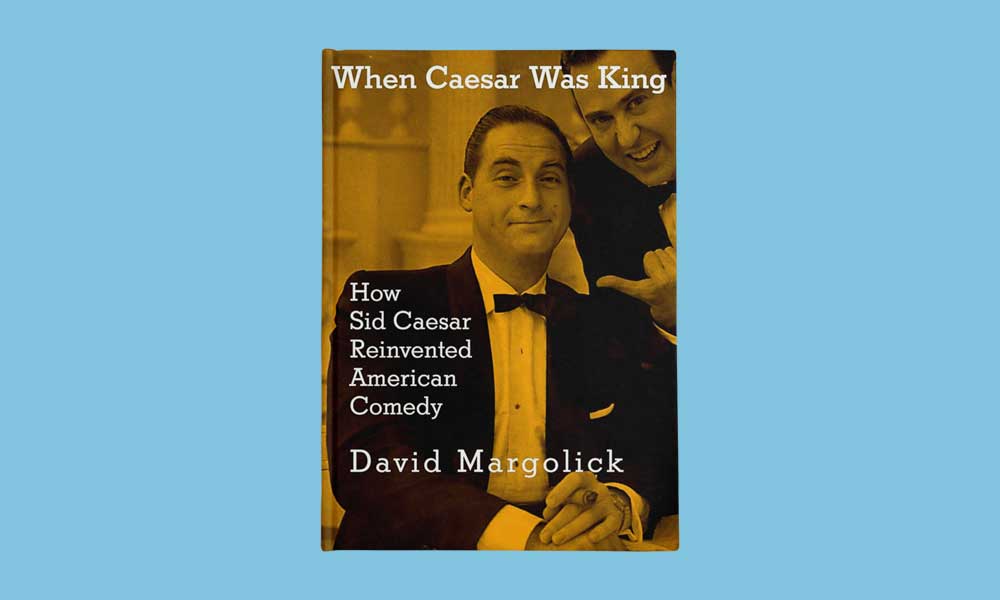
When Caesar Was King: How Sid Caesar Reinvented American Comedy
By David Margolick
Schocken Books, 400 pp.
In the middle of the 20th century, Sid Caesar, a Jewish comedian, introduced a new kind of comedy to the then-infant TV industry and an audience of enthusiastic critics and weekly viewers. He replaced traditional vaudeville acts, which featured one-liners, pratfalls and slapstick, with longer situation- and character-based routines, satires and parodies of foreign films and American fads. He brought a cultural context to the world of comedy and severed it from the socially irrelevant humor of the vaudeville stage. His famed “double-talk” (mimicking the sound of half a dozen foreign languages) reflected the country’s new role in international affairs.
Caesar’s wild facial expressions and powerful physicality dominated the small screen for only a few years. But his influence, buoyed by an amazing group of writers—many of them Canadian and virtually all of them Jewish—lives on today in contemporary sitcoms and in the work of comics like Eddie Murphy, Judd Apatow, Woody Allen and perhaps most notably in the films and crazy imaginings of Mel Brooks.
For author David Margolick, as for other Jewish commentators, Caesar’s success mirrored the increased acceptance of Jews in American culture. His performances dominated TV’s first blockbuster, an hour-long variety show called The Admiral Broadway Review. Airing Saturday nights in prime time, it was written largely by Jewish writers and directed by impresario Max Leibman, who had deep roots in Yiddish theater traditions as well as a sophisticated awareness of contemporary dance and music. The Review, starring Caesar and comic actress Imogene Coca, debuted in l949. Renamed Your Show of Shows the following year, it became so popular that vast swaths of viewers preferred watching the show at home to spending Saturday nights out. Ironically, Admiral, a major manufacturer of TV sets, was forced to cease its sponsorship when the show’s success created an enormous demand for TVs that demanded the company’s full attention.
One story described him hanging Mel Brooks (his best friend and lifetime supporter) out a hotel window 18 feet above the sidewalk.
The show celebrated a Jewish sensibility that prized irreverence, distrust of authority and satire directed at the powerful and self-bloviating. And while much of its achievement depended on such writers as Larry Gelbart and Neil Simon, as well as some who went on to write for such shows as All in the Family and Sanford and Son, they all gave high praise and credit to Caesar, who frequently improvised his own performances and pushed them toward comedies with character and context.
Just who was Caesar and how did he do it? At 6 feet 2 inches tall and weighing 190 pounds, Caesar was a good-looking young man, given on occasion to fits of rage that were terrifying to anyone near him. One story, which made the news, described him hanging Mel Brooks (his best friend and lifetime supporter) out a hotel window 18 feet above the sidewalk. In response to Brooks’s pleading, Caesar pulled him back in a few moments later, terrified but unharmed.
Caesar was drunk at the time, the story went, but its outrageousness suggests the lack of boundaries that fired his behavior. Brooks, whom Caesar had actually introduced to show business—a detail that surprised me—never held it against him. They shared some of the same antic behaviors, but Caesar, driven by demons of self-doubt, was given to excessive eating, drinking and drug use. On another occasion he actually punched a horse and knocked it to the ground because it had thrown his wife. That incident didn’t make the papers but was reprised in one of the funniest scenes in Brooks’s Blazing Saddles.
Margolick speculates that Caesar’s rage and comedy had their source in his childhood. Born in Yonkers, NY, in 1922 to an immigrant family, he did not speak until he was three, instead making his needs known with funny faces and gibberish that seem to have morphed into the wild expostulations, incoherent double-talk and facial acrobatics that catapulted him to fame. Like many comedians, he had a distant relationship with his father—but this can’t explain his comedic genius. In the end, Margolick is forced to accept Caesar’s insistence that he simply “did it.”
He could not explain why or how and apparently didn’t want to find out.
Caesar’s rise was spectacular, his fall a twisting ride through alcoholism, pills, insecurity and numerous comeback attempts. Sadly, little of his work remains, aside from a DVD collection and the archives of a few of his shows recorded on Kinescope. You will not find his antics on TV because at that time the networks routinely destroyed program recordings, which were costly to maintain and more useful if overwritten for new productions. Caesar ignored Brooks’s advice to make films. He did appear as an actor in some movie roles, but without ever thinking to preserve the performances that had made him famous.


Margolick does his best to wriggle his way into Caesar’s mind and consciousness. But Caesar, determined to avoid introspection, escapes the author’s best attempts, and we learn little from this book about his inner life or the workings of his mind.
For example, the book reveals nothing about his 67-year marriage to Florence Levy, whom he met and married in his early 20s. We know nothing of his relationships with his three children—by all reports happy and successful despite their father’s addictions and temper.
In all fairness, Caesar’s own autobiographical musings—he wrote two books about himself—were equally lacking in self-revelation. (Friends of mine who knew him well—such as Lucille Kallen, one of his writers, who originally told me the window story—found him equally mystifying.) Instead, Margolick has gifted us with something better: a fascinating, thoroughly researched and passionately written journey into the world and people who fostered Caesar’s success, and a nostalgic look into an era in which Jewish confidence seemed secure and Jews stepped boldly into the mainstream of American life.
Gloria Levitas is a cultural anthropologist and the author of six books.
Moment Magazine participates in the Amazon Associates program and earns money from qualifying purchases.