
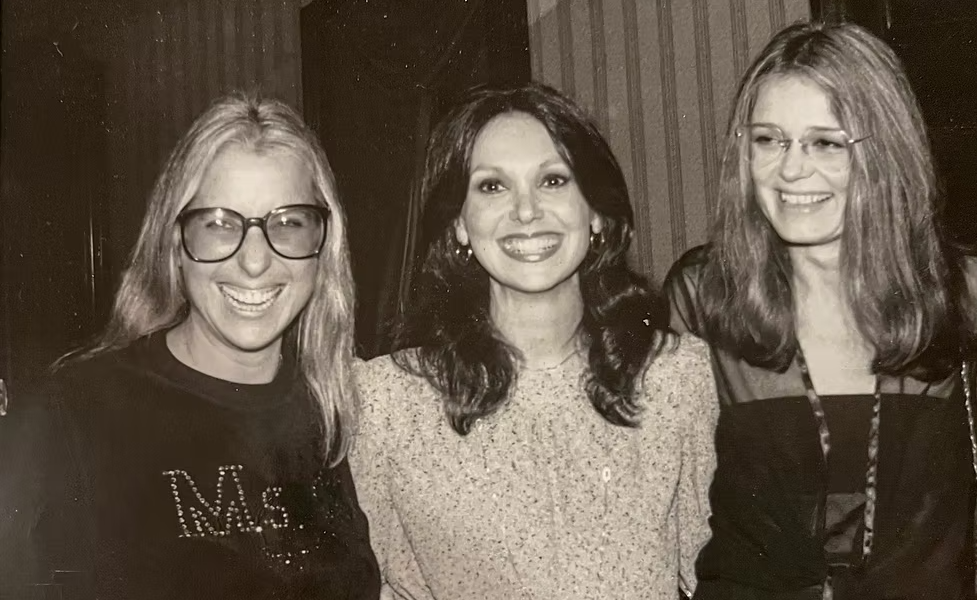
Moment columnist Letty Cottin Pogrebin knew and worked with Gloria Steinem for more than 50 years. Following the feminist icon’s death at 92, Moment spoke to Cottin Pogrebin about Steinem’s friendship, her relationship to Judaism and her love of candy.
People have been calling you all day to ask about your memories of Gloria Steinem. How do you think she’ll be most remembered?
Mostly they really want to know about our friendship. They want to know how it felt to start Ms. magazine and what the actual process was. And they want to know how I think Gloria would feel about the present and the future. They want me to characterize her, describe who she was and what she cared about.
What kind of memories is that bringing up for you?
Some of the memories are very personal. For instance, I remember that she was a candy lover. And a candy thief! I kept candy in my bottom drawer at Ms. because when I was a child, I’d come home from school at 3 and have a brownie and milk, because I was too skinny and my mom wanted to fatten me up. So I got habituated, and I always kept a bag of tiny Milky Ways or Mounds bars or Almond Joys in my bottom drawer. And I went home to have dinner with my children, and she stayed until all hours of the night, and when she got hungry, she’d steal the whole bag and leave me a cute note, signed “Milky Way Thief,” or “Almond Joy Purloiner.” I’ve saved the notes somewhere.
I really loved her, and I tried to model myself after her, her decency and her clarity and her dignity and humor.
She was very honest about her problems with food. She didn’t eat healthy meals during the day, and she said she hadn’t had meals made for her as a child; she’d always had to fend for herself and forage for food because her mother was mentally ill. She was very open about her childhood experiences, which were formative and profound. She grew up in poverty. Her father was an itinerant peddler when he wasn’t running this crazy summer place with entertainment. He was Jewish, and Gloria’s mother was a Theosophist, though she was born Presbyterian.
Did Gloria talk much about her Jewish background or her Jewish heritage?
Well, she famously said, “I feel Jewish when I’m with Christians and Christian when I’m with Jews.” I could understand that. She didn’t feel “Jewish enough” when she was with Jews, but when she was with Christians, she didn’t quite fit in there either. She never went to church. Her mother had been more into mystical things. So Gloria never felt like she came from a faith community of any kind.
We would have arguments about monotheism. She was a pantheist—she believed in multiple gods—and I always argued with her that monotheism is the beginning of equality because if we’re all descended from one parent, or one couple, then what better kind of equality is there? I would describe to her the belief in b’tselem Elohim, that we’re all made in the image of God, which I would tell her means God has a billion different faces and brains and intelligence and body types. But she still didn’t want it. Judaism felt patriarchal to her.
She loved Jewish religious experiences, though. She always came to our feminist seders—every year until this year, when she was too frail. A group of us had begun the feminist seder years before and had written our own version of the Haggadah and invented all kinds of rituals. We’d put up a big piece of oaktag and cite the ten plagues that afflict women, and then the 11th and 12th and 13th, so many plagues. And we’d do the Four Questions for women and then a fifth and sixth and seventh. She just loved it—loved all sorts of feminist re-visionings of Jewish ritual. And she loved being part of a group of women who were knowledgeable Jewishly, and who took on and owned the faith and made it suit them and serve them. Esther Broner and Naomi Nimrod had written the Haggadah, and Bella Abzug and Marilyn French were in the group, along with many others. We had a “Sacred Schmatta” that we wrapped ourselves in. It was a chain of chiffon scarves knotted together that Phyllis Chesler and some other people had carried to the top of Mount Sinai. We wrapped ourselves in it every single year; it’s a tattered mess now, and we keep it in a shopping bag. And we’d all sit on pillows on the floor. And Gloria just went with the flow.
She wasn’t a synagogue-goer, but once she was on a plane, sitting next to a man who said how much his wife and daughter loved her. And his daughter was going to become a bat mitzvah, and would she please come to the bat mitzvah as a treat for his daughter? And Gloria said yes! She went to a stranger’s bat mitzvah, just because she felt that she wanted to come through for the child.
She adored Native American culture. She respected its rituals, she did sweat lodges and she loved Indian jewelry. She always wore a lot of turquoise and those belts around her hips, you know, studded with turquoise. One of her best friends was Wilma Mankiller, the Cherokee tribal leader who died in 2010.
How long were you friends?
I knew her for 55 years. We met just before we founded Ms., and then we started the magazine and worked together for, I think, 17 years. And then we sold it, and then Ellie Smeal of the Feminist Majority Foundation bought it and made it into a quarterly, which it is now. But the magazine accomplished what it meant to: It normalized the truth of women’s lives, the things women’s magazines could never get away with writing about. It normalized talking about sexual harassment, incest, poverty, degradation, dehumanization. All those things happened in women’s lives. My generation had to get our husbands to sign our applications for a loan or a credit card, and had to apply for jobs in the “female help wanted” ads, and all of it seeped into our pores as a sort of secondary citizenship. Ms. wrote about all that. We didn’t write about how to make potholders into prayer rugs or how to satisfy your husband or what to cook for him as a surprise.
I think she made feminism sexy. She made it gentle, tough but kind, clear, but not, as they were always saying about other women, strident. She was one of a kind, irreplaceable. I count her as one of those few people who have had that quirky, idiosyncratic, never-again combination of qualities and the historical moment and appearance and style that allowed them to be so powerful and effective.


Wherever she was, she was a person who was always exactly herself. She didn’t have a public persona that was different from who she was just sitting on the edge of her bed. I admired her for always deflecting the spotlight; she just was the most ego-free human being I’ve ever met. She did not want her fame, or like it, but she used her fame to highlight other people’s achievements. She always went on her lecture tours with another speaker, often an African-American woman whose work she admired. And their stories became as important to her as her own story. She also had stage fright, and appearing in tandem with someone else allowed her to get her sea legs as a speaker.
It was an extraordinary gift, my friendship with her. We stood in for each other; I even went to Israel once to speak in her place when she got sick, years ago, and can you imagine the disappointment at the other end? But I had a nice crowd, and I brought them her greetings. Another time I asked her to interview me—I said, I won’t get a crowd without you—and she flew from England to New York and then to California and interviewed me in San Francisco, and she got a crowd of 2,300 people, which never would have happened otherwise.
I really loved her, and I tried to model myself after her, her decency and her clarity and her dignity and humor. She was not only my friend and colleague, she was my role model.
(Top image, from left: Letty Cottin Pogrebin, Marlo Thomas and Gloria Steinem. Courtesy of Letty Cottin Pogrebin)
3 thoughts on “Letty Cottin Pogrebin on Gloria Steinem: ‘She Was My Role Model’”
I knew Gloria slightly because we met at a number of rallies for women’s rights. And what always struck me was her honesty: With Gloria, what you saw was what you got.
She was warm and friendly, and we bonded intermittently over our name — we were both Gloria and when people called at these rallies, both of us would respond. I wish I had come to know her better but I am consoled by the memoires I have of her — fleeting but profound.
Beautiful remembrance and tribute.
So much of this remembrance could also be said about Letty.
Sending so much love along with the loss, and appreciation for the world we have gained from
the leadership that both Gloria provided and Letty still provides.
Our lives are fuller, our confidence greater because of all they have done and the movement they helped to build.
In addition to the great advances and changes (social, economic, political and more) the movement created, the most wonderful thing, is
that it changed who we are, what women can expect of the society and each other and of ourselves. And they helped show that when we act together, we can change the world.
Yes, kudos to Letty too and Heather. Both who also mentored and supported other women and their causes/projects.