

Jewish Politics & Power is published every other week. Sign up for our newsletter for updates.
1. Legislating synagogue protest
Two recent incidents have drawn renewed attention to the safety and security of Jews attending synagogue.
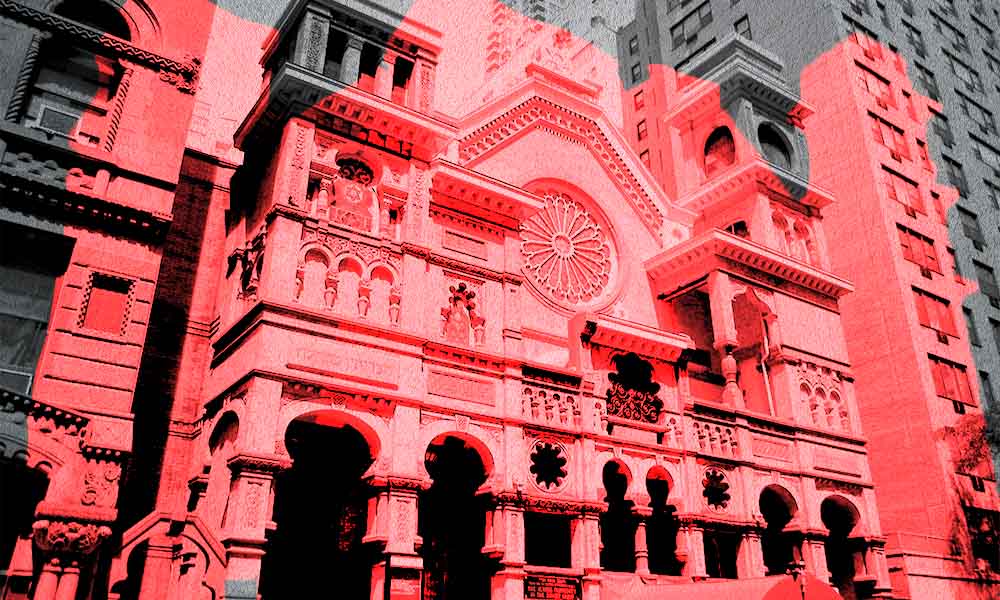
The first, in mid-November, saw a crowd of pro-Palestinian protesters gather outside Park East Synagogue in New York City, where Nefesh B’Nefesh, an organization promoting Jewish immigration to Israel, was hosting an event. The protesters stood right at the entrance to the synagogue, shouting “Death to IDF!” “Resistance!” and “We don’t want Zionists here!” The Anti-Defamation League described the actions as antisemitic, posting on X that “no one going to a house of worship or walking the streets of #NYC should face such hatred.”
In response, hundreds of members of the Jewish community rallied in support of the synagogue. Many in the organized Jewish world condemned the protest, which was seen as an attempt to intimidate Jewish synagogue-goers.
The second incident took place last week in Los Angeles, at the Wilshire Boulevard Temple. At the time, the synagogue, was hosting a community safety event organized by the Israeli consulate. Several protesters entered the hall, trying to disrupt the event. When they were taken out by security guards, a vase shattered, adding to the commotion. Two protesters were arrested.
Both events highlight a question that has increasingly been troubling the Jewish community: How can you make sure that Jews feel safe and secure when attending synagogue, while still respecting the rights of others to free speech?
This question is qualitatively different from the issues of synagogue safety and of securing Jewish communal spaces from threats of terrorism and antisemitic attacks. While no one can argue against the need for security guards and armored doors, it is harder to justify the need for limiting protests outside a synagogue, despite the distress they might cause to Jews going to pray.
New York is now taking a stab at this thorny issue. A group of state lawmakers introduced a bill that would create a 25-foot buffer zone, in which protests will not be allowed, around places of worship. The legislation also would apply to protests outside abortion clinics and is meant to create a safe zone free of harassment for those entering. “We are not saying you can’t protest,” New York state assemblyman Micah Lasher told CNN. “We’re not even saying you can’t protest around a house of worship. We are saying there needs to be some reasonable space so that people who are trying to enter a house of worship or reproductive care facility can do so without having to run a gauntlet.”
The legislation attempts to strike a balance between the right to protest and the right of those attending synagogue to do so without interruption. And it might just work. These limitations are far less restrictive than those the Trump administration has sought to impose on pro-Palestinian protesters on college campuses and seem to ensure that voices of dissent are still heard and that protests are noticed, but that these actions will not limit access to the synagogue or deter participants from entering.
2. Are there legitimate and illegitimate synagogue activities?
A day after the protest outside Park East Synagogue, a spokesperson for New York City Mayor-elect Zohran Mamdani provided an unusual take on the event. “The mayor-elect has discouraged the language used at last night’s protest and will continue to do so,” Mamdani’s press secretary Dora Pekec said. But her statement went on to accuse the synagogue of holding an objectionable event. “He believes every New Yorker should be free to enter a house of worship without intimidation, and that these sacred spaces should not be used to promote activities in violation of international law.”
Did the gathering of Nefesh B’Nefesh promote violation of international law? The accusation seems to rely on the argument that among the Jews being helped by the organization to make aliya to Israel are those who will live in or eventually relocate to West Bank settlements, which are viewed by Mamdani and by many in the international community as illegal.
A similar issue came up following the Los Angeles protest, which was aimed at an event organized by a branch of the Israeli government and at which an Israeli defense contractor was among the presenters.
Both cases imply that the protection of places of worship depends on the content of their events and gatherings.
One could argue that synagogues, mosques or churches are no different from any other institution and are not entitled to an intimidation-free space. But if society does hold them as sacred places in which people of faith are entitled to extra protection, then the Mamdani spokesperson’s claim could lead to a dangerous slippery slope: If synagogues are not allowed to host events that promote immigration to West Bank settlements, or that showcase Israeli military industries, are other worship places permitted to read scripts that include misogynistic content, or promote homophobia, or advance religious superiority? There’s a fine line that is about to be crossed. The onus will be on Mamdani to prove in actions, once he takes office, that the first part of his comment, in which he promises freedom of worship, overrides the second, which seemed to impose conditions on this freedom.
3. Criticism of Israel? Hillary Clinton found the culprit
Last week, former secretary of state and presidential candidate Hillary Clinton participated in a day-long conference in New York City organized by Israel Hayom, a right-wing Israeli publication owned by GOP megadonor Miriam Adelson.
The on-stage conversation focused on criticism of Israel and anti-Israeli sentiments among young Americans, especially those aligned with the Democrats. Clinton argued that the source of this criticism is a lack of knowledge and the tendency of teens to fall for conspiracies and biased reports they find on social media.
“That is where they were learning about what happened on October 7, what happened in the days, weeks and months to follow,” Clinton said. She went on to discuss her own experience with her students at Columbia University, who she said were also influenced by the biased reporting and misinformation on TikTok. “When you would try to talk to them to engage in some kind of reasonable discussion, it was very difficult because they did not know history,” she said. “They had very little context. And what they were being told on social media was not just one-sided, it was pure propaganda.”
While focusing on TikTok, Clinton seemed to put the blame on all social media platforms. “More than 50 percent of young people in America get their news from social media. So just pause on that for a second. They are seeing short-form videos, some of them totally made up, some of them not at all representing what they claim to be showing, and that’s where they get their information.”


Her comments echoed those of Sarah Hurwitz, a former Obama administration speechwriter, who during a speech at the Jewish Federation’s General Assembly last month accused TikTok of promoting falsehoods regarding Israel’s actions in Gaza. “You have TikTok just smashing our young people’s brains all day long with video of carnage in Gaza, and this is why so many of us can’t have a sane conversation with younger Jews, because anything that we try to say to them, they’re hearing it through this wall of carnage,” Hurwitz said.
Clinton, who throughout her career as first lady, senator and secretary of state was known for her staunchly pro-Israel views and policies, was right in pointing out the prevalence of social media as the sole news source for many young Americans. But her comments nonetheless stirred anger among progressives who interpreted them as an attempt to whitewash Israel’s actions in Gaza. “I don’t think that the answer is to disparage the intelligence of young people,” said Rep. Ro Khanna, a progressive Democrat.
4. The rift over Israel hits Maryland politics
As the longtime head of the Jewish Community Relations Council of Greater Washington, Ron Halber has earned the reputation of a tireless nonpartisan advocate for the Jewish community. Halber has forged working relationships with Democratic and Republican lawmakers on all levels in Maryland, DC, and Virginia, relationships that focus on issues at stake for members of the local Jewish communities.
Last week, Halber found himself embroiled in a rapidly escalating exchange of accusations with Maryland Senator Chris Van Hollen, a Democrat who has historically been close to the Jewish community, despite his harsh criticism of Israel’s actions.
“It’s almost like he cannot wait for the next opportunity to jump down Israel’s throat,” Halber said of Van Hollen during a meeting with elected officials. He claimed that Van Hollen had become the “leading senator agitating against Israel in the U.S. Senate” and that Van Hollen’s social media posts are “filled with a lack of empathy for Israel’s strategic position.”
The comments, which were unusually harsh but seemed to reflect the veteran advocate’s frustration with Van Hollen’s staunch criticism of the Netanyahu government and of Israel’s actions in Gaza, were met by an even more unusual response from the senator’s office. “Instead of representing the diversity of views that, in the senator’s experience, are held by the Jewish community of Maryland, Ron Halber has become an apologist for the Netanyahu government,” a spokesperson for Van Hollen told Jewish Insider.
What followed was a slew of statements from across the organized Jewish community supporting Halber and condemning Van Hollen’s attack on him, while some on the left expressed support for the senator’s tough stance on Israel.
But this is more than a story about a falling out between a local activist and a U.S. senator. In many ways, this Maryland spat provides a window into the current state of Jewish advocacy. Halber and Van Hollen had worked together for years for the benefit of the local community. Their differences of opinion on Israel were always there but never threatened to derail their relationship. Now, with the topic of Israel turning so toxic in Democratic circles, it’s becoming increasingly difficult to maintain the bridges between progressives and mainstream Jewish institutions.
5. JD Vance is throwing a Christmas-themed Hanukkah party
It’s that time of the year when Jews all across Washington are checking and double-checking their inboxes for Hanukkah party invitations. Some will make it to the White House reception hosted by President Trump, and it will be quite a different invitee list from last year’s. Expect to see more Orthodox Jews, more Florida figures and virtually none of the Jewish activists and donors who populated the event during the Biden years.
A day earlier, Vice President JD Vance will be hosting his own Hanukkah event at the official V.P. residence.
Hanukkah event? The invitation sent out by the Vance’s office called it “A Golden Noel: Celebrating 50 years of Christmas at the Vice President’s residence.”
Turns out that when Trump said he’s bringing back Christmas, he wasn’t kidding.
Top image credit: Gryffindor via Wikimedia Commons (CC BY-SA 3.0).
2 thoughts on “Legislating Synagogue Protest”
I think Ron Halber was way out of line when he told reporters at that recent organizational breakfast event that Chris Van Hollen is now “the leading senator agitating against Israel in the U.S. Senate.” Really? Worse than Rand Paul? Halber also went way too far IMO in accusing Van Hollen of lacking empathy for Israeli suffering in the wake of Oct. 7. To say that someone lacks empathy implies that you know what’s in that person’s deepest emotional heart. I get that Halber is extremely exasperated with Van Hollen these days, but that’s no excuse for saying such things on the record.
I couldn’t agree with you more, Nancy. There is no doubt in my mind that Senator Van Hollen is a friend to the American Jewish community and to Israel. I’ve met him and heard him speak many times. He must be given license to speak his mind as he sees fit. He can absolutely be supportive of Israel’s right to exist and the safety and security of its citizens while being critical of the use to which Netanyahu’s government puts weapons made in the United States.