

Jewish Politics & Power is published every other week. Sign up for our newsletter for updates.
1. All dressed up and no Jewish heritage event to go to
For most U.S. Jews, Jewish American Heritage Month (JAHM) isn’t on their top-five list of annual events. In fact, many have probably never heard of it. An annual presidential proclamation is issued every May 1 in its honor, some Jewish organizations put out statements or hold events, and sometimes there’s even a White House or congressional reception. Nothing that ordinary Jewish Americans should know or care about.
But for Jewish machers, i.e., the communal leaders whose business is to mingle, connect, influence and advocate, the month of May is a golden opportunity. JAHM is a chance to rub elbows with those in power and to demonstrate their own standing within the community.
This year, however, this special month demonstrated something else: the growing political division and the shifting of power within the Jewish community’s political establishment. Two events taking place in Washington and New York illustrated how old structures of power and control within the community are less relevant.
The far left and the far right are growing in access and power; those in the middle are struggling to find their footing.
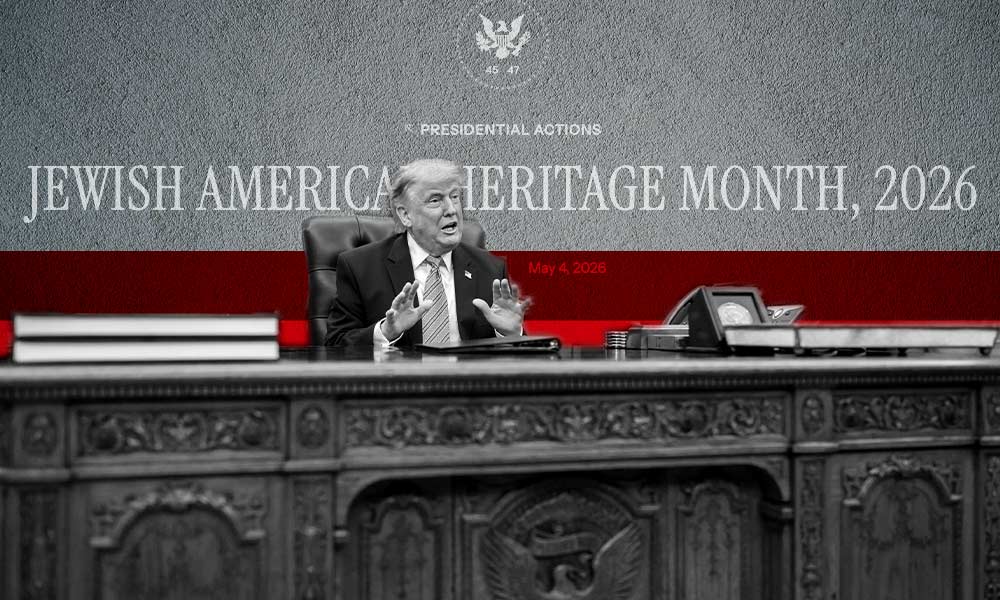
In the nation’s capital, the Trump administration declared a day of observance titled “Shabbat 250,” which included a White House Friday evening Shabbat candle lighting, attended by Jewish staffers, Orthodox rabbis and leaders, and dozens of MAGA-supporting Jewish Americans.
At Gracie Mansion in New York City, Mayor Zohran Mamdani hosted a Jewish American Heritage Month/pre-Shavuot reception, where the guest list was made up of the who’s who in the Jewish progressive camp and the few Hasidic groups that support Mamdani.
Left out of both events were mainstream Jewish organizational figures. Those who used to be seen as the backbone of the community and as its representatives in the halls of power weren’t invited. The far left and the far right are growing in access and power; those in the middle are struggling to find their footing.
2. A place in Trump’s Jewish world
Trump’s idea of proclaiming “Shabbat 250” as the keystone of Jewish heritage month raised some eyebrows within the Jewish community. Many praised the initiative—which for the first time added real-life substance to the otherwise ceremonial events marking the month—and praised the idea of focusing on the Sabbath, the Jewish day of rest, which carries a universal call for reflection, attention and worship.
Others took issue with the idea, which seemed to focus more on Jewish values close to those of the Orthodox community rather than of the majority of American Jews who are less strict in observing Shabbat and emphasize the social justice values of Judaism. The marking of Shabbat by non-Jewish Americans also echoes the writing of far-right Christian activist Charlie Kirk, who was murdered last year and whose posthumous writings detailed his own observance of what he called the “Jewish Sabbath.”
A May 15 White House event seemed to confirm concerns of liberal Jews that this year’s Shabbat event wasn’t planned with them in mind. Leo Terrell, who heads the Department of Justice’s task force on antisemitism, shared a video of the celebration, depicting participants holding hands and dancing around the room. Influencer Emily Austin, known for her ties to the Trump administration, lit the Shabbat candles. Shabbos Kestenbaum, a former student activist who supports the Republican Party and was critical of the Biden administration, was also in attendance, posting a photo from the event with a caption urging “more young American Christians should be going to Church, and more young American Jews should be going to Synagogue!”
Rabbi Levi Shemtov, executive vice president of American Friends of Lubavitch, was in charge of the ceremony, explaining to non-Jewish participants the meaning and practices of Shabbat and leading the group in prayer and blessings. (The event began at the White House Indian Treaty Room and then continued at the nearby Decatur House, to make it easier for observant Jews to celebrate.)
Absent from this first-ever White House gathering were leaders of major Jewish organizations, non-Orthodox rabbis and denominational leaders, and communal stalwarts who in the past had topped every official Jewish guest list.
3. The Mamdani option
Three days later and a couple of hundred miles away, a festive reception hosted by the mayor of New York City offered a mirror image of the White House celebration.
Marking Jewish American Heritage Month and the upcoming holiday of Shavuot, Mayor Mamdani’s Gracie Mansion guest list offered a different perspective on current Jewish American political power. The room was filled with top Jewish officials from the Mamdani administration, alongside leaders of progressive and liberal Jewish organizations and of ultra-Orthodox sects that had thrown their support behind Mamdani during the mayoral race. “The reception,” concluded Jacob Kornbluh, who reported on the gathering for The Forward, “suggested that Mamdani is continuing to cultivate a smaller alternative Jewish coalition, separate from the traditional pro-Israel communal establishment and rooted more in progressive activism and pragmatic community relationships.”
Here too, mainstream Jewish leaders were not to be found. Some weren’t invited, others chose not to attend. The New York UJA-Jewish federation, which is the largest in the nation and whose ties with City Hall run long and deep, boycotted the reception, stating that it would not participate in an event “hosted by a mayor who denies a core pillar of our heritage—the State of Israel as the homeland of the Jewish people.”
Once again, the Jewish center was left out. And while absence from a White House Shabbat event or from a New York mayoral reception is largely symbolic, it is not going unnoticed in organizational Jewish circles. Beyond hobnobbing and nibbling on kosher hors d’oeuvres, these types of events signal access and importance. As of now, the access is shifting toward those on the right and left margins of the community. And as their access increases, so will their power, at the expense of the old guard.
4. Israel adds to the divisiveness
As the political divide within the Jewish community grows, another reason for concern has emerged, courtesy of Israel’s ambassador to the United States Yechiel Leiter. The top diplomat representing the Netanyahu government chose an event aimed at countering antisemitism to lash out at the dovish pro-Israel lobby group J Street, calling the organization a “cancer within the Jewish community.” Leiter, in his speech, took issue with J Street’s support for congressional measures aimed at conditioning military aid to Israel and ending U.S. taxpayer funding of such aid. “How can you be pro-Israel and advocate for an arms embargo on a state that’s fighting a seven-front war against Iranian proxies?” he said. The ambassador argued that if American Jews want to influence Israeli policies, they should “make aliyah, vote in the next election and express yourself.”
The response was quick to come. A letter signed by hundreds of rabbis and communal leaders urged Leiter to “retract your remarks and issue a public apology to the many American Jews, rabbis, cantors and communal leaders who have been hurt by them.”


Leiter has not responded, nor did he take back his comments.
For context, it is important to remember that Israeli governments have a long history of viewing J Street unfavorably and some have boycotted the organization. Leiter’s offense not only deepens the divide, but also makes it harder to see a path for reconciliation between Israel’s right-wing government and J Street and the broader Jewish community, which has grown more critical of Israel and more inclined to support measures aimed at pressuring Israel.
5. A moment of unity
With all the talk about division and divisiveness, there are some red lines that all unite behind. One of them is blatant antisemitism trying to enter national politics.
Maureen Galindo, a Democrat running for Congress in Texas’s 35th congressional district, has called for turning an ICE immigration detention center into “a prison for American Zionists.”
The comment earned wall-to-wall condemnation from across the political spectrum. A rare Democratic consensus, from progressive Alexandria Ocasio Cortez to conservative-leaning Josh Gottheimer, spoke out against Galindo’s comments. Some Dems have been actively working to ensure she does not win the upcoming primary runoff.
Gottheimer, alongside fellow Jewish Democrat Jared Moskowitz of Florida, vowed to keep up the fight against Galindo even if she wins the elections and to force votes demanding her expulsion “every single day we are here.”
(Top image credit: The White House)
4 thoughts on “Finding Space in the New Political Jewish Landscape”
Leiter should have just kept his mouth shut. It’s not always prudent to speak the truth.
Jewish American Heritage Month could have been promoted by our congregational Rabbis, JCRCs with connections to government and school systems, Hillel and Chabad officials on campus, our medical institutions, and major employers. The places of public respect ignored it, leaving it to default to our political opportunists. During the month, I attended an event sponsored by a local chapter of a legacy institution. My path from the train to the event took me past the National Museum of Jewish American History, which had no banner announcing the special month.
Were our mainstream leaders right to keep a low profile? For all the travails our largely secular Jewish community has experienced, we are still very successfully embedded in American science, education, commerce, medicine, law, and public affairs. Those who attack us mostly have not shared the achievements that our freedom blended with our culture has enabled. The displays from both political poles looked like cheap shots at Other, the very things that challenge our unity and our dignity. Our tradition which enables us to excel without calling attention to ourselves has proven itself valid once again.
We need more centrists and to hear not just the loudest and most contevertial voice but all voices like a true democracy. False news and photos shoukd be a crime with severe penalties as the implications of false education are far reaching into the future. As far as jews, they are politically divided just like any other race, religion, culture or nationality within the USA, but it is a more crucial division considering what a small mini minority they are, and the genocide ìnflicted upon Israel, and how many enemies Israel has that want Israel to disappear from the map of the world. Mamdani and his wife are just one example of the immence hatred developed towards Israel/Jews, all based on false news and no historical context, which is the history Jews endured with the progroms, Holocaust, and antisemitism throughout the centuries.
We need more centrists and to hear not just the loudest and most contevertial voice but all voices like a true democracy. False news and photos shoukd be a crime with severe penalties as the implications of false education are far reaching into the future. As far as jews, they are politically divided just like any other race, religion, culture or nationality within the USA, but it is a more crucial division considering what a small mini minority they are, and the genocide ìnflicted upon Israel, and how many enemies Israel has that want Israel to disappear from the map of the world. Mamdani and his wife are just one example of the immence hatred developed towards Israel/Jews, all based on false news and no historical context, which is the history Jews endured with the progroms, Holocaust, and antisemitism throughout the centuries. The New School in NYC just discontinued funds for Hillel, the beginning of a downward scary trend.