
It’s well-known that time plus tragedy equals comedy, but what if comedy can spring up in the middle of tragedy? If, in the gravest of situations, people still meet on the street to let off some steam?
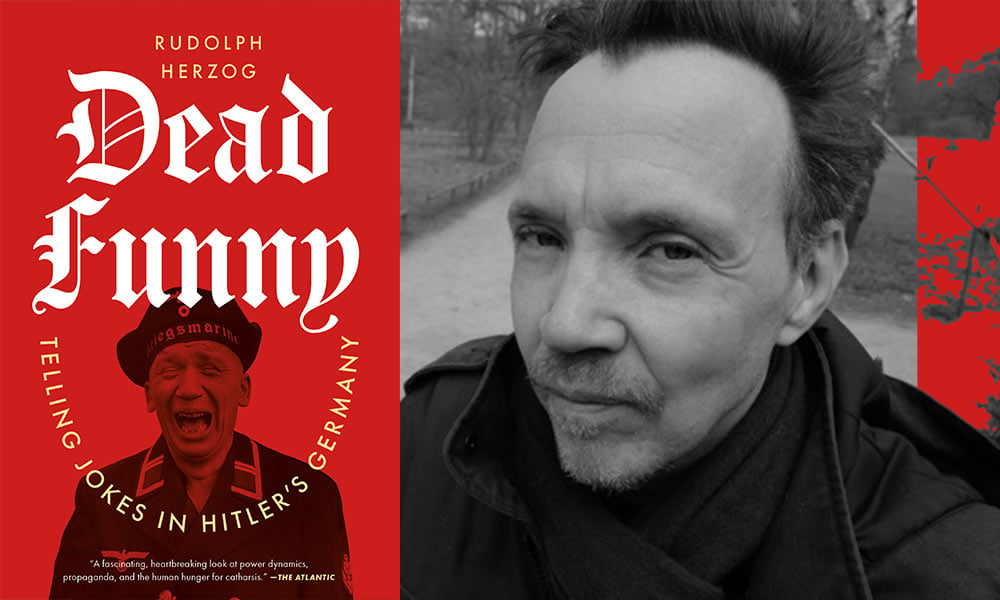
Filmmaker and writer Rudolph Herzog wrote his 2012 book, Dead Funny: Telling Jokes in Hitler’s Germany, out of his documentary Laughing With Hitler. Now reissued by Melville House and translated by Jefferson Chase, Dead Funny traces how comedians and laypeople in the Third Reich used humor as a balm for the struggles of the time. Citizens laughed about some of history’s most insidious people—Adolf Hitler’s incompetence, Hermann Göring’s vanity. Charlie Chaplin even parodied the supreme leader in The Great Dictator, and actors would be hired to record propaganda skits for the Nazis. Cabaret stars performed send-ups of the Nazi Party with officers sitting in the audience; people everywhere feared spies. The consequences were extreme—after a crass joke, a civilian might be whisked away to a concentration camp, or simply be executed on the spot. How did these jokes survive? Were these a form of political resistance? And were they even funny?
Moment caught up with Herzog—also the author of the horror short-story collection Ghosts of Berlin and nonfiction work A Short History of Nuclear Folly—to discuss the history of jokes in Nazi Germany, a surprisingly robust and plentiful field of study.
This interview has been edited and condensed for clarity.
I couldn’t stop thinking about Donald Trump while I was reading this book. Hitler went after his political enemies and spewed lies and propaganda, while the general population largely made fun of him and his team for their brutality—of course, Trump’s not quite Hitler yet. This book was re-issued at a very strategic time, having been originally published in 2011. What do you think about the timing?
I’m happy Melville House decided to reissue it; there’s always a good time to remind us of the consequences of totalitarianism. I’m German, so I’m not abreast of everything happening in the United States. I think the book stands on its own, it doesn’t need a specific context. I always thought Trump’s techniques were lifted from [Hungarian Prime Minister Viktor] Orbán, whom he likes a lot.
It’s always a bit tricky if you want to compare democracy and hardcore totalitarianism—humor works quite differently in these two systems. In a democracy, political humor is part of the natural process of forming an opinion about your political leaders, hence Trump’s attacks on comedians. Totalitarian regimes don’t have elections. I’ve argued in the book that political humor under the Nazis, at least the jokes told in the street, were more of a release valve for pent-up frustration. You don’t get that much in a democracy. Could you tell me a Trump joke? I couldn’t tell you one about our chancellor in Germany. They tend to flourish in dictatorships when people need to vent, where they can retreat and say, “Well, this is a joke.”
It’s interesting because when it came out, Trump wasn’t in the political consciousness. But now, your mind goes to these parallels and it changes the reading experience.
The bridges you’re crossing might be rickety, though.
Well, I’m glad for that.
The bridge you could actually cross is the humor that suddenly popped up during COVID. We go from zero to having to wear masks and gloves, and our life completely changes. This trauma was used for memes that integrated weird-seeming new ways of behavior into our understanding and our reality. In order to do that, some people joked about it. That’s a bit like what you find in the Third Reich as well. People suddenly had to do Hitler salutes when they entered a new building; it was an order from one day to the next. It’s odd. It’s like wearing your mask all of a sudden.
You write that jokes were not a form of political resistance, but why did the Nazis try to suppress them, if they didn’t have at least some power?
They didn’t suppress them at first. If you look at court proceedings against people who had told a joke, you’ll see they got let off very lightly; small fines, a reprimand. People would say, “Oh, he’s been a party member for three years now, he’s usually reliable, he was just drunk.” Toward the very end, when the regime had its back to the wall, the Eastern Front had fallen and they knew they were losing—that’s when they really started cracking down. Not just on jokes, on individuals. The judicial system of a dictatorship of that ilk is not comparable to ours. This is very simplified, but in ours, we have a book of laws, and if you do something not according to the book, you get told off. It’s the same for everyone, in an ideal world. In the Third Reich, it’s not about any kind of rules, it’s about who you are. Do they need you? Do they like you? They looked at a priest who had fraternized with Polish laborers and who had been critical of the regime. The priest told a joke, and they used it as a means of trying and ultimately executing him. But it wasn’t because of the joke—they were waiting for some excuse to take care of him, if you will.
One thing that comes up in the book is that Hitler didn’t like “defeatists,” or people who told jokes that suggested the demise of the Nazi Party. Was this a way to quell the idea of failure?
Yeah, I think so. They were in a bad position toward the end. They had to somehow align realities on the ground with delusions, frankly, about what was going on. This got increasingly painful, difficult and impossible. If someone came out with the truth on the BBC and blabbed whatever, it made the construct fall apart.
In the beginning, most of the jokes were harmless. People joked about Göring, who was fat and vain. They said he had his medals made of rubber so he could wear them in the bath. That wasn’t really critical of him—you’re almost endeared to him because of his human faults. But toward the end, they got darker—there was one where Hitler, Göring and Joseph Goebbels go out to sea where there’s a big storm, and the boat sinks. Who is saved? The answer: “Germany.” The jokes got pretty sinister, and defeatist. It undermined morale, that truth-telling, even if it was in the guise of a joke.
You write that there wasn’t a lot of humor—or simply none survived—around Hitler’s suicide. Was that surprising? Jokes imagining their deaths, like your example, were common.
I’ve never asked myself that. Certain things were so dark that they just couldn’t joke about them. There were no jokes about Heinrich Himmler—people were really scared of him. Maybe it was just so traumatic that there were limits. Very few COVID jokes crossed a line about the deaths. There seems to be a natural frontier. It’s not that these jokes never existed—they could’ve—just that they didn’t spread. If nobody passes them on, they become extinct.
I find political humor right now tricky, because it can turn didactic or corny very quickly, as I think somewhat like Jon Stewart does. Were there any satires or shows that came up in your research where you just rolled your eyes?
Yeah, sure. The weakest of all was when the Nazis tried being funny. It was toe-curling. There are songs and satirical parodies, like, “If you don’t behave, you’ll end up in a camp…” done as if it were a concert. It’s frightening! Of course, there was antisemitic humor, they tried that, which was awful. When the Nazis were joking, there wasn’t anything remotely funny. That said, most of this stuff isn’t laugh-out-loud, even the good jokes by the right people. Humor is very rooted in its moment. There’s a joke about the shortest books of all time, one of which is “500 Years of German Humor.” There’s a bit of truth in that.

Did you have a favorite joke that came up during your research?
Golly, quite a few. I turned one into a film that I directed, where Hitler’s on a drive with his chauffeur and they run over a chicken. The driver holds it up and says, “You’ve gotta tell the farmer!” So Hitler goes to tell the farmer and comes back with a black eye. They keep going, and later, they run into a pig. Hitler makes the driver tell the farmer this time. An hour goes by and he comes back totally drunk, carrying a basket of sausages and other gifts. Hitler asks what the driver told the farmer, and he says, “Nothing special, I just said, ‘Heil Hitler, the swine is dead.’” I like that one. It’s also wishing him death, which is a good thing.
Yeah, I remember laughing out loud at that one. So, it feels like a fraught moment for comedy. Stephen Colbert is off the air after pressure from the Trump administration. Leftists were doxxed for celebrating the murder of Charlie Kirk, and right-wingers are made famous for racist tirades. Where do you think humor in the Trump era will go from here?
It’s always difficult with Trump. He’s a living satire of himself in the first place, so how do you turn him into a joke? It’s not that easy, somehow.
Well, he’s got a team, too—I see jokes about Marco Rubio and JD Vance, and all the people he’s fired as well.
Yeah, but is that laugh-out-loud? Saturday Night Live had a couple of good skits about Trump. It’s had its moment, the whole thing. My feeling is that after the midterms, it’ll calm down a bit. He’ll get less erratic, since he’s able to do less. There’s less to satirize. Then the jokes will be about him watching telly, or something. He’s older now, as well. He might be tired if there’s too much resistance. He could collapse in on himself.
(Top image credit: John Goetz)