
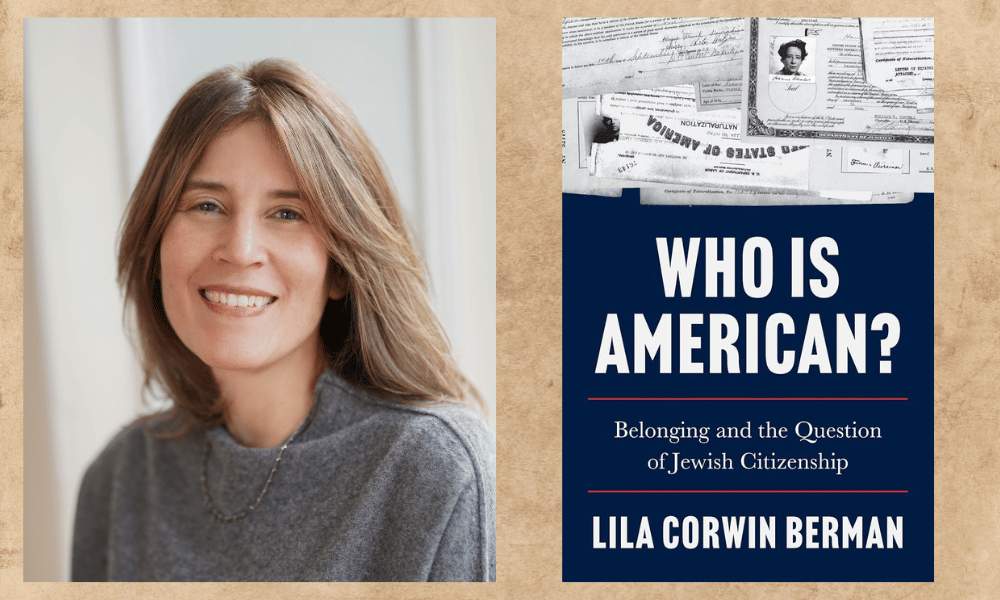
Before embarking on the research for her book Who Is American? Belonging and the Question of Jewish Citizenship, historian Lila Corwin Berman accepted the familiar narrative that says Jewish citizenship in the United States has always been secure and uncomplicated, free of the tortured debates over “the Jewish question” that wracked 19th-century Europe. No such luck, it turns out. Even with George Washington’s famous letter asserting “no sanction” for bigotry, it was only after the Civil War and the adoption of the 14th Amendment that the states all recognized Jews’ full rights of citizenship. And even after that, Berman says, questions about their ambiguous status as a group—were they a race, a religion, a nationality or all three?—made Jews a useful “example to think with” as courts weighed the claims of other groups.
Examining a series of pivotal court cases, the book looks not so much at how Jews themselves have viewed their place in America but at how the wider society’s ruminations on Jews—who they are, where they belong, whether they are “white”—have shaped larger categories of American law. Those categories, constantly in flux, remain hugely significant—whether in 1909, when a Boston judge concluded that Armenians, like “Hebrews,” were “white” despite their Near Eastern ethnic origins and therefore, like them, eligible for citizenship, or in 2017, when an Alabama football coach with a Jewish mother alleged racial, not religious, discrimination after a Baptist college “red him for having “Jewish blood” despite his having converted to Christianity. Berman spoke with Moment Opinion & Books Editor Amy E. Schwartz.
One message of almost all your examples is that decisions about categories always have wider meaning and it’s never just about Jews. That’s right. I don’t contend that race or nationality or religion are true or real categories, but that what they mean is always changing and being reinvented. And they’re constantly being used to classify the legal status of Jews, and others, when it comes to citizenship and civil rights.
One surprising case is how Jews and Israel affected the law on dual citizenship. Citizenship is about more than rights—it can also be a form of foreign policy and diplomacy. Dual citizenship really makes no sense if we think of citizenship as a contract between the individual and the nation-state. And up through the middle of the 20th century, most modern countries were reluctant to allow it. If you voted in another country’s election, or served in a foreign army, you were treated as having relinquished U.S. citizenship. But in the Cold War era, when there was a competition for countries to be on our side, that started to change—notably, for naturalized American Jews who had spent time in Israel. In 1960, Beys Afroyim, a naturalized American citizen who had lived in Israel and voted in a Knesset election, lost his citizenship but appealed to the Supreme Court, which restored it, 5-4. It was the first legal pronouncement that dual citizenship is okay. It reversed a similar case that had gone the other way in the 1940s. And it mattered that Chief Justice Earl Warren not only was an admirer of Israel as a “pilot plant of democracy” but believed that it was a strategic partner in the Cold War and that dual citizenship was a way of projecting American power.
You describe the use of denaturalization law in 1909 as a weapon to deport anarchist Emma Goldman. It made me think of the raid on Minnesota Rep. Ilhan Omar’s home. Goldman, who was born in Russia, had become a citizen through her first marriage. Authorities investigated her ex-husband and determined that he had made misstatements on his naturalization papers, and on that basis stripped her of her citizenship and deported her. Obviously, we’re seeing deportation policy being applied unevenly and unfairly today, targeting and profiling particular groups, or people we want reasons to expel. And for people who maybe aren’t fans of someone like Ilhan Omar, it’s worth keeping in mind that if a government can seek out legal pathways to attack people in this way because of their politics, it compromises everybody’s rights.
You’re skeptical of the recent turn toward treating Jews as a protected group through Title VI. It’s pretty much settled law now, though it wasn’t before, that Jews now have protection under Title VI based on national origin. The big question is what happens with anti-Zionism. Some Jewish organizations and lawyers argue that anti-Zionism is not simply political speech but a form of discrimination against all Jews, because Zionism is intrinsic to Jewish identity. Could Muslims make the argument that being anti-Zionist is intrinsic to their identity? In the book I try to demonstrate that legal claims don’t exist in isolation. If organizations become invested in the protection of Jewish rights through these kinds of claims, they become available for other groups as well.
You say that belonging and citizenship are best understood “not as an answer but as a question.” People in my field sometimes say there’s no “Jewish question” in the United States because citizenship answered it. But citizenship doesn’t answer anything, because it’s always changing. The Supreme Court just determined that birthright citizenship remains good law, but the decision wasn’t overwhelming; it could shift. Citizenship has been used to promote all sorts of different visions. You can’t take it for granted. And your own status as a citizen is linked to that of other people and other groups.
