
1. The Israeli Press Learns About Charlie Kirk
The news from Utah travelled quickly. As night fell in Israel on Wednesday, the media’s focus shifted quickly—from coverage of the Gaza war to reporting on the drama unfolding in the United States.
More than one influential social media commentator admitted that until that moment, they’d never heard of Charlie Kirk. The same is true for most Israelis. While extremely influential in the United States and incredibly instrumental in harnessing the power of America’s youth in favor of Donald Trump, Kirk was not widely known abroad.
But within hours, Israelis knew. And cared.
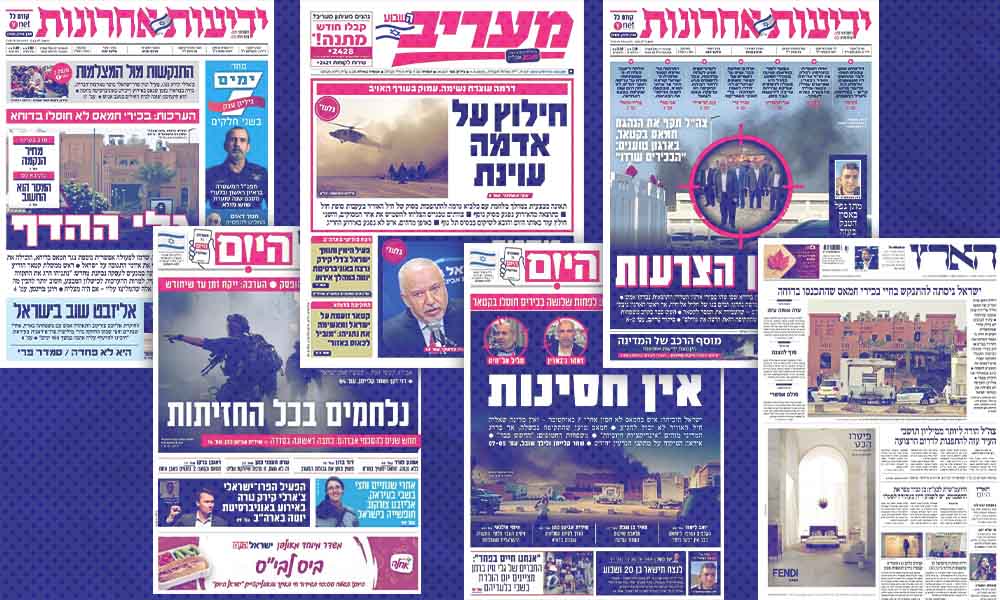
“Assassination in front of the cameras,” read the top headline in the popular daily Yediot Ahronot. Like other print publications, it came out before Kirk’s fate was clear.

By Thursday, the story of Charlie Kirk’s killing dominated Israel’s news cycle. KAN-11, the public broadcasting network, opened its main evening news with no less than 18 minutes of coverage of the assasination, followed later on in the program with an extensive profile of Kirk’s life and beliefs. “It may sound a little strange that the opening story in a newscast in Israel, which is in the midst of a two-year-long war, is about the murder of a media influencer. But this murder demonstrates the growing rift in American society that will impact Israel and the entire world,” the anchor explained as he presented the story.
Friday’s newspapers featured the manhunt for Kirk’s assassin prominently on their front pages.
The themes in all media reports were similar: America may be on the verge of a violent eruption and this murder will only unleash more political violence.
2. The Charlie Kirk Israelis Saw
In less than a day, Kirk went from a virtually unknown figure to a household name in Israel and, more importantly, a hero of many on the Israeli right.
To understand why, it’s sufficient to look at how the media portrayed the conservative influencer. “Pro-Israel activist Charlie Kirk shot during a public event at a Utah university,” is how Israel Hayom introduced their readers to Kirk. “Right wing activist and Israel supporter Charlie Kirk murdered in Utah,” wrote Maariv. Yediot Ahronot described him as a “well known right-wing pro-Israel activist.” Ynet, Israel’s leading news website, which is owned by Yediot Ahronot, devoted an article to Kirk’s relationship with Israel, describing him as a fighter for the Israeli cause, and as a debater who gave pro-Palestinians a piece of his mind.


In fact, almost all coverage of Kirk’s assasination in the Israeli press included references to his positive views on Israel, many times simply using the shorthand phrase “Israel supporter,” when talking about Kirk. Some pundits were even quick to speculate that these pro-Israel views were the motivation that led to Kirk’s assasination and that his killing is somehow related to anti-Israel activists in the United States.
To be clear, Kirk did support Israel, its government and the war in Gaza. He spoke out on Israel’s behalf even as other young influencers in the MAGA camp took a step back and called out the actions of the Netanyahu government.
But at the same time, much of the coverage in Israel ignored the many issues that dominated Kirk’s public work and made him a leading conservative voice: his views on religion, race, women, LGBT rights, vaccines and other issues that might make many of his newly found supporters in Israel feel uneasy.
But in a media environment that sees the world exclusively through the lens of “Are they pro-Israel or anti-Israel?” Kirk became an instant hero. Your average media consumer in Israel could very likely end this turbulent week believing that Charlie Kirk’s sole focus was on supporting Israel and fighting back against pro-Palestinian voices.


3. How to Cover a Failed Attack
Israel’s surprise attack aimed at Hamas negotiation team leaders in the heart of Qatar was a stop-the-press moment for Israeli media. Minutes after reports began to flow in about plumes of smoke covering the skies of Doha, it was clear to all that Israel had launched an unprecedented attack. The Israeli media switched into emergency mode, filled with around-the-clock coverage of the events, reporters struggling to understand who was targeted and why, and endless discussions in TV studios about the boldness of carrying out an attack in Qatar, a country that has been playing a key mediation role in efforts to end the Gaza war and release the hostages.
The mainstream media were giddy with excitement.
“No more immunity,” exclaimed Israel Hayom, which leans to the right. To drive home this point, the paper added photos of four senior Hamas leaders targeted in the Israeli attack, each of them surrounded by crosshairs. “Israel proved: No one in Hamas has immunity after October 7 and there is no country the Air Force cannot reach,” the paper added on its front page.

The more centrist Yediot also went with the crosshairs graphic element, above a headline reading: “Fire in the hornets’ nest.”

The liberal-leaning Haaretz, on the other hand, refrained from superlatives, stating simply in its main headline: “Israel attempts to assassinate Hamas leaders convened in Doha.”

TV and radio coverage also carried a celebratory tone, while giving airtime also to families of hostages still held in Gaza who feared that the Israeli attack on Hamas’s negotiating team would inevitably harm their loved ones.
But as days passed, the tone soured. What was supposed to be a brilliant attack, aimed at “decapitating”—a term used by military affairs pundits— Hamas’s senior brass, turned out to be inconclusive at best.
By Thursday, Yediot was already reporting in a matter-of-fact fashion that “Assessments show Hamas leaders not killed in Doha.” Israel Hayom buried in its front-page coverage a sentence saying that “the fate of Hamas leaders targeted in Qatar is still unclear,” while Maariv ignored the question altogether and moved on to report on the harsh Qatari response to Israel’s attack.
By Friday, a consensus emerged in the Israeli press that the military operation had failed to achieve its goals, that the bold attack may have seemed impressive at first, but resulted with nothing more than a diplomatic blunder threatening the delicate relationship between Qatar and Israel.
“The failure in Qatar is deeper than it seems,” wrote Middle East scholar Ellie Podeh in an opinion piece published on N12, the news website of Channel 12 News, Israel’s most influential TV network. He warned that the brazen attack could turn out to be a major strategic debacle and that it “caused immense political damage” by endangering the trust with Qatar and Arab countries and complicating relations with the United States. “At the end of the day, Israel remains even more isolated,” he concluded.
4. When the Minister of Defense Tries to Sound Cool
Israel Katz, Israel’s defense minister, holds one of the most consequential positions in the Israeli government. While second to Netanyahu when it comes to making decisions, Katz oversees the vast military establishment in charge of running the multi-front, years-long war Israel is engaged in.
He also has a penchant for trying to relate to the public through memes, tweets and slogans. Spoiler alert: They are all really lame.
As the Israeli military embarked on its most dramatic, and controversial, phase of the war, with a full ground incursion into Gaza City, the defense minister chose to accompany military operations with visual posts on X.
“We’re starting,” he posted on September 5, alongside a video clip of an entire apartment high-rise being bombed into rubble by Israel. “We’re continuing,” he posted the next day, with video of another residential tower turned into dust. “A huge hurricane-like attack will hit Gaza City today,” he warned on September 8, calling on all remaining residents in Gaza’s most densely populated city to evacuate. Soon after, he stuck with the metaphor, announcing on X that an “unprecedented hurricane storm hit Gaza, bringing down 30 buildings.” Once again, the defense minister accompanied his post with visuals of towers crumbling to the ground. Since then, it has become a daily occurrence, with Katz tweeting out videos of homes and buildings being destroyed, and with catchy phrases, such as “The house of cards is down, Gaza’s skyline is changing.”
The military necessity of systematically destroying any livable space in Gaza is a matter for a separate debate. The tasteless social media posts of Israel’s senior cabinet minister are undoubtedly out of line.
5. Whataboutism
Katz’s posts drew very little attention in Israel. Two years of fighting have numbed the Israeli media’s sensitivity to suffering on the other side.
Much of that was on display last month, when Israel came under attack for not allowing sufficient food supplies to enter the Gaza Strip, thus causing mass starvation. The Israeli press largely joined the government’s effort to push back against this claim, including by airing reports depicting a Gaza market full of fresh produce and goods, and by publishing stories questioning the integrity of members of the UN-led committee that wrote the report on food scarcity in Gaza.
Ynet, whose content is read by more Israelis than any other news website, ran an article complaining about an alleged imbalance between the time and effort spent by the World Food Program and the UN discussing the situation in Gaza, compared to other famine crises across the world. “The gaps are enormous: this is the amount of time dedicated by the UN to 215 million hungry people around the world, compared to Gaza.” The article included a fancy interactive graphic feature of famine-stricken zones around the world, from Afghanistan and Yemen to Somalia and the DRC, alongside a bar chart showing the number of UN sessions dealing with the humanitarian situation in each region. Ynet’s conclusion is that while Gaza has “only” 640,000 people in danger of hunger, it received more discussion time in the UN than all other zones in which tens of millions are at risk. “Hypocracy,” Ynet cried out in the article, which led the website’s homepage for hours.