
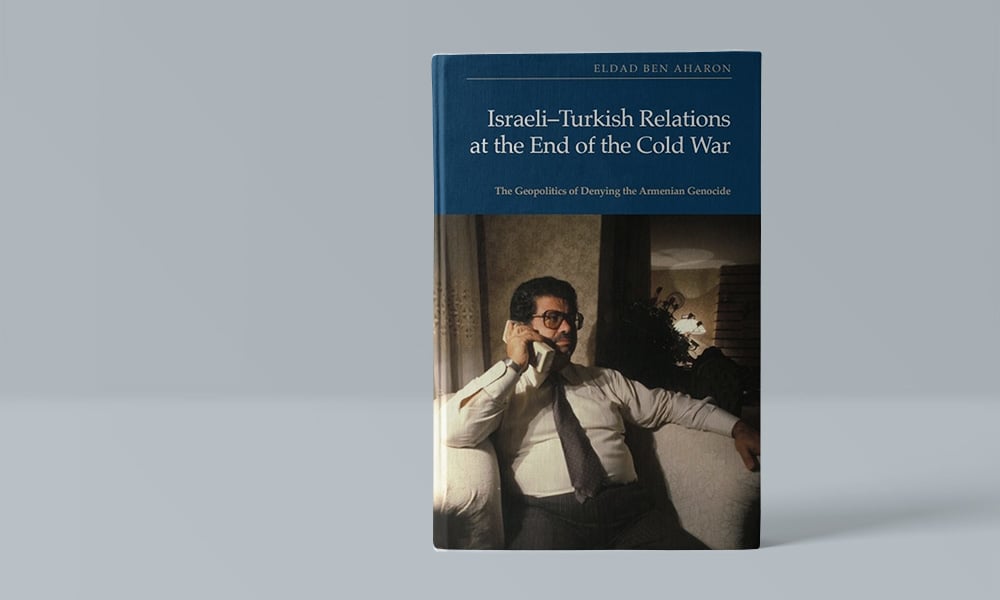
Israeli-Turkish Relations at the End of the Cold War: The Geopolitics of Denying the Armenian Genocide
By Eldad Ben Aharon
Edinburgh University Press, 304 pp.
Eldad Ben Aharon was about 23 when a Haaretz article stopped him in his tracks. It was about Turkey’s outrage over the potential mention, during the 2003 Independence Day torch-lighting ceremony, of the Turkish massacres and expulsions of 1.5 million Armenians that took place around World War I. What struck Ben Aharon was not the politics but the framing. The article had not called the event the Armenian genocide but the “Armenian holocaust of 1915.” In Hebrew: Shoah.
“I’d never heard the Armenian case framed in relation to the Holocaust before,” he told me. “So I found myself wondering, what does Turkey have to do with this? Why haven’t I heard about this before?”
His grandmother was a Holocaust survivor, the sole survivor of her family. He grew up in Israel inside that memory. The possibility that his country had leveraged the moral weight of the Shoah to help another state deny its own mass atrocity struck him as not an abstract academic question but as an urgent one that needed answering.
The result is Israeli-Turkish Relations at the End of the Cold War: The Geopolitics of Denying the Armenian Genocide. Drawing on declassified Israeli and American archives and 30 oral history interviews, the book’s argument is about the 1980s: It shows how Israel systematically helped Turkey suppress international recognition of the 1915 massacres in exchange for an alliance neither country could afford to lose. But it casts a telling light on the deteriorated and still worsening relationship between Turkey and Israel today.
“The moment you try to apply the genocide framework to an ongoing conflict, you move from historical analysis into something far more immediate, contested and politically charged.”
Each country’s leadership is now racing to tear apart what remains between them. Last week an Istanbul prosecutor indicted Prime Minister Benjamin Netanyahu and 34 other officials, seeking 4,596 years in prison over Israel’s 2025 interception of a Gaza-bound Turkish flotilla. Turkish President Recep Tayyip Erdoğan threatened military action, citing Turkey’s interventions in Karabakh and Libya. Israeli Heritage Minister Amichai Eliyahu answered: “Turkey, which built its economy on the Armenian genocide, dares to accuse us of genocide.”
After the 1979 Iranian Revolution stripped Israel of its most important Muslim partner, the Jewish state needed Turkey—a Muslim, non-Arab country willing to maintain open relations, share intelligence, allow Israeli Air Force exercises in Turkish airspace and provide a bridge to NATO. Ben Aharon’s archival citations show Israeli diplomats describing the relationship in terms approaching desperation, not the language of allies managing an equal partnership but of a smaller power protecting access to something it could not do without. What Turkey wanted in return was help suppressing international recognition of what had happened to the Armenians in 1915. Israel provided it.
The NATO border, the missile sales, the hawks in Washington who needed Ankara cooperative: All of it created a political environment in which keeping Turkey happy was simply what responsible actors did. The most visible, and morally troubling, episode in the alliance was the fight over the United States Holocaust Memorial Museum, which opened in Washington in 1993. As representatives of the Armenian diaspora pushed resolutions through Congress and the European Parliament officially recognizing the Armenian genocide, the Israeli Foreign Ministry worked to block them. It applied pressure on Jewish organizations. It directly influenced members of the committee establishing the museum to dissuade it from creating a permanent exhibit on the Ottoman slaughter of the Armenians, settling for a temporary one instead.
The diplomat whose papers capture this most clearly is Yitzhak Lior, director general of the Israeli Foreign Ministry’s Middle East Department. Lior’s written report describes putting extensive pressure on Jewish members of the memorial committee, arguing that including the Armenian genocide would turn the museum into the only controversial venue on the National Mall rather than a Jewish asset. Why open this Pandora’s box? he wrote. Who authorized us to reduce the singularity of the Holocaust by including other historical disputes?
The Congressional bill to recognize the Armenian genocide recurred every year. From the Turks’ perspective, the Holocaust Museum was different: A permanent Armenian presence there would carry implications for decades, possibly generations. The Armenians received a temporary room. The Israeli Foreign Ministry considered the mission accomplished.
A 1987 memo by Gideon Tadmor, head of the Foreign Ministry’s Jewish Diaspora Department, captures the internal anxiety. Writing to colleagues in Jerusalem and Ankara, Tadmor admitted what was at stake: “In ten or twenty years’ time, the Jews will not be represented in the memorial, instead the goyim will be there, and the memorial will become an international institution of genocide, which guarantees the minimisation of the value of the Shoah.” That anxiety about the Holocaust’s singularity was not a fringe view. It was mainstream Israeli diplomatic culture in the 1980s, and it dovetailed with what Turkey needed. The book quotes Kenneth Bialkin, chairman of the Conference of Presidents of Major American Jewish Organizations at the time, who was blunt: “It was the right thing to do for people like myself, to be friendly and sympathetic with Turkey.”
The Turkish-Israeli alliance, however, ran deeper than memory politics. Ben Aharon’s archives show Israeli intelligence sought to link the Armenians’ cause to that of the Palestinians, capitalizing on the violent activities of a group called the Armenian Secret Army for the Liberation of Armenia (ASALA), which targeted Turkish diplomats in several terrorist incidents and had documented ties to the PLO. The linkage allowed Turkey to frame its campaign against recognition of the Armenian genocide as part of the Cold War struggle against Soviet-backed radicalism.
Turkey’s denial that its Ottoman forerunners had committed genocide was built up gradually, not inherited. The story did not arrive whole in 1923: It evolved in phases, each shaped by pressure from outside. For decades after the Turkish Republic’s founding, nothing was said about the issue from either the Armenian or the Turkish side. In the early 1970s the Armenian diaspora launched its recognition campaign, and Turkey began constructing an organized counternarrative. In the 1990s, after horrors in Rwanda and Srebrenica forced the world toward a precise legal definition of genocide, Turkey’s position shifted: What happened in 1915 was wartime tragedy, not genocide, the Turks argued, and in any case the Holocaust was the only true genocide of the 20th century. Around 2014, as the centenary approached, came something closer to acknowledgment, carefully worded condolences that stopped short of the legal threshold.
Today, most serious historians and more than 30 governments recognize the Armenian genocide. (Armenian Genocide Remembrance Day is April 24.) The Turkic world, however, still carries its own memory of displacement and violence, and that memory is part of what built the denial position, not purely cynical invention but grievance hardened into state policy, then exported to Jerusalem. Ben Aharon’s book shows how this seemingly regional conflict had ripple effects across multiple Turkish communities, from Azerbaijan to Los Angeles. Russia had cultivated Armenian communities as a wedge against the Ottomans for centuries. Armenian fighters, with Russian arms and tacit support, were operating behind Ottoman lines at the time the 1915 massacres took place.
Nor did the story end in 1915. In the early 1990s, as the Soviet Union collapsed, both Turkic Azerbaijan and neighboring Armenia became independent nations. Armenian forces seized Nagorno-Karabakh and surrounding Azerbaijani territory, expelling hundreds of thousands of Azerbaijanis. Azerbaijan dealt with nearly a million internally displaced people before retaking the territory 30 years later, in 2020 and 2023.
Israeli policy kept pace. Ben Aharon traces how after Azerbaijan’s independence in 1991, Israel extended its support for Armenian genocide denial, opening an embassy there in 1993 while keeping relations with Armenia deliberately thin. By 2020, Israel was supplying nearly 70 percent of Azerbaijan’s major arms imports.
I live in Istanbul now, and when my California friends and my Turkish friends end up in the same room in Los Angeles—where a wave of violence between Turkish and Armenian diaspora communities raged in the 1970s and 1980s—the history Ben Aharon excavates becomes something you can feel. My California friends interrogate Turks about 1915 the way their parents’ generation interrogated Germans about the war, except they are asking Turks to account for something their own government spent a century ensuring they would never be taught to account for.


So what went wrong between Israel and Turkey? The flip came gradually, then all at once. As Erdoğan consolidated power after 2002, Turkey’s alignment shifted from Israel toward the Palestinians, reacting successively to Operation Cast Lead in 2008, the Mavi Marmara flotilla in 2010, the U.S. Embassy move to Jerusalem in 2018, and finally October 7. Each crisis pushed Erdoğan closer to Hamas. At the same time, each crisis pushed voices inside the Knesset closer to formally recognizing the Armenian genocide. The two positions moved in tandem, in opposite directions. When the U.S. Congress recognized the Armenian genocide in 2019, Ben Aharon notes, Turkey’s response was fierce in public and negligible in practice: Trade between the United States and Turkey spiked to a record $21 billion the following year. The objectives of the Turkish-Israeli alliance were already gone; both sides were free to use the other’s history against them.
Within days of October 7, 2023, Erdoğan accused Israel of operations amounting to genocide. Turkey severed diplomatic relations in November 2024, joined South Africa’s case at the International Court of Justice, and in November 2025 issued arrest warrants against Netanyahu and 34 other Israeli officials on charges of genocide and crimes against humanity. Netanyahu, for his part, cast Turkish accusations as antisemitic distortions.
Then came the podcast. Last August, when Armenian-American host Patrick Bet-David pressed Netanyahu to recognize the Armenian genocide, the prime minister said: “I just did. Here you go.” Netanyahu had served as deputy foreign minister in the 1980s and helped deepen Ankara-Jerusalem ties while the Foreign Ministry worked to support Turkey’s denial. The recognition was headlines without legislation; no such Knesset resolution ever passed. Within days Turkey closed its airspace to Israeli aircraft.
The irony Israeli Heritage Minister Eliyahu was reaching for cuts both ways. The UK, Canada, Australia and New Zealand have sanctioned Ben-Gvir and Smotrich, cabinet ministers whose coalition support Netanyahu requires to govern, for their genocidal statements about Palestinians. The genocide charge against Israel at the International Court of Justice rests in part on such statements. An Israeli heritage minister invoking the Armenian genocide as a shield against Turkish accusations of the same crime, while two of his colleagues face international sanctions for their genocidal language, is the argument of this book playing out in a single press release.
Ben Aharon, who is now a visiting scholar at NYU’s Global Institute for Advanced Study, joined a roundtable in Leipzig in March with German and Palestinian scholars. When asked to apply the genocide framework to Gaza, he declined. “The moment you try to apply the genocide framework to an ongoing conflict, you move from historical analysis into something far more immediate, contested and politically charged. My book is about the 1980s, and what archival declassification allows us to understand about that decade is vastly richer than what contemporaries could see. I’ll leave that question to whoever writes this chapter in 30 years, with the documents in hand.”
On the Turkish irony he was unambiguous. “How states use memory selectively in the service of present alliances. That’s precisely the argument.”
Meanwhile, the word that Yitzhak Lior spent a decade keeping off the National Mall is the word an Istanbul prosecutor used last Friday to seek 4,596 years in prison for the Israeli prime minister who said, on a podcast, that he had just recognized it.
“Alliances don’t collapse,” Ben Aharon told me. “They become unnecessary. And once they’re no longer necessary, the costs become visible in a way they weren’t before. The relationship was always more transactional than it appeared. When the transaction stopped making sense, the friendship turned out to be thinner than anyone wanted to admit.”
Jacob Wirtschafter is a journalist based in Istanbul.