
On June 12, Canada played their home opener of the 2026 World Cup against Bosnia and Herzegovina in front of a nearly sold-out crowd. The match ended in a 1-1 draw, but that was not the only thing that people walked away talking about.
On an embankment on the side of a busy expressway outside of the arena, protesters had covered the official FIFA World Cup logo with a large circular red banner with white lettering that read “Kick Israel out of FIFA.” The protesters wore “Jews for a free Palestine” T-shirts.
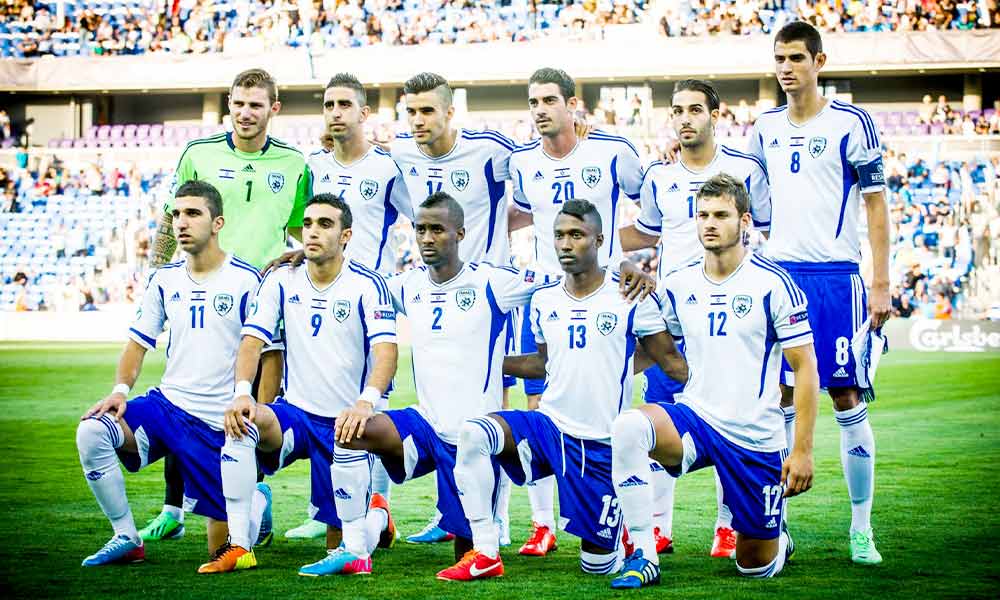
This is not the first time the question of Israel’s participation in FIFA has been raised. In March 2024, the Palestinian Football Association (PFA) submitted a formal complaint with FIFA, the international soccer governing body, asking them to suspend the Israeli Football Association (IFA) over the participation of IFA clubs based in the West Bank and discrimination against Arab players. In response, the U.S. State Department said it would work to stop any effort to ban Israel from the World Cup. (While Israel participated in qualifiers, it did not gain entry into the World Cup this year.)
In mid-March 2026, FIFA decided not to ban Israel and instead fined them 150,000 Swiss francs for breaches of its anti-discrimination regulations. FIFA said in a statement that the IFA was in breach of two sections of the FIFA disciplinary code: Article 13, which regards offensive behavior and violations of the principles of fair play, and Article 15, which pertains to discrimination and racist abuse.The PFA later appealed the decision not to ban Israel to the Court of Arbitration for Sport, which has not yet come to a decision.
“Singling out Israel and seeking to bar it from FIFA undermines the very essence of sports: bringing people together,” the Anti-Defamation League’s Marina Rosenberg wrote in an email to Moment. Rosenberg, who is senior vice president for international affairs at the ADL and served as Israeli ambassador to Chile from 2019 to 2022, added, “International sports must remain a force for connection and coexistence, not division.”
Yoav Dubinsky, an Israeli professor in the College of Business at the University of Oregon and former sports journalist, agrees that the World Cup brings people from diverse backgrounds, religions or nationalities together. “They find commonality in human performance in football,” Dubinsky says.
If Israel is banned from FIFA, he notes, it will hurt their international reputation. “Being part of [the World Cup], hosting it, competing in it, qualifying to it or just being one of the members that is part of the organization,” Dubinsky says, “puts you in a legitimate place in the international community.” He adds that if Israel is kicked out of the Union of European Football Associations (UEFA), which is one of the six confederations in FIFA and the one Israel currently plays in, then they might try to find a new league for the next few years or decades.
While the PFA officially submitted the proposal to FIFA itself, the United Nations and Amnesty International both called on UEFA and FIFA to suspend the IFA.
The question of Israel’s participation in international football goes back to 1974, when Kuwait introduced a motion to remove Israel from Asian Football Confederation (AFC) tournaments. The motion passed 17-13 with six abstentions, leaving Israel without a league to play in. They had qualified for their only World Cup tournament with the AFC in 1970. Israel played different qualifying tournaments in the European and Oceania leagues until they officially joined the UEFA in 1994.
Regardless of people’s belief in the power of sports diplomacy, sports, and football specifically, have always been political, says Tamir Sorek, a professor of modern Middle East history at Pennsylvania State University. He notes that the IFA originally carried the name Palestinian Football Association and was founded as a Zionist organization under the British Mandate and Jewish leadership in 1928 in order to gain international legitimacy for Zionism.
“It was part of a political move,” says Sorek. “Countries use their international status, their presence, their achievements in the international sphere as what political scientists call soft power.”
In 1948, the name of the organization was officially changed to the Israeli Football Association. The current PFA is a separate entity that was created in 1962, but it was not officially recognized as a full member of FIFA until 1998.
Sorek feels that the attempt to keep sports and politics separate is a political move in itself. “What you are saying basically is, don’t touch the status quo, okay? We’re just playing sports here,” he says. “What is happening outside is not important enough to bring it inside.”
Despite the PFA’s complaint to FIFA, Robert Kelley, a professor in the School of International Service at American University, says that he does not think that the suspension will go anywhere, largely due to Donald Trump’s close relationship with FIFA President Gianni Infantino (who famously awarded the inaugural FIFA Peace Prize to Trump last year). Still, banning a country from the international football federation would not be an unprecedented move; after its invasion of Ukraine, FIFA banned Russia before the 2022 World Cup indefinitely.
“Infantino is nothing if not an avowed Trump supporter, and wants to maintain that relationship,” Kelley says. “If the question of Israel’s membership in FIFA were to rise to the level of a serious consideration, I don’t think the United States would stand by and watch it.”
Infantino has on multiple occasions said or alluded to his belief that the focus of athletics should be on the game itself, not on politics. In April, while speaking about whether Iran would be playing on American soil in the World Cup given the ongoing tensions between the two countries, Infantino confirmed the team would participate and that “sports should be outside of politics.”


A video posted on Instagram from the match on June 15 between Iran and New Zealand, which was hosted in Los Angeles, showed the confiscation of a fan’s Israeli flag without the confiscation of nearby Palestinian flags. While FIFA has not commented on what happened publicly, Alex Freeman, the director of sports engagement at the ADL sent out an email calling on FIFA to acknowledge what happened, explain the inconsistency in enforcement and commitment to equal treatment of fans. “Jewish and Israeli fans shouldn’t have to wonder whether they are welcome at a global celebration,” Freeman wrote.
Dubinsky says that what fans do, especially if they are outside of the arena, is not something that FIFA can control. He says that this is a problem of Israel’s image and public opinion and that the protests do not cloud or overshadow the competition itself. He added that the World Cup is a celebration of a global community and that it is important for Israel to be recognized as part of it.
“Being sanctioned, the impact of not playing in the World Cup, is smaller than the impact of not being seen as a legitimate part of the global community,” Dubinsky says. “And that’s the real fear that Israel is facing.”
(Top Image Credit:David Katz (CC BY-SA 2.0))
3 thoughts on “Israel and FIFA: The Battle off the Field”
This article has quotes about “singling out Israel” and bringing “people from diverse backgrounds, religions or nationalities together,” but does not address whether the Israeli team in fact includes any Arabs. They have clubs from the West Bank — how are they bringing people together there?
I want to see Israel play
”The United Nations and Amnesty International both called on UEFA and FIFA to suspend the IFA.”
“In mid-March 2026, FIFA decided not to ban Israel and instead fined them 150,000 Swiss francs for breaches of its anti-discrimination regulations. FIFA said in a statement that the IFA was in breach of two sections of the FIFA disciplinary code: Article 13, which regards offensive behavior and violations of the principles of fair play, and Article 15, which pertains to discrimination and racist abuse.The PFA later appealed the decision not to ban Israel to the Court of Arbitration for Sport, which has not yet come to a decision.
Yet, by Israel’s seeming restrained responses to the egregiousness of the above; I subscribe that if Israel does not fight as hard in the court of ‘World Opinion’ to defend its reputation against such apparent attempts at ‘Defamation’, ‘Liable’; then they by their loud silence may be viewed to a degree as complicit in the acceptance of such self-serving agenda hate against Israel that can be extended to Jews, worldwide. Silence never worked for Jews in the 1930’s during their exploitation leading to the ‘Final Solution’ and near liquidation of European Jewry within the Holocaust; and its certainly not working now within the United Nations; Amnesty International;TheNew York Times,;or within New York City under Mayor Zohan Mamdani;, for starters.
I guess if Israel and Jews are not actively engaged in their own defense, they may, indeed, be part of the problem. As Hillel accurately implied: “If we are not for ourselves; who will be for us? ; “If not now, then when? To which I respectfully, but painfully add; “Lest we forget our past history over the millennia, then we are are certainly doomed to repeat such and perhaps we are living the early stages of the Dark Side, as we speak.
Best,
Dr. Bruce Portnoy, O.D.(ret.)
Opinion Journalist/independent analyst
Author of the geopolitical thriller,
“First, the ‘Saturday People’, and then the…”
Journalist compilation of previously published articles:
https://muckrack.com/bruce-portnoy/