
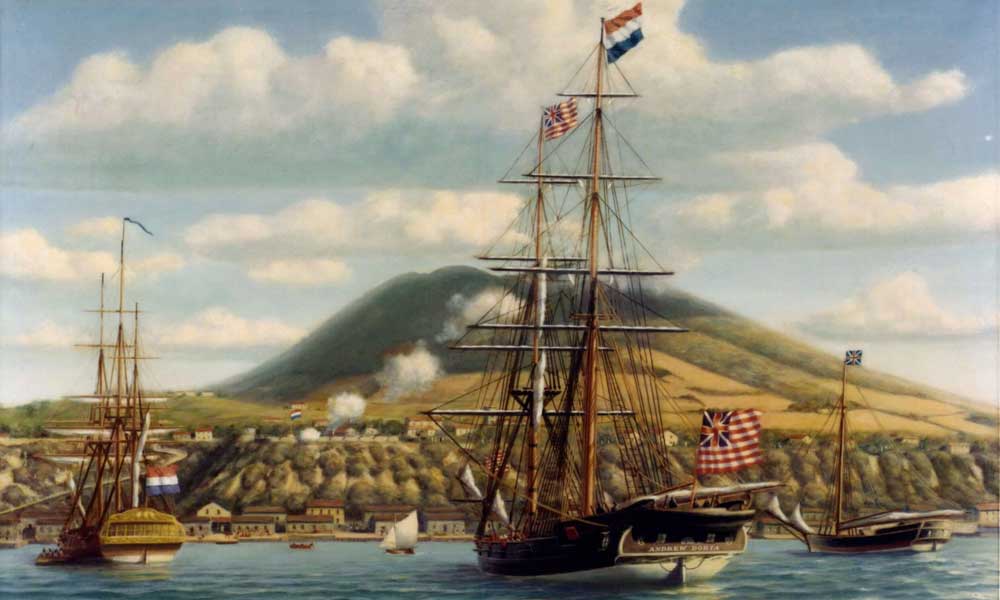
On the 16th of November, 1776, the American brig Andrew Doria sailed into the bustling harbor of the small Caribbean island of St. Eustatius. The ship, which had set out from Gloucester, NJ, outside Philadelphia, was flying the Grand Union Flag and bore a rare treasure—a copy of the United States of America’s recently adopted Declaration of Independence. The ship had come to purchase gunpowder and other military supplies for the Continental Army. Upon entering the harbor, it fired a dramatic 13-gun salute, one for each American colony. In response, the local Dutch governor, Johannes de Graaff, ordered that the cannons of Fort Oranje fire a welcoming 11-gun salute. Thus this tiny Dutch island, which was home to a cadre of Jewish merchants, became the first international body to recognize the newly minted American government of the former British colonies.
Now this obscure chapter of American Jewish history is being brought to light in a major new exhibition at the Weitzman National Museum of American Jewish History in Philadelphia. Titled “The First Salute,” the exhibition marks the 250th anniversary of America and pays tribute to the island’s Jewish merchant population and its role in the American Revolution. Scheduled to open on April 23, the exhibit will remain on view through April 2027.


St. Eustatius, locally known as Statia, is part of the northern Leeward Islands and lies just northwest of the island of St. Kitts. About eight square miles, the island’s most outstanding feature is a dormant volcano the islanders call The Quill. Now a special municipality of the Netherlands, St. Eustatius has an intriguing history. Its earliest inhabitants were Arawaks and Caribs. In 1625 French and British settlers arrived, but didn’t stay long. The island was taken over by the Dutch West India Co. in 1636, and 80 families from the Netherlands settled in.
The colonists planted tobacco and later cotton, but the island’s main wealth was based on commerce, the slave trade and on smuggling arms. Pirates and European powers jockeyed for wealth and dominance, and the island changed hands numerous times.
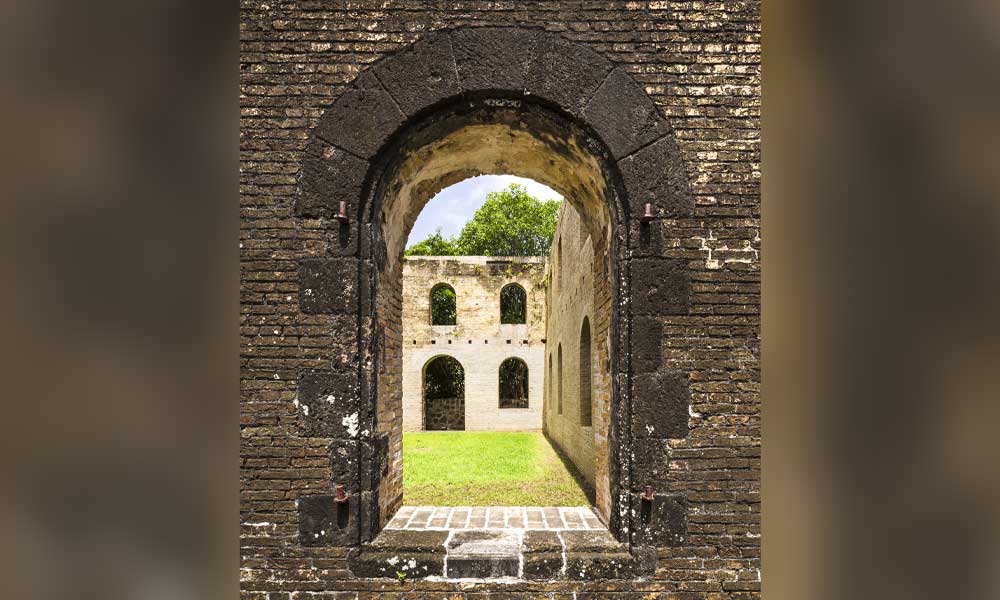
The restored walls of St. Eustatius’s Honen Dalim synagogue, built in 1739. (Photo credit: Photograph by Wyatt Gallery from Jewish Treasures of the Caribbean / Herman Benjamins and Johannes François Snelleman)
In the 18th century, St. Eustatius became the center of Caribbean duty-free commerce, with thousands of ships passing through its harbor annually in the 1750s. Hundreds of warehouses packed with trade goods lined the shore below the walls of Fort Oranje, known as the Golden Rock.
Attracted by the culture of religious tolerance and economic freedom, descendants of Jews expelled two centuries earlier from Spain and Portugal were drawn to St. Eustatius in the early part of the 18th century. By 1776 a population of some 600 to 750 Jewish merchants (representing about 30 percent of the island’s permanent European residents) had built a thriving community there. Initially trading in tea and rice, their international maritime and family ties enabled them to excel in commerce and prosper. They built a synagogue, Honem Dalim, in 1739, along with a mikvah and a Jewish cemetery.
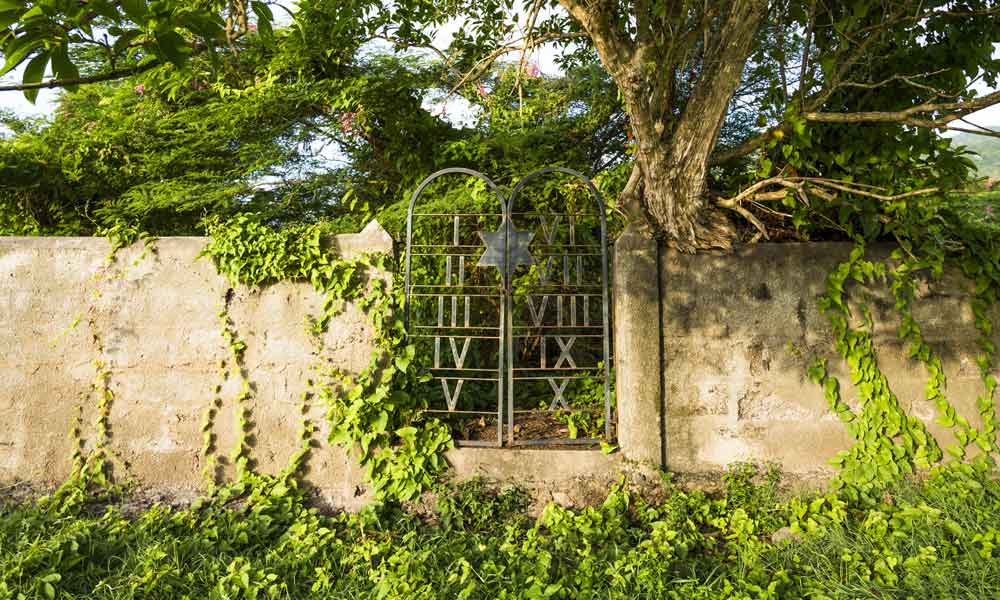
Entrance to the 18th-century Jewish cemetery on St. Eustatius. (Photo credit: Photograph by Wyatt Gallery from Jewish Treasures of the Caribbean / Herman Benjamins and Johannes François Snelleman)
As a Dutch colony, St. Eustatius was a neutral port that served as a critical trading hub, supplying arms and supplies to the American colonies during the Revolutionary War. The local network of Jewish merchants in particular supplied American forces with smuggled shipments of gunpowder, often disguised as tea and rice. In fact, most of the ships engaged in this enterprise were Jewish-owned and navigated by Jewish captains. During 1776, 18 ships from Statia ran the British blockade.
Thus this small island played an outsized role in the success of the American Revolution, and the Jews there were central to that success. The island’s support for the American cause, however, led to its capture by British forces under Admiral Sir George Brydges Rodney and the demise of its Jewish community.
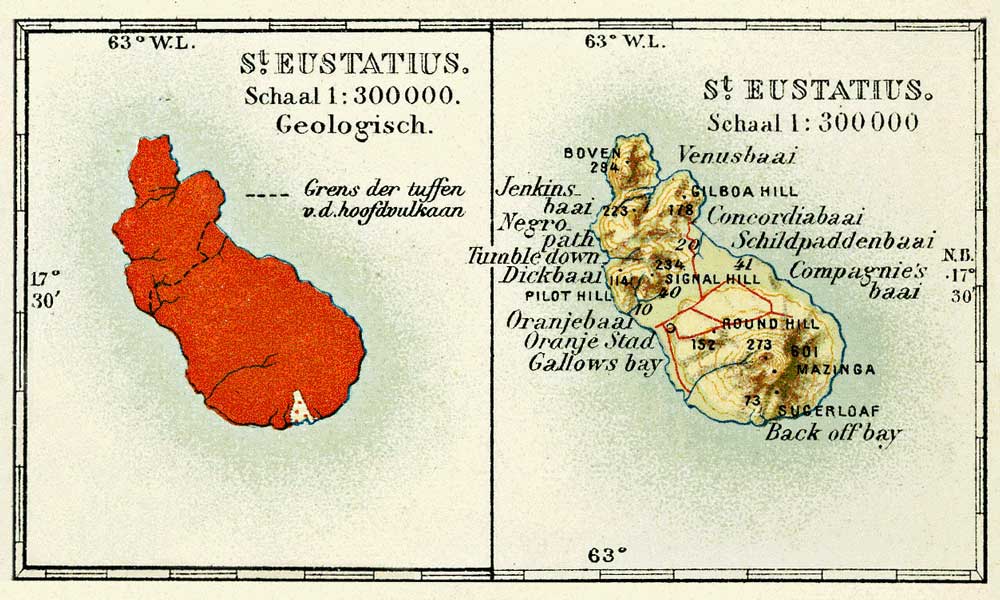
Map of St. Eustatius from the Encyclopaedie van Nederlandsch West-Indië, 1914-1917. (Photo credit: Photograph by Wyatt Gallery from Jewish Treasures of the Caribbean / Herman Benjamins and Johannes François Snelleman)
On February 2, 1781, following the outbreak of the Fourth Anglo-Dutch War between Britain and the Dutch Republic, Rodney, acting under orders from London, arrived on St. Eustatius with 13 ships and 3,000 troops. He captured the island with no contest. He had already identified several individuals there who were aiding the Americans: “…[the Jews of St. Eustatius, Caribbean Antilles] cannot be too soon taken care of—they are notorious in the cause of America and France,” he had written.
Rodney immediately arrested and imprisoned 101 Jews in the warehouses near the harbor and deported 31 adult Jews to nearby St. Kitts. He looted the personal possessions of Jews, most of which he appropriated for himself, and even dug up their cemetery in search of hidden valuables. “Had it not been for that nest of vipers…[on] this infamous island, the American Rebellion could not possibly have subsisted,” Rodney wrote in 1781 in a letter to Rear Admiral Sir Peter Parker.
The debt-ridden and vengeful admiral spent five months looting, continuing his focus on the island’s Jewish population. While lingering in St. Eustatius, however, Rodney blundered badly by missing the Battle of Fort Royal, thus allowing the French fleet to sail north and blockade Yorktown, contributing to Britain’s defeat.
Statia’s commerce was severely damaged by the British takeover, and most of the Jews who were not already exiled or imprisoned moved on. Some became founding fathers of Jewish communities on other islands, such as St. Thomas.
The Weitzman museum’s CEO Dan Tadmore came across the story of St. Eustatius when he was leading a renovation of the ANU Museum of the Jewish People in Tel Aviv. He was intrigued by the colorful history, the fast ships, the cannons, the swashbuckling Jewish smugglers.
“Think Hamilton meets Pirates of the Caribbean,” he says. He brought the idea with him when he came to the Weitzman museum in January of last year and discussed it with Josh Perelman, the museum’s senior adviser for content and strategic projects. Together they consulted with Jonathan Sarna, the distinguished professor of American Jewish history at Brandeis University. “This is a story that needs to be told,” Sarna advised them.
The exhibition will feature artifacts, storytelling, original films and an immersive video experience. Photographs of the walls of the synagogue, its mikvah and the cemetery will be on view, along with various artifacts, including Admiral Rodney’s “Roll”—his inventory of St. Eustatius’s inhabitants and their belongings. Moses Myers, one of the Jewish merchants who was “relieved” of his belongings, is featured on one of the pages.
Today on the island, the walls of the synagogue and its mikvah have been rebuilt and the Jewish cemetery has been restored. Cannons remain in place at Fort Oranje, but the turbulent times of high-seas smuggling, pirates and persecution are past. These days, it’s ecotourism, scuba diving and historic sites that draw visitors to this verdant, windswept corner of the Caribbean.