
Saeid Golkar is an associate professor of political science at the University of Tennessee at Chattanooga and a senior adviser at United Against Nuclear Iran. Golkar was born in Iran and received his PhD in political science from the University of Tehran before emigrating to the United States in 2010.
First, are you in touch with family or friends in Iran, and how are they doing?
Saeid Golkar: The internet is completely shut down, but one of my nieces was able to send a text message that they are okay. But I have not been able to speak directly with them. It is a difficult moment right now for everybody in Iran.
How reliable are our sources here in the United States about the reaction to the death of Iran’s Supreme Leader Ali Khamenei? We see reports of celebration but also of mourning.
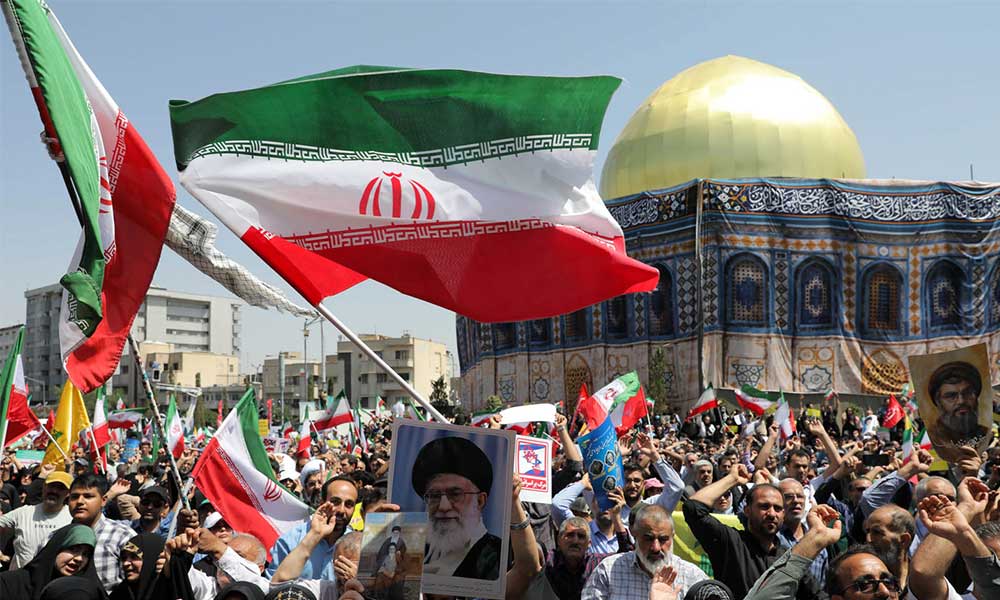
Both of them are correct. The Islamic Republic has support of about 10 percent of the people, so that 10 percent go to the street, they go to the mosque and mourn, and the government broadcasts it. Some are actors, beating themselves in front of the camera.
“The mood in Tehran is they’re waiting for the Crown Prince Pahlavi or Benjamin Netanyahu or Trump to tell them that the street is safe and that they can now go out and take over the state apparatus, neighborhood by neighborhood.”
On the other hand, massive numbers of Iranians oppose the Islamic Republic and are angry at the regime, which killed 30,000 to 40,000 people in January [for demonstrating against it]. Several videos have shown people celebrating in the street or at home. And as in January, the Islamic Revolutionary Guard Corps (IRGC) are coming and shooting these people. Even people shouting for joy from their apartments or from their cars—the guards are shooting at them.
And of course, they’re in the middle of a war.
The war actually has been celebrated. Even four days into it, we see a few videos coming from people who have satellite internet—they’re on rooftops celebrating any missile attack. Based on what I heard from my niece, the city of Tehran is shaking. There is noise, there is bombardment, there is attack, and you don’t know where they will attack next. So they are living in fear. But still, they’re happy that Khamenei is dead, and they are happy that the IRGC bases have been targeted. Anything that makes the regime suffer is welcomed by the people inside of Iran.
You’ve said a huge majority of Iranians oppose the regime. What were their feelings about the United States and Israel before they attacked? Have those feelings changed dramatically?
They were happy when President Trump came back into power, because they felt he would put more pressure on the regime. Some criticized him after the massacre in January, saying that he was betraying them by not acting. But since the war started four days ago, they are saying, “This man is a man who kept his promises.”
Trump and Netanyahu are very popular among Iranians, both in the diaspora and inside of the country.
How do Iranians remember the days of the shah in the 1950s? Is it romanticized? What kind of society do most Iranians want now?
That’s a very good question. From 1989 to 2009, Iranians mostly wanted change inside of the regime. Some political reform, economic reform, cultural reform. But since 2017, the protest movement has been oriented around regime change, and gradually I think many have come to the realization that they want the Pahlavi dynasty to come back. The slogan you hear is: “This is the last battle. The Pahlavi will return. Long live the king.” People from middle-class, leftist, or Islamist backgrounds may believe Pahlavi doesn’t have enough social support, but you have to remember that in January, more than 1 million people came to the streets after Pahlavi’s call.
Because they realize the 1979 revolution was a mistake. They compare Iran right now with the countries in the region, with the United Arab Emirates, with Saudi Arabia, Oman, and they realize, We went completely backward. For them, the reign of Mohammad Reza Pahlavi [shah of Iran from 1941-1979] represents a period of rapid modernization, secularization, normal life. Thinking about liberal democracy is usually reserved for the middle and upper class, educated people. For ordinary Iranians, like ordinary people around the world, they don’t care about the politics. They want to have a normal life.
And do they want it to be secular?
Absolutely secular. A large majority of the Iranian people today believe that church and the state should be separated. And many are resentful toward religion. I’ll give you one personal story. I was talking a few days ago with an Iranian student who arrived in Italy a few months ago. He was asking me, “What is going to happen?” And I said, “Inshallah (God willing), we are going to defeat this monstrous regime.” And he became angry and said, “Inshallah is an Islamic religious concept. Say “I hope so.”
This is how strong the resentment is among his generation. They want to live a secular life. They want to be able to walk down the street with their boyfriend or girlfriend, and not have anyone come up and ask them: What you are wearing, or what you are eating, or what you are watching? They believe that Mohammad Reza Pahlavi’s eldest son Reza is the only one with a lot of political capital. His grandfather, Reza, was the shah that marginalized the clergy. Now, punishing the theocratic regime and the whole clerical system is one of the dreams of younger Iranians.
In your Moment piece from June about the supreme leader’s reign of fear, you wrote, “If Khamenei were to die in an Israeli attack, constitutionally, there is an assembly of experts, 88 Grand Ayatollahs (all high-ranking clerical males), who will choose the next leader.” Do you have any sense of how many of these grand ayatollahs are still alive?
Twenty minutes ago, I received information that the Assembly of Experts, which is that council of 88 grand ayatollahs, has been targeted by Israel. So we really don’t know how many are still alive.
Based on the Constitution, you have an interim council of leadership that consists of the president, the head of the judiciary and one of the clergy from the Guardian Council. This council has been formed since yesterday to take the responsibility of the supreme leader, until the Assembly of Experts comes together to appoint somebody. But this could take years. Right now, it seems that with this interim council, the parliament and judiciary, the state structure is still intact.
Clearly, the clerical network has been targeted. And a lot of IRGC commanders have been targeted. If this continues, it will create a political vacuum. But for now, the interim leadership council is in power.
It sounds like the hope is that if enough of that controlling upper level is taken out, these lower levels will decide it’s in their interest to give up.
Especially security forces and military. The hope is they realize that defection will let them live, that it’s in their interest to defect to avoid being killed by the Israelis. We are only into the fourth day of the operation, so it’s too soon to think about it. Remember that Iraq under Saddam Hussein collapsed on the 21st day with the boots on the ground.
But also, the street must be safe for the Iranian people. The mood in Tehran is they’re waiting for the Crown Prince Pahlavi or Benjamin Netanyahu or Trump to tell them that the street is safe and that they can now go out and take over the state apparatus, neighborhood by neighborhood.
But this requires eliminating the security and military forces, because the people have no arms.
In order to give that signal with confidence, would it require American and Israeli boots on the ground?
Not really. A few small groups of special forces could take control over a few buildings, for example, the presidential palace or the parliament or the TV station. The people are waiting for the moment to take revenge on the system.


What do you say to Americans who have questions about this operation, who are very critical of Trump and doubt that he’s doing this for the Iranian people? They say he always has some other business interest and are skeptical that he’ll finish the job.
The only chance Iran has for regime change is through the foreign intervention that we are seeing. The modern security state is not going to collapse by internal revolution. People are not able to do that in Venezuela, in Russia, Belarus, China. Because the state is much, much more powerful than the people. In the 20th century, the gap between the power of the state and the power of the people was not as great. So if you had enough people go to the street, it was possible to change the regime. Today, the modern security state is too technologically advanced.
In America, people see domestic or foreign politics through the party line. If you’re a Democrat, you criticize anything Republicans do and vice versa. Viewing this through a humanitarian lens, we have to think about protecting those under this repressive regime. In terms of national security, undermining this regime will actually remove one of the biggest threats to that security. A third factor is blowing up the relationship between Iran, China and Russia. All of the Democratic friends that we have are concerned about China and Russia, correctly. So, just imagine, you’re breaking one of the biggest links of this authoritarian axis. Thinking about the Israeli strategy, thinking about the regional policy, it will solve a lot of problems in the region. And if you don’t care about undermining authoritarianism or the human rights aspect, if you don’t care about the national security aspect, think about your pocket. Iran is a billion dollar market that has not been touched by the Americans since 1979.
And so I would say, think about what is good for the United States, what is good for the region and what is good for the whole world.
Above image: A Tehran demonstration in support of the Iranian regime in June 2025. According to Saeid Golkar, only a small fraction of the Iranian people support the Islamic Republic. credit: Avash Media (CC BY 4.0)