
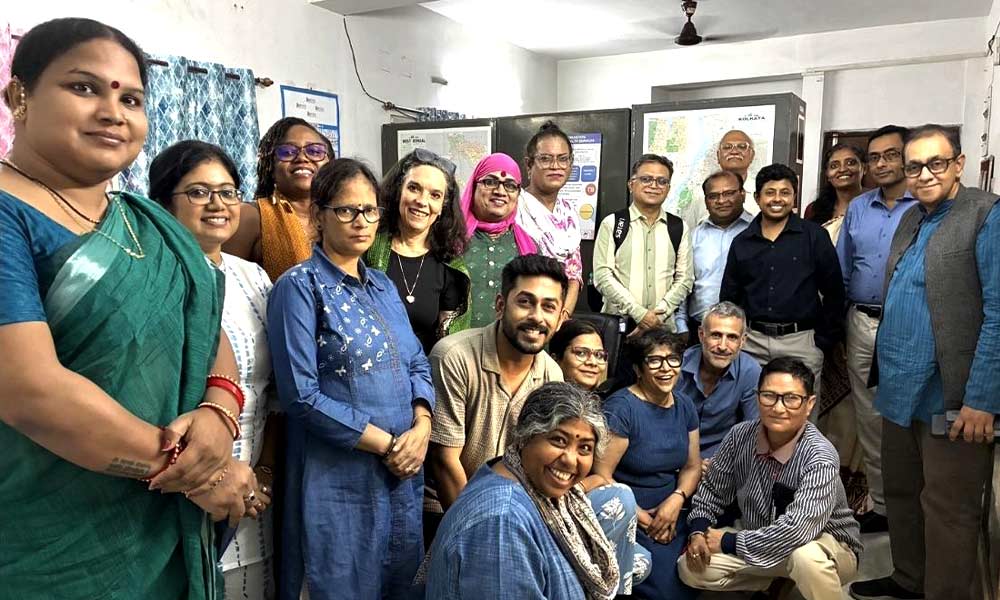
On February 24, activists packed the Kolkata office of Solidarity and Action Against the HIV Infection in India (SAATHII). As one of India’s most established LGBTQ+ health and rights organizations, for more than two decades SAATHII has been the country’s go-to institution on HIV and AIDS treatment, respected even by a government that hasn’t always embraced the communities SAATHII serves. Trans women—who face disproportionate barriers to healthcare and employment and are overrepresented in sex work as a result—make up one of the largest of those communities.
Trans men and women had come from Odisha, south of Kolkata along the Bay of Bengal; from Manipur in India’s northeast, on the Myanmar border; and from across West Bengal to address legislation taking shape in the Indian Parliament that would pose a threat to their very identity. Joining them was SAATHII Senior Vice President Dr. L. “Ramki” Ramakrishnan, who took to a whiteboard to map out the dozens of India’s gender-diverse communities—as varied and ancient as India itself.
Also present was a delegation from the American Jewish World Service (AJWS) who had flown in from New York. Among them was AJWS Vice President of Programs Shari Turitz and Director of Sexual Health and Rights Joaninne Nanyange—an attorney who for 12 years has been fighting for trans rights across Uganda, Kenya and Liberia.
The bill discussed was a proposed amendment to the Transgender Persons (Protection of Rights) Act of 2019, which had granted trans people in India the right to self-identify their gender and obtain legal identity certificates. This allowed them to access government housing subsidies, education benefits and healthcare programs. The amendment would make registration far harder, cutting off access to welfare; would replace self-identification with medical board gatekeeping; and would, in some cases, criminalize the communities built to support trans people. The proposed amendment included a statement that it “will not include or will never have included” self-perceived gender identities—as if the 2019 law had never afforded that right.
Thirty-four days later, on March 30—the eve of International Transgender Day of Visibility—Indian President Droupadi Murmu signed the Transgender Persons (Protection of Rights) Amendment Bill into law.
Loss of identity, guilt by association
The amendment essentially strips India’s trans people of the right to self-identification by limiting legal recognition to historically accepted sociocultural categories like hijra—a recognized third-gender community with centuries of history in South Asia—and kinner, a term for trans women in north India. Trans men are excluded entirely.
The bill passed in India’s lower house of Parliament without floor discussion, and over the objections of a Supreme Court-appointed expert committee that had recommended withdrawing it. Two members of the National Council for Transgender Persons resigned in protest. Court challenges are moving through the high courts of Delhi, Kerala, Karnataka and Rajasthan; on May 4 the Supreme Court issued formal notices to the Central Government but declined to stay the law.
Sudipa Chakraborty had been in that packed room alongside the AJWS delegation in the lead-up to the amendment. She began her career at SAATHII—one of the first openly trans women on staff—before moving to Varta Trust in Kolkata, where she now works as a peer counselor providing mental health support, sexual health guidance and legal aid to trans and queer individuals. The SAATHII office and the drop-in center Chakraborty runs at Varta Trust are part of the same network, sustained for more than two decades by financial support from the American Jewish World Service—support that has made AJWS one of the largest U.S.-based backers of international LGBTQ+ rights and India its largest country program. That support started in Uganda as early as 2010, when the first wave of anti-homosexuality legislation threatened to criminalize not only gay Ugandans but the organizations that supported them.
Since March 30, Chakraborty’s drop-in center has been overwhelmed by people seeking help. Recently, a trans woman came in with her partner, a trans man. Their family had turned against them and tried violently to take possession of their property. The center provided free legal support. The new law’s clause prohibiting the promotion of trans identity directly affects that work. “If I am providing support to a trans person, and their family member goes to the police station and blames me, the police can arrest me,” Chakraborty explains, adding that such a violation could carry a prison sentence of more than ten years.
Rituparna Borah, who grew up in a village in Assam and co-founded Nazariya—a Delhi-based organization advocating for LGBTQ+ and women’s rights—traces two currents that have shaped the Indian trans movement. One originated in response to the HIV/AIDS crisis in the 1990s, which brought resources but framed queer people primarily as a public health problem rather than a rights-bearing community. The other emerged from feminist organizing around identity and self-determination. At the center of both is a concept that Indian law has never fully recognized: chosen family—the networks of partners, friends and community members that replace the natal families that reject so many trans people.
Borah’s network filed a Supreme Court petition in 2023 asking for legal recognition of “chosen family” as well as marriage rights. The court acknowledged the concept of chosen family without granting it legal status as an alternative to “next of kin” designations.


Today, because of the amendment that passed in March, the free safe room Borah offers in her former flat to queer and trans couples is now potentially criminal, because the law contains provisions against “compelling” someone to present as a gender other than their assigned sex. A cisgender lesbian couple living together could be accused of promoting non-normative gender expression, particularly if one partner is gender non-conforming or butch. The vagueness of “undue influence” is what makes the law so dangerous, rendering landlords, shelter operators or peer counselors all potentially liable. “We feel those couples do not have any spaces,” Borah says of her decision to continue offering free shelter, “not in the feminine spaces, not in other spaces.”
The amended law creates a tiered system of criminal penalties—from two years for basic offenses to life imprisonment when a child is involved—and its broad “undue influence” language has led legal experts to warn that peer counselors, support workers and advocates could be prosecuted under it. The fines are equally significant: The minimum for a serious offense is roughly $2,400, rising to $6,000 when the alleged victim is a child. These are substantial sums in a country where the monthly welfare benefit for registered trans persons was roughly $18. Those who registered before the amendment retain their certificates and their access to benefits; the law makes new registration far harder. Chakraborty still provides support—but only after clients sign consent forms confirming they sought help voluntarily, documentation that protects her against the charge of initiating or encouraging a transgender identity.
As a further result of the promotion clause, surgeons have canceled procedures, and endocrinologists have stopped writing hormone prescriptions. Hospitals must now report all gender-affirming surgeries to the District Magistrate and Medical Board, creating a surveillance regime that has driven many doctors to cancel procedures. The law now also requires adults seeking gender-affirming surgery to produce a parental consent video—a requirement that treats grown adults as minors. Among five individuals recently shortlisted for surgery in the southern Indian state of Tamil Nadu, three were denied because they could not produce such video.
“There is no single Indian transgender community.”
Oinam Hemba has been working in Manipur’s gender and sexual minority community for 12 years, first with SAATHII and now leading Empowering Trans Ability, the first organization serving trans men in the northeast. He is Nupa Maanba—the Meitei term for trans man. His parents had wanted a son; among all their daughters, Hemba was the one they raised as a boy. Through sixth grade he wore pants to school, the boys’ uniform. The following year, at a new school, he was told to wear a skirt. “At that time I didn’t know what gender was, what Nupa Maanba was,” he says. “I used to think of myself as a man.” It was years later, working with SAATHII, meeting others who shared his experience of knowing himself to be a man while the world assigned him otherwise, that the language arrived for what he had always known.
Hemba has been doing the work the promotion clause now defines as a crime: peer counseling, legal referrals, coordination with government departments, creating safe spaces for trans people to access healthcare and education. “It creates fear not only for community leaders but also for the people who rely on that support,” he says. “It feels like the values of compassion, inclusion and human rights that have guided my work are being challenged.” His commitment, he says, remains unchanged.
“The government is questioning us—questioning whether we are ‘true’ transgender people,” says Chakraborty. “But what is the meaning of true and false? As a person who is Indian, who is part of the Indian population—why must I prove my authenticity? This absurd thing is creating a very scary atmosphere—in all of India.”
Dr. Ramakrishnan notes the bill’s wording is not new to those who’ve closely watched the government, which since 2014 has been ruled by the right-wing Bharatiya Janata Party (BJP). “Some of the language [in the amendment] comes from the Criminal Tribes Act that the English passed in the 1800s,” he says. The British passed that act in 1871, labeling hijras congenitally criminal. India’s Supreme Court acknowledged this history in its 2014 NALSA judgment, finding trans people’s right to self-identification rooted not in Western import but in Indian culture and constitutional principle. What the BJP’s recent legislation cannot see—and what Ramakrishnan was mapping that February morning—is that there is no single Indian transgender community. There are dozens of them, each rooted in a distinct region, language and tradition, stretching from Tamil Nadu to Manipur. In addition to hijras, who have blessed weddings and newborns for centuries, there are the kinnar in the north, and in the southern Indian state of Tamil Nadu, there are aravani, a transfeminine identity recognized in Tamil culture. In the southwest state of Karnataka, jogappa are devotees of the goddess Yellamma and live as women.
AJWS’s Shari Turitz notes that before the Transgender Persons (Protection of Rights) Act was amended, the trans Indians she’d met had existed under a kind of tolerance. “There was a level of acceptance, some degree of ignoring of their existence, that meant there was no persecution, not a literal policy that erased their very existence,” she says. “The new amendment ends that.”
“What the law seems to miss,” says Ramakrishnan, who has spent 22 years building SAATHII, “is that anyone can experience a mismatch between their innate gender and the socially assigned one.” The 2011 Census—the planned 2021 census, first delayed by COVID-19 and later by the BJP government, is finally underway but won’t be completed until 2027—recorded exactly 487,803 individuals under the “other gender” category. Estimates for the number of trans people in India today vary; the figure often given is 2 million, however Ramakrishnan regards that as a vast undercount. He believes the real number could run into the tens of millions—closer, he says, to the scale of a major Indian city than a small minority. Regardless, he says the number should not matter. Even if one person has their rights violated, that is one person too many.
The fight continues
“It’s clear the public health emergency caused by steep reductions in PEPFAR will decimate human rights movements,” says Peter Taback, AJWS’s vice president for marketing and communications, who was also in that room at SAATHII in February. “In India, that means a war emerging on two fronts. HIV prevalence among India’s transgender population is between 20 and 40 times higher than in the general population. Anything that further stigmatizes trans people or obstructs their access to care also worsens the health discrepancy and denies India’s trans community of its inherent dignity.”
The fight for trans rights is not limited to India. Pakistan gutted its own progressive trans rights law in 2023. However, in Kenya last month, AJWS partner Jinsiangu won a High Court ruling affirming the right to select the gender of their choice on official documents—a right that’s been stripped from India’s trans community and that activists are committed to restoring.
“It’s a moral, theological and historical imperative to do this work,” says Turitz. AJWS was founded on the grounds of b’tselem elohim—the principle that every human being is created in the divine image and therefore worthy of dignity. For more than four decades it has directed Jewish philanthropy across Africa, Asia, Latin America and the Caribbean. Turitz says she has never encountered resistance to this work inside the American Jewish community. “I have never, ever been questioned by those in the Jewish communal space about why this is important or whether AJWS should be focused on this,” she says. “Our mission has been clear since day one.” AJWS will continue to support actors on the ground in India, she adds. “We will be supporting the ecosystem of organizations that are coming together to decide what to do—providing solidarity, safety, security and recourse to challenge the provisions of this amendment.”
Top image: AJWS staff with members of SAATHII at their Kolkata office, February 2026.
One thought on “India’s Transgender Crisis”
As a 70-year-old, lifelong Catholic Christian, straight, cisgendered woman, I heartily commend your work – and the love of neighbor that motivates it. It is so difficult for me to understand the increasing belief that people do not understand themselves, and must be forced into specific “boxes” designed by others. May the Divine bless you, your work, and your clients!!