
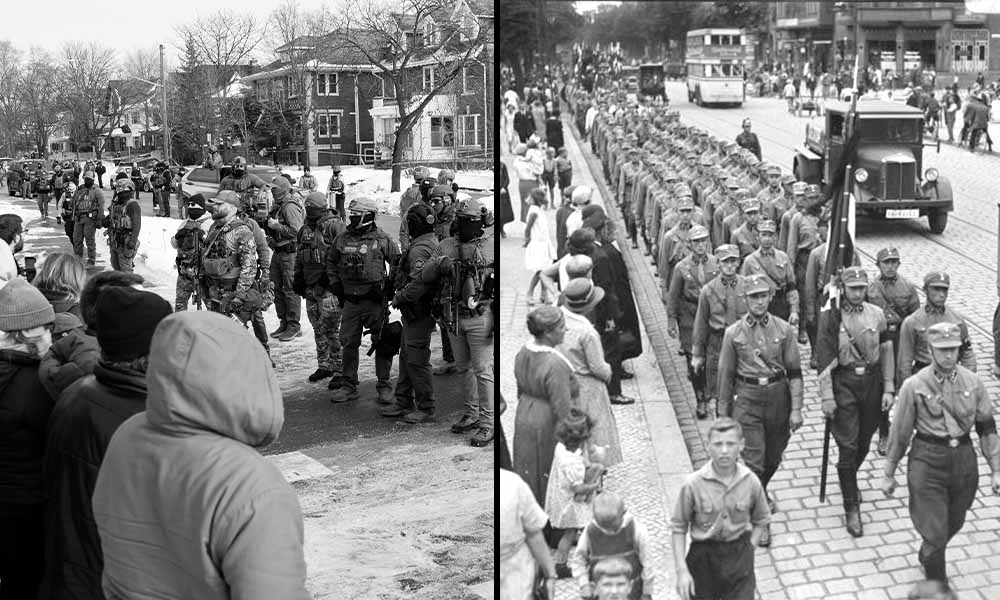
The 11 a.m. Sunday service at the Church of the Assumption of the Blessed Virgin Mary is conducted in Spanish. The Richfield, MN, church serves an immigrant population, largely Hispanic, in the suburbs of Minneapolis. The parish staff know some worshippers may be undocumented, but they welcome everyone. When federal agents showed up in Minneapolis in early December, looking for immigrants to deport, church leaders naturally wondered what it might mean for their congregation.
What happened next is part of a story that has become familiar—and has made many observers wonder if history’s darkest chapter could be repeating itself. On the morning of Sunday, December 7, shortly before the Spanish service, people noticed a black Ford Explorer with tinted windows driving repeatedly past the church entrance. Someone notified one of the local “Indivisible” groups, which had begun to monitor the actions of Immigration and Customs Enforcement (ICE) and the Border Patrol. At the time, Operation Metro Surge, as the Minnesota intervention was called, involved only about 100 federal agents, and local opposition was just coalescing. A notice was posted on the Indivisible group’s Facebook page calling on community members to go to the Richfield church and find out what, if anything, was happening there.
A handful of local folks promptly answered the call. Among them were John Biestman, a 69-year-old retired banker, and his wife, Janet Lee, 67, a retired speech pathologist. In sworn declarations filed later in U.S. District Court, Lee said she and her husband went to the church because they were horrified “that the federal government might snatch people off the street outside a house of worship.” Biestman said their goal was to “observe and document” ICE activity.
The couple, bundled in bulky parkas and wool hats against the frigid morning air, mingled for a few minutes outside the church with other volunteers. The black Ford Explorer continued to cruise up and down the street, and Biestman and Lee decided to get in their car and follow it. When the Explorer pulled into a parking lot across the street from the church, the couple did the same. They had seen the Explorer run red lights and make U-turns, and they were now convinced it was an ICE vehicle, positioned with a view of people arriving for the Spanish service.
Biestman and Lee had a history of civic engagement and a long-standing commitment to progressive causes, but what happened next, in the couple’s account, was something for which they were entirely unprepared. As soon as they turned into the parking lot, three other vehicles pulled in around them, boxing them in. Several men jumped out, all of them masked, some holding firearms. One man positioned himself in front of the car, holding a rifle. Others took out their phones and began recording the scene. One ordered Biestman, in the driver’s seat, to roll down his window, which he did. Pointing a gun inside, the agent accused Biestman of impeding the law enforcement effort. He threatened to arrest and handcuff him, though nothing he had done conceivably constituted probable cause. Reaching through the open window, the agent pointed to Lee and said, “We’re going to arrest her, too.” When the couple protested that they were U.S. citizens, the agents said it didn’t matter.
“ICE is recruiting the same type of bully boys and street-thug wannabes that the Nazi Party recruited for the SS and SA.”
In her sworn declaration, Lee said, “I wanted to record the interaction on my cell phone, but I was too afraid to do so. I have never had a gun pointed at me in my life, let alone multiple guns pointed at me by representatives of my own government. John was also obviously terrified. Instead, I called another observer so that she would be able to hear what was happening to us. My hands were shaking, and I could barely operate my phone.” When the agents ordered the couple to leave the parking lot, they promptly did so.
“Neither of us were physically aggressive at any time during this interaction,” Lee said. “I was acutely aware that I was smaller, weaker and older than the agents. It was readily apparent that they were armed…I specifically recall thinking that if we made one false move, the agents would shoot and kill us.” Lee filed her declaration ten days after the confrontation and said she was still “tormented by the memory of this encounter.”
The two senior citizens had stayed in their car, did not blow whistles or harass the agents or block their movement, but they were still threatened at gunpoint and bullied. One agent, according to Biestman, warned the couple, “We have your license plate. We now know where to find you.” In his own declaration, Biestman said the federal agents “were obviously not trained at all in professional conduct or public safety…They had the professional demeanor of criminals and thugs.”
Before leaving the scene, Biestman said he told the agents, “This is like Germany 1938.”
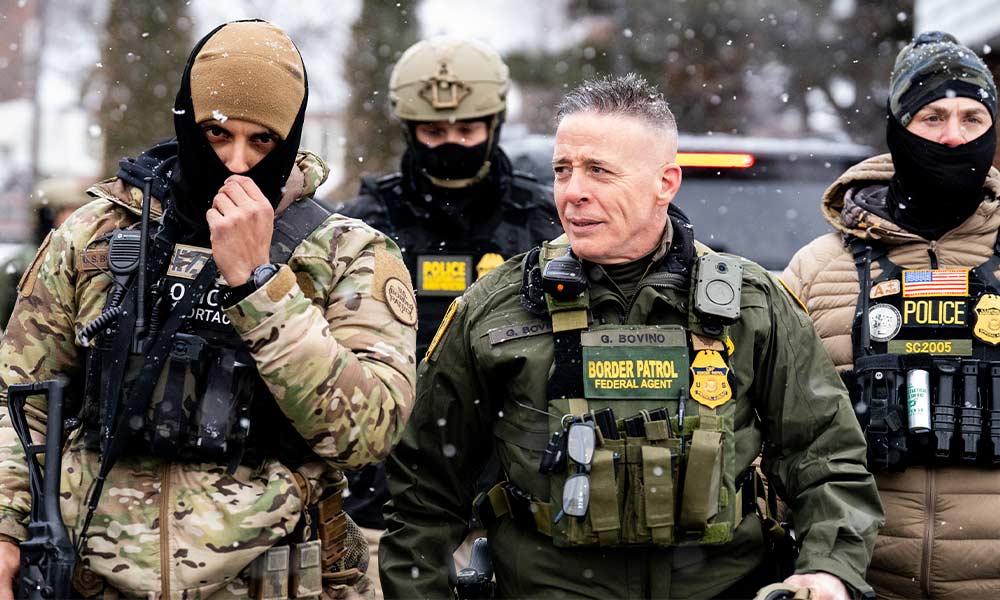
Border Patrol Commander Greg Bovino with officers at a Minneapolis gas station on January 22, 2026. Chad Davis (CC BY 4.0)
In the weeks that followed, the Department of Homeland Security (DHS) dispatched about 3,000 more federal agents to Minnesota, two-thirds of them from ICE and the rest from the Border Patrol.
At their peak, the federal agents present in Minneapolis and St. Paul outnumbered the total metro area police force by about three to one, and with federal authority superseding state and municipal law enforcement powers, local police in the Twin Cities had trouble controlling their own streets. Videos and affidavits showed that the agents acted aggressively, often egregiously, in pursuit of anyone they suspected to be in the country illegally. They engaged in racial profiling. They stopped people on the street, demanding identification or proof of citizenship, and even forced their way into private residences without judicial warrants. When they found themselves facing furious resistance from local residents, the federal agents pushed well beyond standard policing practice, openly brandishing semi-automatic weapons and using chemical agents almost indiscriminately against those they saw as standing in their way. Biestman and Lee got off easy compared to what other protesters encountered.
Biestman’s reference to 1938 Germany was echoed hundreds of times in the next two months, both by those dealing with the federal immigration agents firsthand and by those following their actions via the many video recordings posted on social media. Masked agents, often with guns drawn, could be seen stopping cars, refusing to identify themselves, demanding that drivers exit their vehicles and smashing their car windows if they did not immediately comply. Many people were violently tackled, handcuffed and taken to a local detention center.
In December, The Washington Post reported that the Trump administration, determined to boost ICE numbers, had employed a “wartime recruitment” strategy, focusing on people who attend mixed martial arts (MMA) competitions or NASCAR races, listen to conservative-leaning podcasts or show an interest in guns and tactical gear. ICE recruiting ads sought applicants ready to “defend the homeland” and fight “foreign invaders.” One former MMA fighter, interviewed at an ICE career expo several months before, said he had lost work opportunities due to competition from foreigners and therefore wanted to work “with these guys that are going to arrest you, slam your face on the pavement and send you home.”
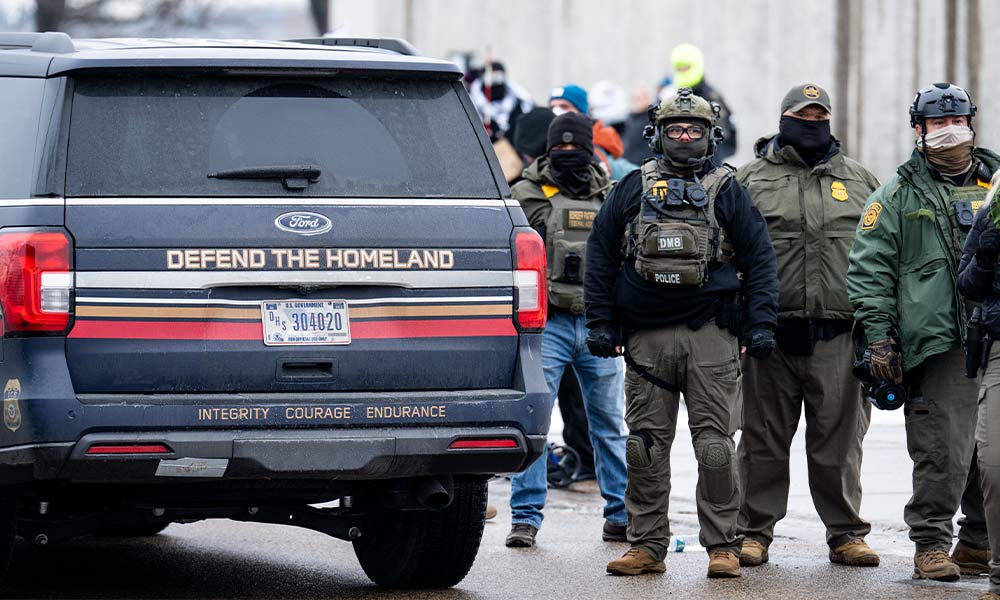
Agents next to a US Government SUV in Minneapolis, MN, January 8, 2026. Chad Davis (CC BY 4.0)
The Post story quickly elicited more than 2,000 comments, with a huge share of the commenters noting parallels with Nazi Germany. Many cited Hitler’s use of the Sturmabteilung (SA)—the Stormtrooper units known colloquially as the Brownshirts, a violent paramilitary force that played a key role in the consolidation of Nazi rule—along with the Schutzstaffel (SS) and the Geheime Staatspolizei (Gestapo). Commenter AdotHam said, “Germany had the Brown Shirts to bully the opposition and Trump will have ICE.” From NSmith212: “The advantage to being German is that I’ve seen this all before.” Bite22 said, “ICE is recruiting the same type of bully boys and street-thug wannabes that the Nazi Party recruited for the SS and SA.”
As is well known, on January 7, an ICE agent named Jonathan Ross killed Renée Good, a 37-year-old mother of three who was reportedly acting as an observer to alert people to the presence of ICE agents in the neighborhood. Video showed agents drew guns and shouted at Good to exit her vehicle. When she began to drive away, Ross fired at her through the windshield, then again from the side, shooting Good through the head. A voice, presumably that of Ross, was then heard saying, “Fucking bitch.” Speaking less than three hours later in Brownsville, TX, then Homeland Security Secretary Kristi Noem baselessly claimed that the dead woman had attempted “an act of domestic terrorism.”
Less than three weeks later, also in Minneapolis, Border Patrol agents shot and killed another anti-ICE protester, Alex Pretti, also 37. Pretti had been filming ICE and Border Patrol agents with his cell phone when agents wrestled him to the ground. He was legally carrying a handgun at the time, but it was in a holster. An agent grabbed it and moved away. Moments later, two agents shot Pretti multiple times in the back as he lay face down on the pavement.
Within hours, Trump administration officials once again jumped recklessly to unfounded conclusions. Deputy White House Chief of Staff Stephen Miller called Pretti a “would-be assassin” and accused him of trying to murder the federal agents. In both the Good and Pretti cases, administration officials said they saw no reason to investigate the shootings and barred Minnesota officials from conducting any investigations themselves. Under bipartisan pressure, the administration eventually agreed to open a federal civil rights investigation into Pretti’s killing, although it continued to deny Minnesota authorities access to evidence in the case.
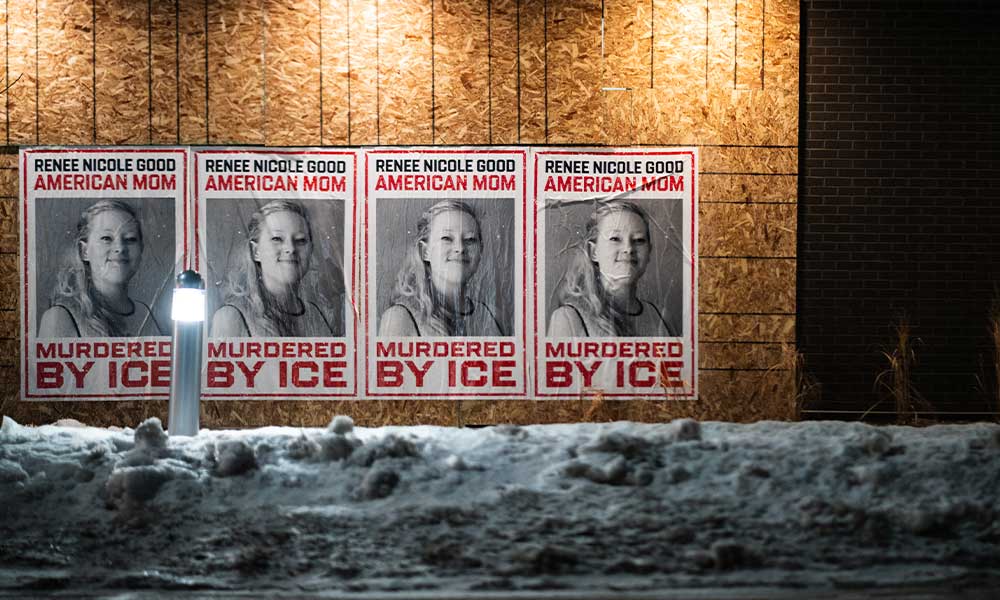
Posters of Renée Good outside a boarded-up business in Minneapolis, MN. Chad Davis (CC BY 4.0)
As ICE and Border Patrol agents took over the streets of Minneapolis, references to the Nazis became commonplace. Podcaster Joe Rogan, normally a pro-Trump voice, broke with the president over what he had seen. “You don’t want militarized people in the streets just roaming around, snatching people up,” Rogan said. “Are we really going to be the Gestapo? ‘Where’s your papers?’ Is that what we’ve come to?”
Minnesota Governor Tim Walz also invoked the Gestapo in talking about ICE and Border Patrol actions in his state and then went further, noting that children in immigrant families were hiding at home, afraid to go outside. “Many of us grew up reading that story of Anne Frank,” he said. “Somebody’s going to write that children’s story about Minnesota.”
Walz’s comment drew an immediate objection from the U.S. Holocaust Memorial Museum in Washington, DC. “Anne Frank was targeted and murdered solely because she was Jewish,” the museum said on X. “Leaders making false equivalencies to her experience for political purposes is never acceptable. Despite tensions in Minneapolis, exploiting the Holocaust is deeply offensive, especially as antisemitism surges.”
The museum founders, however, believed that broader lessons could and should be drawn from the Holocaust story. Michael Berenbaum, a leading Holocaust scholar who served as project director during the museum’s creation, told me the recent conduct of ICE and the Border Patrol is “not equivalent but reminiscent” of what happened in the early Nazi years. “It echoes something we’ve known in history,” he said, “which is the creation of a paramilitary force that does not feel bound by restraint, whose equipment gives it power, and whose training does not involve restraint on the use of such power.”
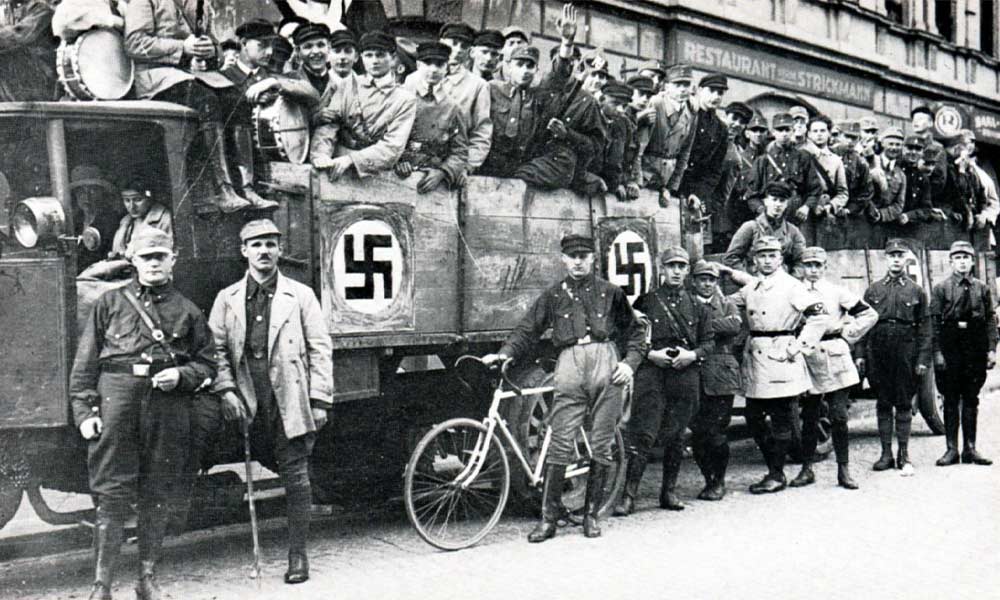
Members of the Sturmabteilung (aka SA, Brownshirts, Stormtroopers) in the 1920s Weimar Republic.
As the armed wing of the Nazi Party, the Brownshirts (or Stormtroopers) killed hundreds of Communists, trade unionists and Jews in the latter years of the Weimar Republic and the early period of Hitler’s rule. Originally a loose collection of right-wing bar brawlers, many of them unemployed, the Stormtroopers were organized in the 1920s to provide muscle and security at Nazi Party rallies. Easily recognizable in their brown shirts and jackboots, they served to terrorize anyone who dared to stand against the Nazi Party, targeting Jews in particular.
One incident that highlighted their role took place in August 1932, when a group of Brownshirts marched into the village of Potempa in eastern Germany, a few miles from the Polish border, and murdered Konrad Pietzuch, an unemployed 35-year-old who had loudly made known his anti-Nazi and Communist sympathies. The Brownshirts had been dispatched by a local Nazi leader who got them drunk and supplied them with pistols, rubber truncheons and a broken billiard cue. The gang found Pietzuch asleep in the dilapidated hut he shared with his mother and brother, woke him up, and savagely beat him to death. The incident took place in the waning days of the Weimar Republic, before the Nazi Party had come into power, and the Brownshirts were still unofficial. Weimar authorities promptly arrested five of the men responsible for the Potempa murder, put them on trial, and sentenced them to death.
“Hitler and the Nazi Party felt no particular need to look respectable. Violence seemed the obvious way to power.”
Adolf Hitler had no idea who the men were, but once he learned they were devoted to him personally and even had his picture hanging in their cells, he came roaring to their defense. In a telegram sent to the men in jail, Hitler declared his “unlimited loyalty” to the convicted killers, saying, “Your liberty is from this moment a question of our honor.” Hermann Göring, the Nazi chief who would assume control of the Stormtroopers once Hitler came to power, followed with another telegram of support. “I promise you, my comrades, that our whole fight from now on will be for your freedom. You are no murderers. You have defended the life and the honor of your comrades.” He told them he was sending 1,000 Reichsmarks to their families. The pressure campaign worked. The men’s death sentences were converted to life imprisonment, and when the Nazis came to power seven months later, they were all set free.
With Hitler now in charge, the Brownshirts were converted officially into an auxiliary police force, provided with badges and put on the government payroll. Daniel Siemens, author of Stormtroopers: A New History of Hitler’s Brownshirts, has written that the Brownshirts from that point on were a major force to be reckoned with: “Overnight, former thugs and political hooligans became paid representatives of state order, with police powers, firearms and the right to make arrests in cooperation with regular police units.”
In the following months, Hitler’s consolidation of power reached completion. The Brownshirts ruled the streets, extinguishing all opposition to the regime. Historian Richard J. Evans summarized the story succinctly in The Coming of the Third Reich, the first volume in his land- mark trilogy on the rise and collapse of Nazi rule: “Hitler and the Nazi Party felt no particular need to look respectable. Violence seemed the obvious way to power…The Nazi movement despised the law and made no secret of its belief that might was right.”
Comparisons between developments in Nazi Germany and what was happening under Donald Trump in the United States were resisted for years. Evans pushed back hard on any parallels in a 2017 interview with Slate, noting that “democracy dies in different ways at different times.” Germany had a weak democratic foundation, while U.S. institutions had endured for nearly 250 years. Hitler had his opponents imprisoned, tortured and killed. That was not yet happening in America.
With Trump’s return, however, Evans has been less sanguine. “Donald Trump has been waging a relentless and comprehensive war on American democracy and its institutions,” he wrote in an April 2025 column, just months into Trump’s second term. “Loyalty to Trump is replacing competence and democratic accountability as the basis of state appointments. Legal challenges to these orders are being mounted, but it is by no means clear that Trump will obey them.” That same tendency, he said, was evident in the early years of Nazi rule, when existing legal constraints were too weak to prevent the rise of a one-party state. “Hitler simply used his power of rule by decree to quash prosecutions brought by concerned legal authorities against the stormtrooper thugs who had illegally arrested and imprisoned his opponents.” Democracy, Evans advised, “is a fragile plant, all too easily uprooted and cast onto the bonfire of history, and the lessons to be drawn from the precedent of the fall of the Weimar Republic and the creation of the Nazi dictatorship are not encouraging.”
So what are those lessons? Critics of the Trump administration say the example of Germany hints at the general process by which a country can slip into autocracy. One book getting renewed attention is The Dual State, drafted in the 1930s in Germany by a Jewish labor lawyer, Ernst Fraenkel, and published later in the United States. Fraenkel argued that the Nazi regime was simultaneously a “normative state” that generally respected its own laws and a “prerogative state” where those laws didn’t apply. Citizens accustomed to the rule of law suddenly realized it was subject to arbitrary application. Fraenkel subtitled his book A Contribution to the Theory of Dictatorship, seeing it as an explanation of how tyrannies can emerge. Aziz Huq, a University of Chicago law professor, argued in The Atlantic last May that what Fraenkel observed in Germany is now happening in America as well. “The list of measures purpose-built to cleave off a domain in which the law does not apply grows by the day: the pardons that bless and invite insurrectionary violence; the purges of career lawyers at the Justice Department and in the Southern District of New York, inspector generals across the government, and senior FBI agents; the attorney general’s command that lawyers obey the president over their own understanding of the Constitution.”
Huq was writing months before a huge new federal immigration enforcement operation exemplified his thesis. In Minnesota, a federal judge ruled in January 2026 that ICE had violated 96 court orders and likely defied more judicial directives in January alone than “some federal agencies have violated in their entire existence.” The examples, he wrote, “should give pause to anyone—no matter his or her political beliefs—who cares about the rule of law.”
“We have to be careful about making analogies and not do it in a way that obscures our understanding of what’s actually in front of us.”
After Jonathan Ross shot and killed Renée Good in Minneapolis, Vice President JD Vance’s reaction was to say, “That guy is protected by absolute immunity.” In the days that followed, rather than hold Ross accountable, the Justice Department opened investigations into Good’s wife, Becca Good, Governor Walz and Minneapolis Mayor Jacob Frey, all for allegedly impeding the immigration enforcement operation. Several federal prosecutors in Minnesota resigned in protest over the Justice Department moves.
Blatant double standards—one for the regime and another for its opponents—were a feature of the “dual state” in Germany and have also been evident in the United States under the Trump administration. Ashli Babbitt, shot and killed while violently attempting to breach the Speaker’s Lobby of the House of Representatives during the January 6 insurrection, was later portrayed by Trump as “an innocent, wonderful, incredible woman.” At the same time, he said the U.S. Capitol Police officer who shot her was “getting away with murder.” Though the officer was cleared of wrongdoing, the Trump administration agreed to a wrongful death settlement of nearly $5 million for Babbitt’s family. Good, on the other hand, likewise shot and killed by a federal agent, was vilified, and the ICE agent who shot her was praised for his actions.
Similarly, Kyle Rittenhouse, who showed up at a police brutality protest in Wisconsin in 2020 carrying an AR-15 rifle and subsequently shot and killed two men and injured another, was hailed as a hero by Trump supporters. Touting his strong support for the Second Amendment, Trump later welcomed him to his Mar-a-Lago estate, calling him “really a nice young man.” But when Pretti brought his legally registered and holstered handgun to an anti-ICE protest in Minneapolis, Trump criticized him, saying, “You can’t walk in with guns.”
Some historians nevertheless continue to counsel caution about historical comparisons, even with the rule of law breaking down in America in ways reminiscent of the Nazi era. Richard Bessel, a British-American historian who has written about the Potempa murder and how the Brownshirts were absolved of responsibility for it, sees similar examples of impunity in the United States today, but he argues that each situation should be viewed separately. “We should concentrate on what’s in front of us,” he told me. “A lot of times I feel that as soon as you bring up Hitler and the Nazis, you’ve already lost the argument. It’s pretty awful what’s going on [in America], but I think we have to be careful about making analogies and not do it in a way that obscures our understanding of what’s actually in front of us.”
The story of democratic decline in America can indeed be explained without citing historical parallels. A big fear is that Trump could turn ICE into a paramilitary force answerable only to him, to be deployed as he sees fit. The ICE budget, boosted by a windfall from legislation passed last summer, is now larger than the combined budget of all other federal law enforcement agencies in the United States. Spending on immigration enforcement, including that by the Border Patrol, exceeds the total budgets of all local and state police agencies across the country. As a joint armed force, moreover, ICE and the Border Patrol report directly to the president via DHS Secretary Kristi Noem. The U.S. military, by contrast, is embedded in the Department of Defense, with a professional officer corps, a clear command structure and a heritage of independence from political pressure, despite Defense Secretary Pete Hegseth’s current determination to politicize it.
ICE has traditionally limited its activity to highly targeted enforcement and removal operations, while the Border Patrol, as its name implies, has usually operated within 100 miles of the U.S. border. Neither agency has a well-developed professional culture akin to what local police departments have nurtured through two centuries of dealing with their local communities, and it shows. Minneapolis Police Chief Brian O’Hara, writing in USA Today, said aggressive immigration enforcement actions such as what he saw in his city were “profoundly damaging” to public trust in law enforcement. Other police commanders across the country have been critical of ICE and Border Patrol for their repeated failures to de-escalate tensions with local residents. For example, when ICE agents in Cumberland County, ME, detained a corrections officer who happened to be an immigrant, they left his car on the side of the road unlocked, with windows open and its lights on. The local sheriff, Kevin Joyce, denounced the actions as “bush-league policing.”
Critics of the crackdown in Minnesota suspected it had a broader significance beyond its stated rationale of immigrant removals. As of 2023, according to the Pew Research Center, only about 130,000 immigrants were residing unlawfully in Minnesota, compared to 2.1 million in Texas and 1.6 million in Florida, and yet the immigration enforcement effort in Minnesota was the largest ICE had ever carried out. DHS officials said a disproportionate intervention was needed in Minneapolis only because its “sanctuary” policy, which blocks local cooperation with federal immigration agents, made enforcement efforts especially challenging. But political considerations were also evident.
Minnesota Democrats concluded that Trump simply wanted to bully their state. He had alleged “tremendous theft and fraud” in Minnesota and singled out the large Somali population as “garbage.” He called Governor Walz “grossly incompetent” and “corrupt” and baselessly claimed he would have won the state in the last three elections if the votes had been counted properly. Attorney General Pam Bondi herself linked the ICE deployment in Minnesota to Trump’s election obsession when she wrote to Walz in January, suggesting that a “common sense” solution to the tensions with ICE would be to give the Justice Department access to the state’s voter rolls.
“You’re damn right we’re gonna have ICE surround the polls come November,” Bannon said. ”We’re not gonna sit here and allow you to steal the country again.”
To some Minnesotans, it seemed the federal agents were more intent on sending a message to the protesters than on tracking down law-breaking immigrants. Brandon Sigüenza and Patty O’Keefe were among the thousands of Minneapolis residents who took to the streets in the days after Renée Good was killed, when ICE and Border Patrol agents were busy rounding people up. “We’ve been told federal agents are less likely to hurt people if there are witnesses, if there are people documenting,” Sigüenza told me at the time. “So our intention was to go and document, honk the horn, blow a whistle.” After they came up behind an ICE vehicle, they were immediately surrounded. When they declined to roll down their windows, the agents broke into the car and dragged Sigüenza and O’Keefe away.
“You guys gotta stop obstructing us,” one agent told O’Keefe, by her account. “That’s why that lesbian bitch is dead.”
“It didn’t seem like law enforcement techniques,” Sigüenza said. “To me, it was more like intimidation.” The two of them spent eight hours in a cramped and dirty detention facility, held with many others, without charges or explanation.
“It’s very clear that this is not just a targeted operation, where they have a list of people who have committed crimes, and they go out and find those people,” O’Keefe told me. “It’s been much broader than that. They’ve been expanding their tactics, to go after brown and Black people and anyone, like us citizens, who get in the way of them taking those people.”
On February 12, border czar Tom Homan announced that “Operation Metro Surge” in Minnesota would be ending, but the damage to the ICE and Border Patrol reputations had been done, and fears remained that the federal agents could be used for other purposes. In the aftermath of the murder of Charlie Kirk last September, Stephen Miller posted an ominous message on the social media site X. “There is a large and growing movement of leftwing terrorism in this country,” he wrote. “It is well organized and funded. And it is shielded by far-left Democrat judges, prosecutors and attorneys general. The only remedy is to use legitimate state power to dismantle terrorism and terror networks.”
Steve Bannon, Trump’s former campaign manager and still an informal adviser, had his own suggestion for using “state power,” saying ICE agents could patrol voting places and monitor who was showing up to cast ballots. “You’re damn right we’re gonna have ICE surround the polls come November,” Bannon said. “We’re not gonna sit here and allow you to steal the country again.”
Just a day before, Trump had said Republicans should “take over the voting in at least…15 places,” and “nationalize the voting.” White House Press Secretary Karoline Leavitt said she had not heard the president talking about sending ICE to stake out polling places, but she did not rule it out.
Missouri Republican Jason Smith, chairman of the House Ways and Means Committee, meanwhile said he saw no problem with ICE monitoring voting on Election Day. “Why should you ban ICE from being at polling places?” he said when interviewed on CNBC. “Illegals are not supposed to vote in this America.” Acting ICE Director Todd Lyons later told lawmakers he saw no reason to deploy ICE agents at a polling facility but he would not promise to defy a presidential order to do just that. Nor did then DHS Secretary Kristi Noem put concerns about election interference to rest with her comments a day later in support of legislation that would require voters to show proof of citizenship. “When it gets to Election Day,” she said, “we’ve been proactive to make sure we have the right people voting, electing the right leaders to lead this country.”
Were the Trump administration actually to enlist federal agents in some kind of paramilitary election intervention, ICE and the Border Patrol would be an obvious choice. Not only is their combined budget far and away the largest of all federal law enforcement agencies, it is arguably the most supportive of Trump’s agenda. The union representing Border Patrol agents enthusiastically backed Trump during the 2016 campaign—the first time in its history it had made an endorsement—and did so again in 2020 and 2024. Radley Balko, author of The Rise of the Warrior Cop, says the Border Patrol in particular is “the most notoriously abusive of the federal police agencies.”
Even if heavily armed federal agents do not directly interfere in the voting, their presence at polling places could frighten people and deter them from showing up. The effect of aggressive ICE and Border Patrol operations on a community is readily evident in the example of the Twin Cities. Minneapolis city officials said businesses there saw a revenue decline of more than 50 percent during Operation Metro Surge. Employees failed to show up for work and customers stayed away. With immigrant children among those being detained, school attendance has dropped sharply. In St. Paul, district officials reported that half of their Spanish-speaking students and a quarter of the Somali students were absent as of mid-January. Attendance at the Spanish language services at the Church of the Assumption in the neighborhood where John Biestman and Janet Lee were detained declined by 60 percent during Operation Metro Surge.
U.S. citizens cannot be arrested for immigration-related offenses, but many, like Patty O’Keefe and Brandon Sigüenza, have been detained, and the experience has been deeply unpleasant, if not terrifying. ProPublica reported last October that more than 170 U.S. citizens had been taken into custody by federal agents in connection with the immigration crackdown, including 20 children. “Americans have been dragged, tackled, beaten, tased and shot by immigration agents,” the report said. Under the circumstances, an armed federal police presence at polling places could certainly suppress voter turnout.
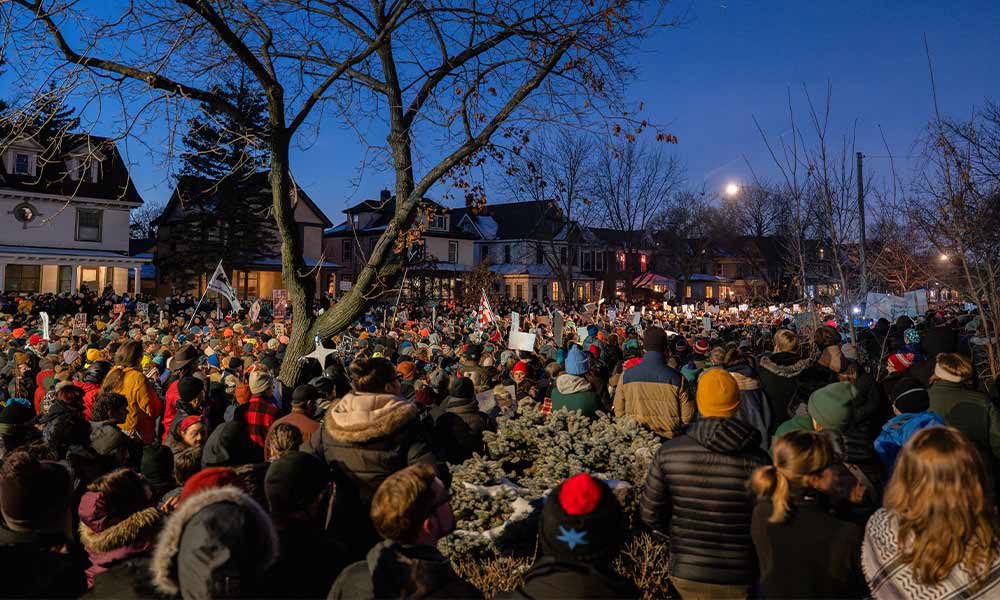
Minneapolis, January 2026. Chad Davis (CC BY 4.0)
The power of fear on a population is another example of how the Nazi experience may be instructive. In his book KL: A History of the Nazi Concentration Camps, Nikolaus Wachsman wrote, “Terror was indispensable for the swift establishment of the regime, stunning the opposition into silence and submission” and spurring hundreds of thousands of Jews to flee. Responsibility for the terror, he wrote, “rested above all in the brawny hands of Nazi paramilitaries, chiefly the hundreds of thousands of SA brownshirts.”
For those people who have grown up knowing how societies can be terrorized, the reports of ICE detention camps and arbitrary arrests are deeply unnerving. Michael Berenbaum, the Holocaust scholar, speaks often to Jewish groups and says he is asked “questions that never would have been asked 30, 40, 50, 60 years ago. [Such as] ‘When will I know to leave?’ I say if it came to that [time], I would know it, because I am a student of that.” To those who wonder about the Nazi comparison, Berenbaum’s answer is half worrisome, half reassuring. “I don’t think it’s the 1930s yet,” he says. “I think it’s late 1920s, which means we have time. But not a hell of a lot.”
Richard J. Evans, the historian of the Third Reich, addressed such fears when he lectured in January 2026 to the YIVO Institute for Jewish Research in New York City regarding the fall of the Weimar Republic. The first question after his Zoom presentation, not surprisingly, was what comparisons he saw with today. He repeated his caution about looking too hard for parallels, but in closing he offered sober counsel for his audience.
“Freedom and democracy can’t be taken for granted,” he said. “You have to fight for them. You have to invest yourself in their future. And I think that’s a very important lesson from Germany in the early 1930s. Hardly anybody was prepared to fight for democracy. I think we have to take a stand.”


Top image credit: Chad Davis (CC BY 4.0) / Bundesarchiv, B 145 Bild-P049500 (CC-BY-SA 3.0)
All Minnesota images credit: Chad Davis (CC BY 4.0)
4 thoughts on “ICE, the Brownshirts and the Danger to U.S. Democracy”
Thank you from Richfield MN. Tell our story.
Such a powerful, thought-provoking and alarming piece of true journalism. Thank you, Tom Gjelten, for reporting and writing it. And thank you, Moment, for publishing it.
To compare the brownshirts to ICE is absolutely ridiculous. ICE is trying to remove some of the 14 million undocumented people, who entered the country illegally, making them criminals in the eye of the law. The brownshirts targeted Jews, who were citizens of Germany. How is that the same?
As far as democracy is concerned, Trump has been harassed with multiple lawsuits, while the democrats, including Biden and company have gotten away with far worse. The Russian hoax was proven fake, and was manufactured by the Democrats, but when you have Trump derangement syndrome, true facts do not matter. You are totally biased.
re Mr. Finkelstein’s comments:
1. Immigration violations are civil, not criminal violations. Therefore to characterize undocumented immigrants as criminals is simply incorrect. To go after them with military weapons is unconscionable. In addition, MANY of the people taken into custody (and/or harassed or beaten) by ICE and Border Patrol in Minnesota were either legal immigrants or U.S. citizens.
So, much like the Brownshirts.
2. Trump has a long history (decades) of suing people just for the sake of harassment, so for him to complain about being sued is among his many hypocritical positions. Oh, please, explain what it is that “Biden and company” have gotten away with that is “far worse” than sexual assault. The only place the so-called “Russian hoax” was proven fake was in the right-wing blogosphere. Real investigations showed that Russia was, in fact, attempting to interfere with the 2016 election and Trump’s relations with Putin since then would appear to corroborate the allegations of collusion. In the meantime, he remains a convicted felon.
3. The reference to Trump Derangement Syndrome tells us quite clearly where Mr. Finkelstein sources his so-called “facts”. The number of well-documented lies told to-date by the President and his representatives is so long it would occupy an entire issue of this magazine.