
Hurt While Traveling Through Kentucky? What Out-of-State Visitors Should Know About Injury Claims
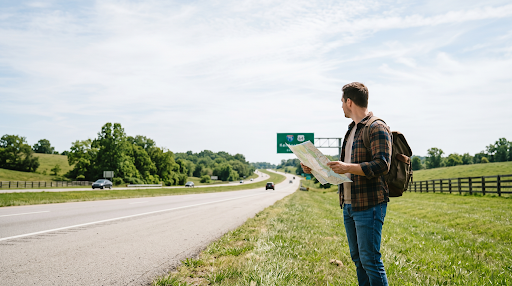
Kentucky sits on the way to a great many other places. Interstates 64, 65, 71 and 75 cross it, and travelers pass through on the way south, stop for a night, visit a cave or a historic site, and continue on. When someone is injured during that kind of trip, the first instinct is to assume their home state’s rules apply, or that the matter can be sorted out after they get back. Both assumptions are wrong in ways that cost people claims, because Kentucky law attaches to the traveler on arrival, and the deadline that governs depends on something as specific as which patch of ground they were standing on.
On a Kentucky Road, Kentucky’s System Applies Automatically
You accept it by driving
Kentucky’s Motor Vehicle Reparations Act contains a provision that catches most visitors by surprise. Anyone who registers, operates, maintains or uses a motor vehicle on the Commonwealth’s public roadways is, as a condition of that use, deemed to have accepted the Act’s terms. There is a way to opt out, but it requires filing a rejection form with the Department of Insurance before the accident. Essentially, no out-of-state visitor has done that.
Benefits are available to visitors
The flip side is favorable. If the accident causing injury occurs in Kentucky, every person suffering loss from the use of a motor vehicle has a right to basic reparation benefits unless they rejected the tort limitation. Residency is not the test. Where the crash happened is.
The threshold that controls a pain and suffering claim
Because tort liability is partially abolished, a claim for pain, suffering and mental anguish requires crossing a threshold: medical expense benefits payable exceeding $1,000, or an injury consisting in whole or in part of permanent disfigurement, a fracture to a bone, a compound, comminuted, displaced or compressed fracture, loss of a body member, permanent injury within reasonable medical probability, permanent loss of bodily function, or death. A fracture counts in Kentucky, which is not true in every no-fault state.
The Deadline Is Not Where Out-of-State Claimants Expect
Two years, measured from an unusual event
For tort claims that survive the no-fault limitation, Kentucky allows an action to be commenced within two years after the injury or death, or the date the last basic or added reparation payment was issued by any reparation obligor, whichever occurs later. The clock can therefore run from a benefit payment rather than from the crash. A replacement for a lost or undelivered check does not extend the date past the original payment.
The trap is the one-year rule next door
Kentucky’s general personal injury limitation is one year, not two. A visitor injured in something other than a motor vehicle accident, a fall in a hotel lobby or a restaurant for instance, is working with half the time they may have assumed, and the extended motor vehicle clock does not help them. People who return home and plan to deal with it later frequently discover this after it is too late to matter.
Federal Land Is a Third System Entirely
Mammoth Cave and other federal sites are not state court matters
An injury caused by negligence on federal property is handled under the Federal Tort Claims Act, not Kentucky law or Kentucky courts. The process starts administratively rather than with a lawsuit.
Present the claim in writing first
A tort claim against the United States is forever barred unless presented in writing to the appropriate federal agency within two years after the claim accrues, or unless suit is begun within six months after the agency mails notice of final denial. The standard vehicle for presenting it is a federal form, Standard Form 95, which requires a specific sum certain rather than an estimate. Filing with the wrong agency does not pause the clock.
The Practical Problems of Claiming From Another State
Treatment happens at home, documentation happens in Kentucky
The emergency record is created in Kentucky and the follow-up care occurs hundreds of miles away, which splits the medical file across systems that do not talk to each other. Requesting the Kentucky records immediately, rather than assuming they will be gathered later, prevents the most common gap.
Evidence stays where the incident did
Intersection camera footage, business surveillance video, incident reports and witness contact details are all local and all short-lived. Someone has to ask for them promptly and in writing, from where they sit.
Counsel in the right state
Venue, the applicable limitation period and the procedural rules are Kentucky’s, which is why visitors with a claim here generally work with a Kentucky firm such as The Fleck Firm rather than their hometown attorney, who will need local counsel regardless.
Knowing Which Clock Is Running
The through line in all of this is that three different limitation periods can apply to injuries suffered on the same weekend trip: two years linked to a benefit payment for a motor vehicle claim, one year for an ordinary negligence claim against a Kentucky business, and a two-year administrative presentation requirement on federal land. Nothing about the injury signals which one governs. Only the location does, and the shortest of the three is the one most people assume they have twice as long to use.