
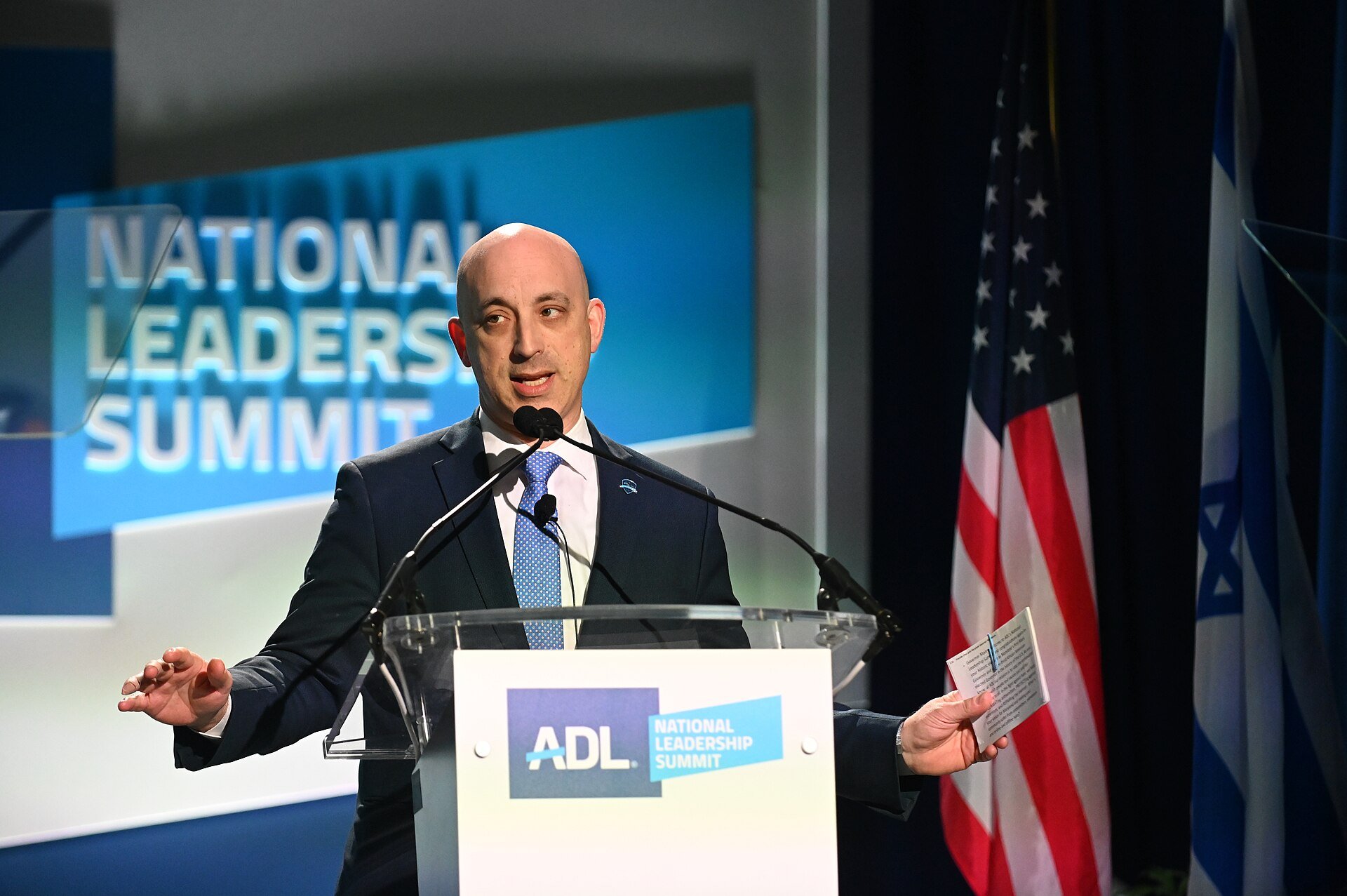
As I’ve traveled the country in recent years speaking to Jewish communities, I’ve heard the same refrain over and over: We don’t feel safe. And it’s not hard to understand why.
From a historic synagogue firebombed in Mississippi, to an elderly woman fatally burned by attackers while marching in solidarity with hostages in Colorado, to a young couple gunned down outside a Jewish museum in Washington, DC, the incidents are real and they’re having a profound impact on Jewish life in America.
And yet the debate about how to respond has been dominated by zero-sum thinking. Either we invest in Jewish security, or we invest in Jewish identity. Either we fight external threats, or we strengthen internal cohesion. Either we fund organizations like the Anti-Defamation League (ADL), which I lead, or we redirect those resources to Jewish schools, campus groups and our own set of institutions.
The epitome of this binary thinking was the argument made by The New York Times columnist Bret Stephens in his State of World Jewry address at the 92nd Street Y two weeks ago. He argued that ADL and similar organizations largely have failed at combating antisemitism and should be “dismantled” entirely, with funding redirected to foster Jewish education and identity instead.
I have tremendous respect for Stephens as a columnist. The two of us agree on many things. But this framing, while provocative and punchy, both elides the concrete reality around us and misses the fundamental point.
First, shutting down ADL or other Jewish organizations is not some magic formula that promises self-reliance; it’s a prescription for unilateral disarmament. From vicious anti-Zionists to violent white supremacists, the threats to the Jewish community are varied, dangerous and real.
Security and identity aren’t competing priorities—they’re inseparable preconditions for Jewish flourishing in an open society.
We don’t have to choose. At ADL, we’re doing both. In the face of emboldened enemies and a volatile operating environment, we have adopted a posture of adaptation and innovation. To this end, I’d like to highlight some of the innovations we’ve implemented in the past three years that demonstrate how we protect Jewish Americans; advocate for Jewish communities; and educate children and adults on antisemitism. This triple focus creates the space for Jews to be proud of their Judaism and freely express it wherever they wish.
First, we protect.
At ADL, we have learned that you can manage only what you measure. For this reason, we have been systematically measuring antisemitic attitudes since the 1960s, tracking antisemitic incidents since the 1970s and analyzing trends that drive these phenomena through the ADL Center on Antisemitism Research. And the data is troubling, such as a mind-boggling 900 percent increase in acts of anti-Jewish harassment, vandalism and violence over the past decade.
In response to these increasing threats, ADL is devoting more resources than ever to threat monitoring and working with community partners and law enforcement to help them stop crimes before they happen.
ADL has a team of researchers in the ADL Center on Extremism who are devoted to monitoring antisemitic and extremist threats. In 2025 alone, our team examined many millions of antisemitic and extremist social media posts and analyzed tens of thousands of hours of extremist videos and audio content posted and shared online.
We don’t always learn the full scope of our impact right away—sometimes it takes years. But in recent years, a number of people, including white supremacists, dangerous anti-Zionists and other extremists, even a potential school shooter, have been arrested after law enforcement investigations that included actionable information based on open-source intelligence from ADL.
For example, in February 2025 the Joint Terrorism Task Force of Orange County, CA, revealed how information that ADL had shared with law enforcement was a key element in the arrest of five members of an antisemitic swatting ring. The group terrorized synagogues across the country in the summer of 2023 by submitting hundreds of fake reports of imminent violence at synagogues to law enforcement, with the intention of provoking a police response that would disrupt prayer services and traumatize congregants.
That same month, following an alert from ADL and their own investigation, Canadian police charged an individual with advocating genocide, willful promotion of hatred and willful promotion of antisemitism. Our team had identified the individual after detecting multiple violent threats targeting the Jewish community on social media, including statements such as, “I’m going to kill so many Zionist rats.”
Protecting the Jewish community also means ensuring that when Jewish Americans face discrimination, harassment or violence, they have access to legal representation. To that end, ADL pioneered the historic Legal Action Network, a nationwide consortium of the top law firms in the country whose attorneys have committed to take cases pro bono. With more than 50 firms taking part and some of the best legal minds in America at the table, this is the largest and highest-powered legal team ever assembled to combat antisemitism.
It also means tracking city and state governments for policies and appointments that threaten to turn back the progress we have made in battling antisemitism. In New York City, for example, ADL is fully engaged in monitoring the new administration in City Hall. While some have criticized our Mamdani Monitor, it already has generated results in the earliest days by reporting on actions of one of the most prominent anti-Zionists in elected office in America. For example, after ADL research identified that the proposed new head of personnel of the new Mamdani administration had a public history of ugly antisemitism, the appointee voluntarily stepped down. The mayor’s administration subsequently cited our research as the impetus for improving their vetting process. These are the kinds of results we’re aiming for—holding public officials accountable for their actions and conduct.
Next, we advocate.
At the state level, we are lobbying in at least 29 states on close to 60 bills and initiatives aimed to prioritize fighting antisemitism, including in New York. In California, we advocated for a law that counters antisemitism in K-12 schools. In Washington, DC, ADL is fighting for more Nonprofit Security Grants and accountability for antisemitism on college campuses. And globally, we work to support vulnerable Jewish communities, while sharing best practices and resources in our collective fight against antisemitism.
Last year, our advocacy helped secure more than $500 million in government funding that supports real-world improvements such as the addition of security cameras at synagogues.
But the battle extends beyond politics. In corporate boardrooms, a whopping 75 of Fortune 500 companies faced boycott, divestment and sanctions (BDS) campaigns last year alone. These initiatives have negligible commercial impact, but they denigrate the Jewish state, demonize its supporters along with Jewish and Israeli employees and distract companies from their core responsibilities. JLens, an affiliate of ADL, is the first organization to launch a Jewish investor network which uses shareholder advocacy to fight for the Jewish community. JLens helps ensure we have a seat at the table to push back.
For example, Microsoft shareholders rejected a BDS-aligned proposal in December 2025; JLens publicly opposed the proposal. This demonstrated what’s possible when the Jewish community has a representative voice in those boardrooms.
Third, we educate.
ADL has long believed that, to tear out antisemitism at its root, we need to operate on the frontline where ideas are transmitted in the battle for hearts and minds. For this reason, we have worked in education for decades. But we need more than just good educational content. In 2024, college campuses were roiled by an 84 percent surge in antisemitic incidents. Jewish students in K-12 environments have been barraged with biased lesson plans and teachers who bring politics surrounding the Israeli-Palestinian conflict into the classroom.
We have seen that when institutions know they’re being measured, they act. The annual ADL Campus Antisemitism Report Card shows what’s possible.
Following our first report card issued in 2023, 70 percent of the schools that we evaluated reached out to ADL to get help. A year later, more than one-third of colleges and universities had improved by a full letter grade because they strengthened policies, mandated antisemitism education and improved bias reporting systems. Ten percent jumped two grades. In short, the climate at those schools improved, ensuring safer spaces so that Jewish students, administrators and staff could thrive.
Students today, like everyone else, mostly access information outside of the classroom via the continuous algorithmic feed of their smartphones. For this reason, ADL has invested heavily in understanding the dynamics of artificial intelligence and new media. Through the ADL Center on Technology and Society, we are working in multiple areas related to this field, such as exposing exposing biased, coordinated manipulation of Israel/Palestine-related content on Wikipedia and battling conspiracy theories spread by social media platforms. ADL researchers regularly engage with leading players in Silicon Valley. We provide them with data and insights where we think they can improve, and we are not afraid to criticize them when we believe they are falling short. This is how purpose translates into action.


Some have accused us of narrowing or changing our mission. But the words in our founding statement—“to fight the defamation of the Jewish people”—remain as urgent today as they did when they were written in 1913. While our overall mission has never changed, our strategies will continue to evolve, and we will continue to experiment and innovate to identify the most effective approaches to beating back hate. We will scale what works, sunset what falls short and, despite the criticism of columnists, continue to fight ferociously every single day to protect the Jewish people.
Jonathan A. Greenblatt is CEO and National Director of the ADL.
(Top image credit: Maryland GovPics, CC BY 2.0)
3 thoughts on “How ADL Is Innovating in the Fight Against Antisemitism”
The ADL has a history of lobbying against formal US recognition of the Armenian Genocide for Israel and Turkey, spying on U.S. citizens and defaming U.S. citizens. It should be disbanded. It has zero credibility.
If the people and state of israel were a light unto the nations we could successfully combat antisemitism. The adl is afraisd to tackle that and so I am not renewing my sub to Moment
Great response to Stephens. There are many fronts on which to fight antisemitism. Do we not have room for more than one approach?