
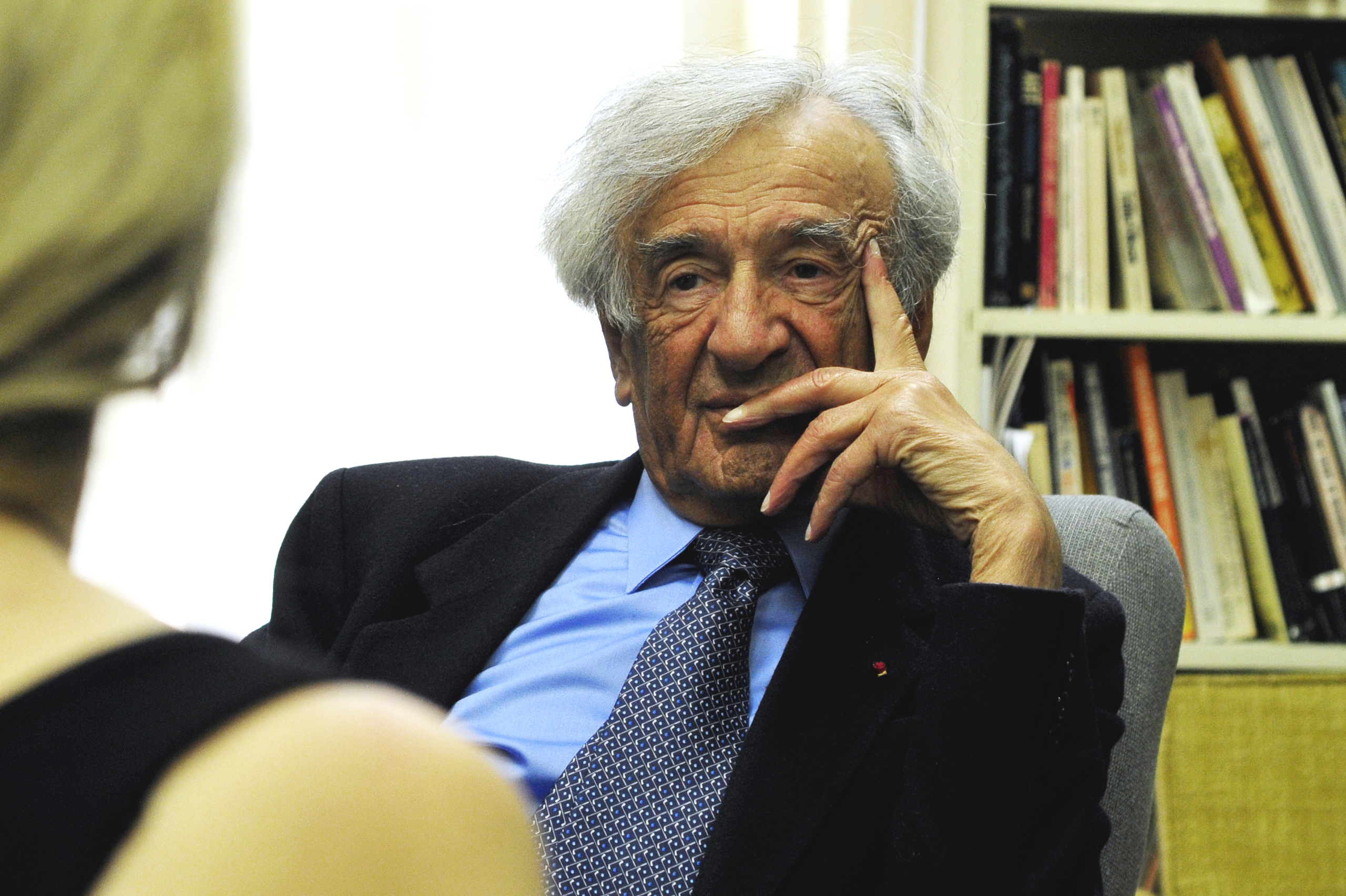
“There I wasn’t alone… Here, I was alone in this condition. I knew I could die. I had, of course, as I say, lived in death over there. But here, it was an ‘I’—not ‘us.'”
NE: As you describe in Open Heart, you recently had open-heart surgery. Was facing death in the hospital different from facing death in Auschwitz?
EW: There I wasn’t alone. I was with my father, as long as he was alive. I was always with others. Nobody was alone, yet everyone was lonelier than ever before. So it’s not the same thing. Here, I was alone in this condition. I knew I could die. I had, of course, as I say, lived in death over there. But here, it was an “I”—not “us.”
NE: Can we ever prepare for death?
EW: There comes a moment when you feel maybe this is the last time that I think the way I do, the last time I see people, the last time I will see my son or my wife. And therefore, you have to prepare yourself. Even after the war, a few months after I came to New York, a taxi ran over me in Times Square, and it was a miracle that I survived. That said, the Jew must prepare himself because death could happen that day. Every morning when we get up is a prayer of gratitude. Thank God for being awake, for having survived my sleep. The fact is, to die is something we all have in common. We still are looking for someone who knows the secret of immortality. Only God is immortal; we are not. The Hasidic masters prepare themselves every day: What if I die tomorrow? What if this is my last prayer? With what am I going to present myself to God before the celestial tribunal where I shall appear afterwards?

NE: How does Judaism teach us to confront death?
EW: One of the most important mitzvot in the Torah is, “And you shall choose life.” It also means that you should choose the living and that you must be faithful to the living more than to the dead. Whatever is living is pure; whatever is not living is impure. The laws of mourning in Judaism are so marvelous. Our sages have invested so much in those laws. As long as the person is alive, everything is centered on him or her. Everything. You may do anything to save that person’s life. Then after death, the interest of the sages is directed to the survivors: What does one do when he or she loses a mother or father?
NE: In Night, you write, “Never shall I forget those moments that murdered my God and my soul and turned my dreams to ashes.” Has your approach to God changed since, and did you think about God in the hospital?
EW: What I wrote in Night is a protest and a question, and I stand by every word I wrote. It’s an outcry, an agonizing outcry. I come from a very religious background. I spoke to God, against God, but the next day, somebody managed to smuggle in a pair of tefillin, portions of bread, and together with my father we got up early and stood in line just to say the morning prayers. My disappointment was with man—what should I expect of man, both good and bad. But with God, the question, “Where is God?” has obsessed me for many years and still does without an answer. Even in the hospital, I couldn’t not think about that question. Without faith there is no question. I remain profoundly attached, of course, to my parents and grandparents. I said, “What good do I do to them if I say goodbye to God?” But I didn’t, because what good would it do to them? It’s really because of my grandfather and my father that I say to God, I pray to you and I bless your name.
NE: Which language did you think in as you conversed with death in the hospital?
EW: In Yiddish. It was, after all, my first language. The language I think in depends on the topic and the period. If it’s about my childhood, I think in Yiddish, because that was my language. If it’s about America, I think in English, but if it’s about literature or philosophy, it goes back to French.
NE: Do you feel that your life work of teaching about the Holocaust has made a difference?
EW: I was invited two or three years ago to address the General Assembly of the United Nations, and I chose the topic, “Will the world learn?” I came out with the answer, no. It will not learn, because it has not learned. Otherwise, how else would one explain Cambodia and genocide, and the hunger and humiliation—how else would you explain it? We haven’t learned. And maybe it’s our fault—mine and my colleagues—maybe we haven’t done enough. And yet we’ve tried.
NE: If Auschwitz can’t convince man to end violence, what can?
EW: That’s what I said, if Auschwitz didn’t cure the disease, what can? But still we must try. When the last survivor will be gone—my God, I don’t want to be that one. When the last will be gone, a page will be turned. That’s what I say wherever I go, I say to young people to be a witness is to become one, because now you are our witnesses.
NE: Do you still believe in humanity?
EW: I believe in humanity against humanity, I believe in God against God, because what else do I have? My disbelief cannot stop them. I disbelieve in many certainties, but then I said okay, there are children in the world, and there I should say, no, no, I need to have faith for their sake.
NE: That brings me to one of the most moving passages in Open Heart. You tell the story of your grandson Elijah’s visit to you after your surgery when you were in great pain.
EW: This is one of the most beautiful stories of my life. He came and sat on my bed, and said, “Grandpa, I know you suffered a lot, and you have great pain. But you know how much I love you, tell me, if I loved you more, would you suffer less?” The words of the philosophers were on his lips.
NE: What did you say to him?
EW: Of course, absolutely. I wanted him to love me more.
NE: Did your open-heart surgery make you a stronger person?
EW: I don’t know, I’d say more knowledgeable. I know more about my own limitations. I realize that to our great embarrassment, there are great moments in life with such pain that a pill has more weight than all the books by Kant, Schopenhauer and Nietzsche. Just a pill, more important than all these great books written by great men and women since history began. It makes you very humble. We are vulnerable, and therefore humble.
NE: Is there anything else you’d like to do with your life?
EW: To begin again.
Listen to an audio recording of the interview here!
2 thoughts on “Heart to Heart with Elie Wiesel”
Dear Nadine:
I’m still wiping the tears as I begin this note. First I read the transcript, then listened to the audio version, Elie’s voice deep and gentile, yours lively and youthful.
I found you because I’ve been trying to understand the mystery of my beloved Rabbi Herman Schaalman’s relationship to God. When I first began attending his Torah Study in 2012 I was shocked at the force and the weight the Holocaust had on his thinking. The existence of the Holocaust necessitated a radical new way of thinking about not only the existence of God but of Judaism itself. He was 96.
Two years later, he concluded his last Yom Kippur sermon citing a story from Night.
He called Night “one of the most astounding literary creations in the 20th century, an unforgettable story. To me, the key to that work is a scene he (Elie) describes that has some of the most profound meaning and has changed my life.”
He described the details of the hanging of boy who couldn’t die, then the question, “So where is God?” and the answer, “He’s hanging there.”
“To the best of my recollection of other books by Elie Wiesel,” Schaalman said that day, “he never drew or at least never stated the final conclusion, that God was dead. God was not listening to prayers. God was not helping the most unfortunate, innocent victims of human viciousness and perversions.”
Rabbi Schaalman is 100 now and still leads his Torah Study every week that he is physically able. In that 2014 Yom Kippur sermon, he said “this world is in such turbulence, in a search for something to believe in, some ideal that would perhaps inflame the emotions and passions of human beings to live by them, and I remembered that that is really what the whole torah is about … that to be human and to have a human world and history, it needed to be guided by two major ideas: tzedek and shalom, justice and peace.”
Since then, however, he has become more disillusioned about the condition of the human race, even his own condition, questioning whether there remains anything sufficient in him that he can still say he is a Jew. We, his students, appreciating all he has given to us, wish we could be of help to him, but what qualifies us, how can we?
As your simple questions and Elie’s answers unfolded in the intimate space shared by the two of you, I felt my quandary lifting, hearing Elie acknowledging his belief in the finality of death, but also the importance of the living, the shared love between a grandfather and grandson.
I’m going to give a copy of your questions and answers to Rabbi Schaalman. I’m sure he will feel the presence of his old friend through you.
Thank you, Norm
God bless you, Norm et al… Am Yisrael Chai! God loves Israel with an everlasting love. He is always listening to our heartfelt words! He tells us that those who search for Him with all their heart will find Him. Death is not final; In the Writings, Daniel, while in exile in Babylon and Persia, was given many prophecies concerning eternal life. They are there for your edification and exhortation. Our faith cannot be in the human race…we see what is happening all around us, both here in the US and around the world. God alone is the source of peace; we must press into Him and seek His Word, His wisdom and His assurance. It is found nowhere else. Please share this with Rabbi Schaalman. I realize this was written earlier, but timing is everything. Many are at their final hour on this earth and have questions that can be answered!